Ask This Old House S24E14: 3-Way Switches, Split Rail Fence, and the Wet Paint Rescue
Mauro Henrique shows why speed beats any cleaner when paint hits the floor, Heath Eastman finally makes three-way switches click with a switch he built himself, and Nathan Gilbert and Lee Gilliam build a split rail fence that stops cars and looks good doing it.
Wet Paint, Warm Water, and the Case for Moving Fast
Mauro Henrique returns not with a brush and roller but with a bottle of green paint and a deliberate mess. He drips it onto a rug, a hardwood floor, and a printed tile while Kevin looks on, neck hair rising. This is the kind of segment that makes Ask This Old House quietly brilliant: a tiny, everyday disaster most of us have faced, demonstrated by a pro who has clearly done it before—and cleaned up after himself more than once.
On the rug, Mauro pours a little paint, then immediately dives in with a rag soaked in plain warm water and a squirt of detergent. “The key, Kevin,” he says, “as soon as you see the paint on the carpet, remove it right away.” The technique is wet, dab, rinse, repeat. When the green vanishes from the fibers, he pulls out a wet-dry vac to suck up the moisture and any lingering pigment. Kevin, colorblind and impressed, calls the result “gone to me.”
Hardwood floors get the same soap-and-water treatment while the spill is still wet, and the finish underneath stays untouched. For paint that has already dried, Mauro starts with a vinegar-and-baking-soda spray. When that lightens the spot but doesn’t erase it, he reaches for denatured alcohol on a fresh rag. The alcohol cuts through the dried acrylic without disturbing the sheen. He points to a can of premium chemical stripper and immediately warns that using it on a floor would take off both paint and finish in one ugly pass—verboten on finished wood.
Tile proves even more forgiving. A dried drip of green lifts completely with denatured alcohol, leaving the printed pattern intact. Kevin jokes that he might skip the drop cloth next time, and the line of the segment lands: speed is the first best friend. See something, do something. The longer paint sits, the smaller your options become. It’s advice that sounds obvious until you’re the one staring at a drip on a Tuesday night, debating whether it can wait until Saturday.
If Mauro’s name sounds familiar outside of paint-spill triage, he was last seen transforming a weather-beaten bulkhead with the same careful attention to finish and surface prep. The tools change, but the instinct to work with the material rather than against it stays the same.
Heath Eastman Finally Makes Three-Way Switches Make Sense
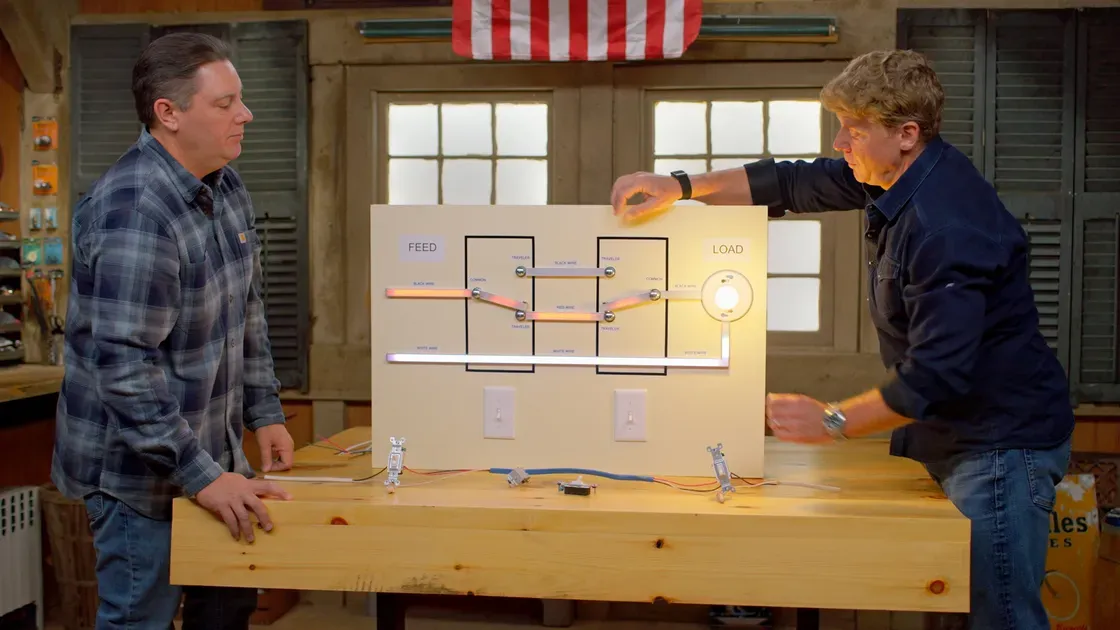
Heath Eastman wants you to understand three-way switches badly enough that he built one himself. Every attempt to cut open a real switch ended in springs flying across the shop, so he fabricated a transparent demonstration model with visible terminals and a flapper that rocks between two traveler contacts. The mockup is big, unashamedly analog, and exactly the kind of teaching tool that makes the concept stick.
Before diving into the three-way setup, Heath walks Kevin through a basic single-pole circuit: power in on the black, neutral returning on the white, and the switch simply opening or closing the hot leg. With that established, he introduces the three-way arrangement. The trick is a three-conductor cable running between the two switches. Black and red become “travelers,” always landing on the two brass screws. The odd-colored screw—black on his demo switch, but often dark on real hardware—is the common terminal. One common gets the incoming feed; the other carries the switched load out to the light. The neutral, crucially, passes through unbroken.
Kevin, who admits he has called Heath more than once while standing in front of a misbehaving switch, walks through the logic: close the circuit at one location, open it at the other, and the light responds regardless of which switch you touch. The extra red wire is what makes it possible. A single-pole dimmer with only two screws can’t do the job, and mixing up the travelers when swapping an old switch is the number-one reason one location works while the other goes dead.
Heath’s shortcut for anyone staring at a tangle of wires in a three-way box is to make the black and red the travelers and put them on the brass screws, period. Whatever’s left that isn’t the neutral is the common. It’s a rule of thumb that removes a layer of guesswork, but it’s worth pausing to note that this isn’t a beginner’s repair. If you didn’t label which wire was where before pulling the old switch, or if the house has non-standard coloring, the safest troubleshooting tool is a phone call to an electrician who owns a voltage tester—and who doesn’t need a custom demo board to keep the travelers straight.
Nathan and Lee Build a Classic Split Rail Fence (and a Parking Barrier)
Nathan Gilbert arrives at Jonathan’s house to find a front lawn that’s doing double duty as a turnaround for lost drivers. Tire ruts have killed the grass, and the only separation between yard and street is a battered mailbox and the ghost of where sod used to be. Jonathan wants a fence, and Nathan quickly lands on a split-rail design in cedar—something that defines the space without turning the yard into a fortress.
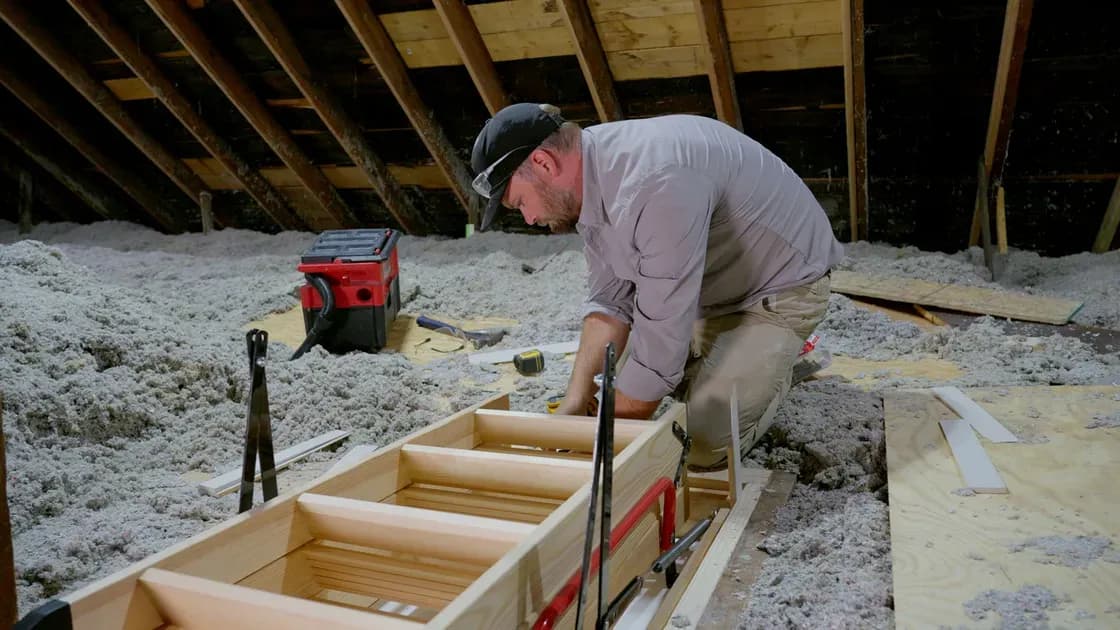
He calls in Lee Gilliam, and the two of them move through the job with an easy rhythm. The first actual stepe, before anyone picks up a shovel, is a call to 811. Lee already confirmed the utilities are clear, but the show makes a point of naming that step on camera, which is the kind of detail that tells you they care about someone trying this at home.
Layout runs 24 feet along the cobblestone curb, with posts every 8 feet on center. Nathan marks locations with a rail laid on the ground, accounting for the 2-inch inset the doweled ends will need inside each post. He likes to start from the anchored end and work downhill toward the waste side; Lee bumps the planting bed out to 36 inches so the fence doesn’t sit lonely in bare dirt.
The holes go about 2 feet deep—enough for a 3-foot-tall fence that catces no wind, but shallow enough to stay away from buried service lines. Backfilling is stone dust, not concrete. Lee explains that wet concrete can rot the post over time, and the stone dust compacts firmly while letting water drain. Once the posts are plumb and the rails run level, Nathan runs a hose at each post base to settle the fill before driving nails.
While Nathan dials in the fence, Lee claims the planting bed. Golden spirea, black-eyed Susans, catmint, and a climbing rose go in, chosen for color, bird appeal, and the way they will cascade over the cobblestones. Jonathan admits he was just expecting a fence, and got a landscaped border instead. Lee’s parting homework is to water twice a day for 15 to 20 minutes—a reminder that even the tidiest fence bed needs aftercare.
This isn’t Lee’s first outdoor rescue this season. He and Nathan teamed up earlier to regrade a mossy backyard, and that project, like this one, relied on patience, a string line, and a refusal to take shortcuts on compaction or drainage.
What TV Makes Look Easier Than It Is
A morning spent digging postholes and setting a fence line doesn’t compress into seven minutes without some editorial sleight of hand. The segment moves from layout to finished fence quickly enough that it’s easy to forget the real time involved: measuring twice, adjusting for grade, tamping stone dust in lifts, and letting water settle the backfill before landscapping. The show leaves in enough detail—the use of a torpedo level on a rail, the deliberate tilt back toward the house—to make the method learnable, but the calorie burn doesn’t make it into the final cut.
Heath’s switch model is its own kind of compression. Rather than struggle with a flimsy real switch that explodes under a utility knife, he built a version that prioritizes clarity over realism. It’s a smart choice, and it serves as a quiet argument that teaching home-improvement skills sometimes requirs detaching the concept from the physical hardware—especially when the hardware is determined to fling springs into your face.
DIY Confidence Scale
Paint spill cleanup: 9/10. If you can dampen a rag, you can do this. The only variable is time. Wet paint comes off with warm water and a little soap; dried paint responds to denatured alcohol on most hard surfaces. Carpet is trickier, but Mauro’s wet-dry-vac trick buys margin. The only way to fail is to let the spill cure and ignore it.
Three-way switch replacement: 3/10. The logic makes sense once you see Heath’s model, but real-world boxes rarely look as neat as a demo board. If you didn’t mark the travelers and common before disconnecting the old switch, the odds of getting it right by guesswork drop sharply. Call an electrician unless you’re absolutely certain you can identify each wire and its destination.
Split rail fence installation: 6/10. The layout and post-setting are straightforward but physically demanding. The real skill is keeping everything level and plumb while working with irregular grade. The crew’s choice to skip concrete in favor of stone dust simplifies the job and reduces future rot, but you still need a post-hole digger, a strong back, and a friend who won’t wander off during the tamping phase. Call 811 before you dig anything.
Additional Resources
Next time a paint drip hits the floor, remember Mauro’s rule: act now, not later. And if you find yourself starring at three mysterious wires in a switch box, maybe start with a YouTube search for a Heath Eastman model-build video—or just pick up the phone.
Keep reading
Related episodes & guides