
Ask This Old House Season 24 Episode 13: Split Water Heater, Attic Ladder, and the Houseplant Doctor Is In
Ross Trethewey installs a split heat pump water heater that puts the evaporator outside, making it a cold-climate winner. Jenn Nawada prescribes treatments for mealybugs, spider mites, and fungus gnats. Nathan Gilbert gives a Massachusetts homeowner safe attic access with a new pull-down ladder. Plus: why a frosty panel is actually a good sign.
Three calls, three different problems, one connecting thread: all the existing setups were working just enough to be annoying. This episode of Ask This Old House starts with a water heater that costs a dollar for every dollar of electricity it eats, moves to miniature invaders taking down houseplants, and finishes with a homeowner who has to balance on a ladder next to a stairwell to access his attic—which is, to put it mildly, a motivation problem. The solutions range from “wipe it with alcohol” to “cut a hole in your ceiling and hope the plaster holds,” with a stop in the middle for a technology most people have never seen.
A Water Heater That Ships Its Cold Air Outside
Ross Trethewey meets homeowner JC in Massachusetts, where an oil boiler handles space heat but domestic hot water falls to an old resistance electric tank. Its coefficient of performance? About one. One unit of electricity in, one unit of heat out. Installer Bruce, from a local efficiency-focused company, lays out the terrain. A conventional heat pump water heater—a unitary, air-source model—could double or triple that efficiency, but it would also dump cold air into the basement, something nobody in a heating climate wants to pay to warm back up.
The answer sits across the room: a split heat pump water heater. Instead of a top-mounted evaporator gulping basement air, an outdoor panel about the size of a solar thermal collector handles the heat exchange. Line sets run through the wall to a compressor unit mounted inside, which heats water in an adjacent storage tank. Bruce explains that the panel works by convection, harvesting energy even without direct sun, and it will keep pulling heat from outdoor air down to -20°F. No defrost cycle—just cold refrigerant moving through an aluminum, powder-coated panel that can’t rust. Ross points an infrared camera at the panel once the system is running. Outside air measures about 50°F, but the panel averages 20°F. Frost forms. That frost, Bruce says, is a good sign: the refrigerant is so cold that moisture in the air condenses and freezes, which means the panel is doing its job.
Real-world annual COP? Bruce pegs it in the high twos. Compare that to the resistance tank’s 1.0 and JC’s hot-water electricity use drops by roughly two-thirds. At the 80-gallon size, Bruce notes that in Massachusetts this split system actually comes in slightly less expensive for his company than a conventional unitary heat pump water heater. The installation itself is not a DIY affair. The transcript describes hammer-drilling for the wall bracket, extending electrical conductors via a new junction box and MC cable, cutting and ProPressing copper, running a refrigeration line set through the exterior wall, testing for leaks with nitrogen, and performing a triple vacuum to purge non-condensables and moisture. Television makes it look like a clean afternoon’s work, but those refrigeration connections demand a technician’s license and a vacuum pump that won’t quit.
Jenn’s Houseplant Clinic: Mealybugs, Spider Mites, and Fungus Gnats
Jenn Nawada sets up what Kevin calls a “doctor section” on the counter, with bottles outnumbering plants. Unlike a previous houseplant segment where the pacing dragged, this one feels tight and useful—each pest gets a name, a diagnosis, and a treatment ladder in rapid order.
Mealybugs appear as white cottony spots, often at the base of a stem or tucked into succulent crevices. They pierce plant tissue and excrete honeydew, which breeds sooty mold. Jenn’s first line of defense is a plain water rinse. If that fails, rubbing alcohol diluted with water, wiped on directly. Last resort: neem oil, an organic product that suffocates the insects but carries a distinct odor. For spider mites, the calling card is fine webbing and yellow-brown speckled leaves. Unlike mealybugs, spider mites thrive in dry conditions, so keeping soil moisture appropriate is half the battle. Treatment starts with diluted dish soap—again a suffocant—and escalates to neem oil. Fungus gnats are the final patient. The adults fly and land on sticky traps (Kevin calls Jenn a “ninja warrior” after she bags one), but the real target is the larvae in the soil. Jenn points to a natural granule that kills mosquito larvae and works equally on gnat larvae; it gets mixed with water and drenched into the pot.
Prevention circles back to watering. Spider mites want dry soil, fungus gnats want wet. Know your plant, and you head off most problems before they start. Kevin offers that his rubbing alcohol comes with tonic, which is the kind of goofball aside that makes these segments feel like a conversation rather than a lecture.
Nathan’s Attic Ladder: Cutting Through Plaster, Lath, and Sheetrock
Homeowner Danilson shows Nathan Gilbert the existing attic access: a small hole near the top of the stairs. It’s tight, awkward, and next to a stairwell that makes ladder work feel precarious. Danilson wants a proper pull-down ladder, partly because future HVAC equipment will need to pass through. He’s already scouted the framing from above—the joists run in the right direction—and picked up a kit requiring a rough opening of 22.5 by 54 inches.
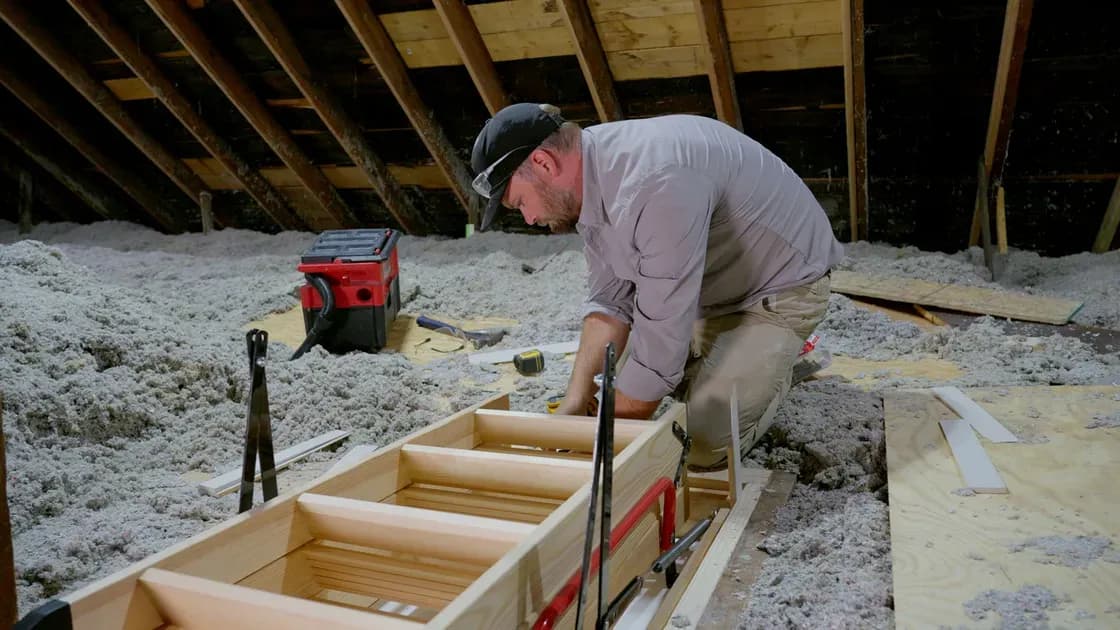
Nathan starts in the attic, driving screws down through the ceiling next to an existing joist to mark corners. Then he frames the new opening from above using 2x4s cut to 25 inches, adding a filler piece to narrow the spacing to 23.5 inches. Before cutting, he screws a 1x4 across each line of screws. That board does two jobs: it creates a straightedge for the saw, and it compresses the ceiling sandwich together. Danilson’s ceiling isn’t simple drywall—it’s wood lath, horsehair plaster, a half-inch sheet of drywall, and another plaster skim coat on top. Without that compression, the vibration from a reciprocating saw would shake the old plaster apart. They cut the opening in two pieces to make removal manageable, and the sandwich holds together surprisingly well.
The ladder goes in, supported on temporary cleats, then checked. The legs come long from the factory. Nathan projects a tape down, measures 32 inches from the back, and makes a square cut. The pre-angled feet slide back on and stop at the mark, putting the ladder flush to the floor. Trim work is a picture frame of 3-1/2-inch colonial casing with a slight reveal, followed by insulation around the rough opening and an insulated attic access cover dropped into place. Nathan leaves Danilson with two homework items: paint the trim and oil the hinge points once a year. Straightforward old-house logic, and the kind of project where careful layout before cutting determines whether you spend Saturday afternoon patching blown-out plaster.
DIY Confidence Scale
Houseplant pest control: Easy. Soapy water, diluted alcohol, sticky traps—the tools are cheap, the risk is low, and a test spot on the leaf underside calms most nerves. Neem oil smells funky but works. Prevention through watering awareness might be the bigger challenge.
Attic ladder installation: Moderate. Layout is forgiving if your joist spacing cooperates and no plumbing or wiring is in the way. Cutting through plaster and lath without shattering it requires the 1x4 trick and patience. The leg cuts are straightforward, but lifting and positioning the ladder alone tests ceiling height and arm strength. If you’re comfortable framing a rough opening and trimming out casing, this is doable in a day.
Split heat pump water heater: Professional only. The electrical rework—running MC cable, extending conductors, installing a junction box—needs an electrician. The refrigerant side demands an EPA-certified tech who can pull a triple vacuum and handle nitrogen pressure tests. Homeowners can choose the equipment and understand the efficiency numbers, but the installation belongs to the pros.
Additional Resources
Watching the infrared camera show a 20-degree panel in 50-degree air, no moving parts, no fan, quietly pulling heat from an overcast backyard—that’s a cold-climate physics lesson wrapped in a water heater upgrade. The furnace doesn’t get the bill for re-warming the basement, and the frost on the panel means it’s working harder than the old resistance tank ever did.
Keep reading
Related episodes & guides



Season 24 · Episode 14