
Ask This Old House S24E2: Seashell Driveway, Radon Mitigation, and Why You Call a Pro
Lee Gilliam rebuilds a coastal Massachusetts driveway with reclaimed stone edging and a 3-inch layer of local shells, keeping the hardpack base intact. Ross Trethewey and a certified mitigator diagnose a 100-year-old slab with grab samples and a manometer, then install a sub-slab depressurization system with an exterior fan wired by Heath Eastman.
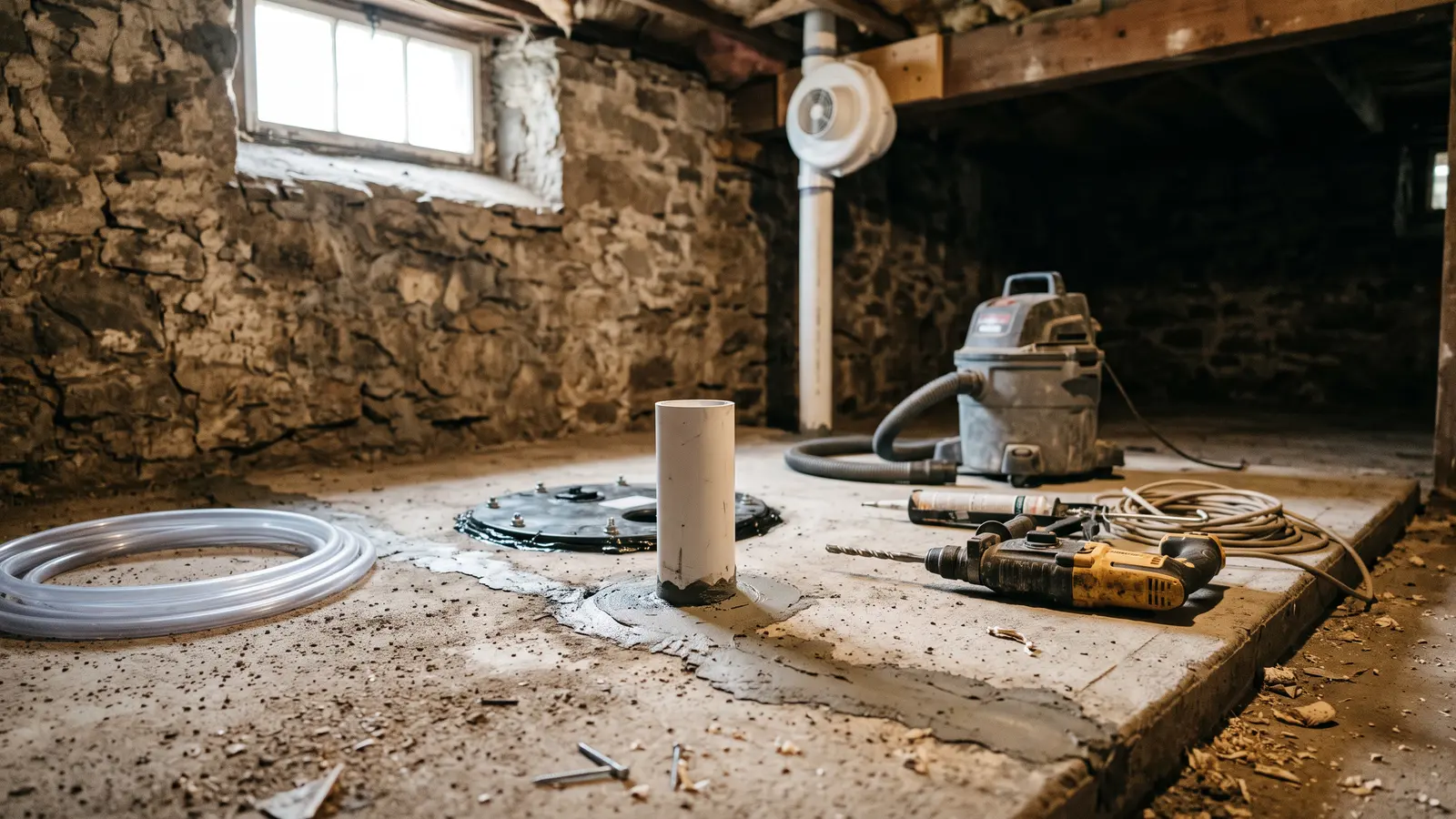
Season 24, episode 2 sends Lee Gilliam to the Massachusetts coast for a driveway resurfacing and Ross Trethewey into a 100-year-old basement to fix a radon problem. One job is a cosmetic upgrade with real prep underneath; the other is invisible until it isn't. Both come down to what happens before the finish layer goes on.
Seashell driveway: layout, estimating, and the base you keep
Patrick wants the classic Cape Cod look: crushed shell instead of gravel. Lee has one at home and gives the honest drawbacks up front. Snow shoveling gets harder, and bare feet notice. Patrick keeps his gravel base and accepts both.
Before anyone touches a rake, they walk the footprint. Squaring a corner, shortening the run to stop at the septic tank, widening by about 3 feet so two cars aren't jammed, and staying off the slope near the flower bed. Lee also flags a step that has to go. This is the part of a driveway project that determines whether the finished job looks deliberate or improvised.
Material estimating is length times width times depth. At roughly 30 feet by 20 feet and a recommended 3-inch layer for a new shell installation, Lee calls the supply company with numbers. The load that arrives is a local mix: clams, quahogs, scallops. Fresh shell smells like the harbor for a couple of days, then it fades. Sun bleaches it out over time.
The old gravel doesn't all get hauled away. Patrick keeps some for other projects, and Lee rents a power broom, a walk-behind machine with a spinning broom head on a straight shaft, to gather the rest into piles. Ear and eye protection first. Then the fun parts. A grub axe with a pick on one end pops the old stone edging. A sod cutter slices under the grass. A Portuguese grub hoe skims the surface soil, and Lee is explicit about not digging down into the sand. Stay on the hardpack.
The reclaimed 3/4-inch stone comes back as edging, set on a plumb line and tamped by hand. Then shells get cast out with a shovel and compacted. Homework for Patrick is loam backfill around the block, about a yard, for touch-up.
Here's what the edit can't show you. Spreading shells is the fast, satisfying part and it occupies maybe the last quarter of the job. The sod cut, the edging, the tamping, and the base correction are where a shell driveway succeeds or fails. If the base is soft or the edging shifts, the shells migrate, and you're re-raking every spring. Lee's line about 30 years in the business, delivered after Patrick says he makes it look easy, is doing more work than a throwaway joke.
If you've watched Lee on an outdoor surface before, the pattern holds. In the season's lawn regrade episode, the visible fix was grass seed, but the actual labor was dethatching, leveling, and getting the grade right. Same structure here: the pretty layer is the last thing you do.
What Is It? and the broom-shaped nut picker
Jenn Nawada's mystery object is broom-shaped, has spiral wires at the bottom, and spins. Richard guesses portable bingo. Tom guesses a back massager and immediately demonstrates on Kevin's neck. Kevin invents a hamster walker with a whole backstory about Harry the hamster and the cruelty of the wheel.
The answer is a nut picker. You roll it over acorns and it collects them in the cage, which is genuinely useful in a yard with oaks and genuinely useless for macadamias. Fine, a segment.
Radon basics: why a dog's illness led to testing
Ross starts with the science. Radon is a radioactive gas produced by uranium decay in rock and soil. It rises and enters a house through a slab, a foundation wall, a water pipe, or a sump basin. It has no smell and no taste, and it's the leading cause of lung cancer among nonsmokers. Pets are at higher risk because they breathe faster and spend long hours indoors, often in basements where radon concentrates.
Vincent inherited his grandparents' house. Five years ago their dog died of lung cancer, which struck him as unusual for a dog that lived with nonsmokers. He read up, found the radon connection, noticed a neighbor's white mitigation pipe running up the exterior wall, and bought a continuous monitor.
The three-month average reads 12.7 picocuries per liter. The EPA action level is 4. His single-day data swings between 3 and 15, and Ross uses that spread to make a point worth remembering: radon isn't static. Cold weather, bath exhaust, dryer venting, high groundwater after rain, and wind all change how much soil gas gets pulled inside. A one-week test kit gives you a snapshot. A continuous monitor gives you a pattern.
Diagnosing an old slab: grab samples and airflow tests
This is where the segment gets technically interesting and where a homeowner should stop taking notes and start calling someone. The house is about 100 years old, which means compacted dirt and soil under the slab rather than the gravel bed you'd find under new construction. Gravel lets a single suction point pull from across the whole slab, a concept Ross calls pressure-field extension. Compacted earth doesn't offer that pathway, so the mitigation has to be designed around what's actually there.
Vincent is on municipal water, so the well-water radon path is off the table, and Ross says so plainly rather than leaving the audience wondering.
Chris, a certified radon technician, walks the basement looking for openings. He mortars a gap, covers a clean-out, and seals it with caulk while keeping it accessible. That sealing matters: the fan needs to pull soil gas from under the slab, not conditioned basement air through every crack.
Four corner monitors run for 30 minutes. Three corners come back between 5 and 7. One corner hits nearly 22. That hot corner becomes the suction point, chosen by measurement rather than by where the pipe would look tidy.
Then the crew drills four 1-inch test holes, one at the suction point and three at the corners, and hooks a Shop-Vac to the main hole. Theatrical fog shows the air path visually. A manometer measures the pressure differential below the slab against the basement, climbing from near zero to about 0.02 and on up as suction is applied. Negative pressure confirmed, air pathway confirmed. This diagnostic step is why I'd rate the DIY version of radon work at essentially zero. You can watch it and learn something. You can't guess your way to a suction point.
Install and electrical: PVC, fan, disconnect
Chris cuts a 4.5-inch opening and removes material under it to create a reservoir where soil gas can collect before being drawn up. Fittings step 4-inch PVC down to 3-inch, running up the wall and out through the rim joist to an exterior fan. This is the active sub-slab depressurization system Ross described: give the gas a path out so it never enters the living space.
Heath Eastman arrives for the electrical, which he cheerfully calls the easy part. A weatherproof exterior disconnect goes on the wall, fed by conduit, with a standard switch inside the housing. It's a service switch, not a daily control. The cover can be locked on or off, and the fan is meant to run continuously. Kill power when someone services the fan, leave it alone otherwise.
Worth noting for anyone pricing one of these: the system isn't the expensive-looking part. It's the diagnostics, the sealing, and getting the suction point right. Earlier this season, Heath was running an exterior circuit for driveway lighting, smaller wire and a different load, but the same principle applies. Outdoor electrical work is a job for someone who knows what's behind the siding.
Handoff and monitoring
Chris explains the manometer as a homeowner-facing gauge. If the fluid levels stay uneven, the fan is working. If they even out at zero, it isn't. An alarm beeps once a minute if the fan dies, and the company's contact info is on the unit.
Fan life averages around 10 years. There's a 5-year warranty on the fan, and the company swaps it when it goes. A continuous radon monitor stays behind for a few days to confirm levels hold below 4. Chris tells Vincent to retest every couple of years regardless, because the system can degrade quietly. Vincent already owns a monitor, so he keeps continuous data going forward.
That's the whole point of the monitoring thread, and it's the through-line of the episode: the shell driveway and the radon system both look finished long before they're actually working. One needs a homeowner to notice shifting edges and re-top with shells. The other needs a homeowner to look at a little fluid gauge once in a while and call someone if it changes.
DIY Confidence Scale
Seashell driveway: 4/10. Spreading and compacting shells is approachable if you rent a power broom and respect the base. The parts that punish shortcuts are sod removal, edging, and staying on the hardpack instead of digging into sand. Do the layout math before you order material.
Radon mitigation: 1/10. Test first, always. Then hire a certified mitigator. Suction-point selection depends on grab samples and airflow testing, sealing has to be thorough, and the fan needs a proper exterior circuit from an electrician. A homeowner's realistic role here is monitoring and calling the pros when the fan quits.
Nut picker: 10/10. Roll it. Eat the acorns you collect, or don't.
Additional Resources
If you've got a continuous radon monitor sitting in a basement and the numbers bounce around all winter, what made you finally call somebody? I keep waiting for mine to do something interesting, which is a strange thing to hope for.
From the captions
Spotted on the job
Tools, materials, and techniques the episode actually showed or discussed. Names stay generic unless the episode said a brand. A name links to an Amazon search only when it is something a person could buy.
As an Amazon Associate, This Old Recap earns from qualifying purchases.
Material
DIY-friendly
seashells
Used to replace the gravel driveway by spreading an even coverage and compacting it.
Tool
DIY-friendly
power broom
Rented power broom was used to gather the old driveway stones into piles.
Tool
DIY-friendly
grub axe
Used to pop up and remove the old stone edging.
Tool
DIY-friendly
sod-cutter machine
Brought in to slice underneath the grass and remove sod.
Tool
DIY-friendly
Portuguese grub hoe
Used to pull up surface soil after the sod was removed.
Material
DIY-friendly
3/4-inch stone
Reused the stone that came out of the driveway as a base under the new edging.
Product
DIY-friendly
continuous radon monitor
Homeowner had a continuous radon monitor installed to track radon levels over time.
Technique
Pro-only
active sub-slab depressurization system
Installed with PVC pipe and a fan to create suction beneath the slab and vent radon outside.
The weekly recap
Get each new recap in your inbox the week it airs.
One email the week the new episodes are up, with links back to the full write-ups. Confirm once. Unsubscribe any time.
Keep reading
Related recaps
Also about Electrical
Ask This Old House · S25 E2
Ask This Old House S25E2: Pull-Chain Basement Lights, Sod Repair, and an Orange Deck-Board Spacer
Also about Electrical
This Old House · S47 E26
This Old House S47 E26: Walpole Ranch ADU Move-In, Propane Hydro-Air, and a C-130 Homecoming
Also about Electrical
This Old House · S47 E21
This Old House S47 E21: Walpole Ranch ADU Begins, a 38-Inch Frost Problem, and a Mechanical Room in Exactly the Wrong Place
Also about Electrical
This Old House · S47 E10