
This Old House New Orleans House Today: Season 29
Season 29's New Orleans house has no later sale to report. Its homeowner does: Rashida Ferdinand rebuilt her Holy Cross shotgun, then founded Sankofa CDC and opened the Lower Ninth Ward's only green grocery.
Season 29 of This Old House went to New Orleans in the winter of 2007–08, a little over two years after Hurricane Katrina, and this is the first "where are they now" in the series where the house itself is not the news. The house has no later sale, no listing, no revisit to report. The homeowner does — and the "now" is bigger than the house.
Rashida Ferdinand was 32 when the show found her, a ceramicist and art teacher rebuilding an 1892 shotgun house in Holy Cross, in the Lower Ninth Ward. The work finished in March 2008. Then she spent the next seventeen years rebuilding the neighborhood around it: she founded a community development corporation, restored a 40-acre wetland, and opened the Lower Ninth Ward's only green grocery. In September 2025 she was named a national Health Access Hero for that work. The house was the start. The neighborhood is the story.
The season
Season 29 ran for 26 episodes, from 4 October 2007 to 27 March 2008. The New Orleans stretch was the second half — ten episodes, E17 to E26, airing from 24 January 2008. The show followed two threads there: Ferdinand's house in Holy Cross, and Habitat for Humanity's Musicians' Village in the Upper Ninth Ward, where displaced musicians were earning their houses with sweat equity. Midway through, in E20, Norm Abram took Kevin O'Connor across the river by ferry to Algiers Point, to look in on the show's first New Orleans project, from 1990. I'll come back to that visit — I couldn't find out what they found there.
The house
What it was
The house is an 1892 Italianate shotgun in Holy Cross, in the Lower Ninth Ward, a few steps from the Mississippi — the river is directly across the road, and a passing ship looks as if it is floating along the top of the land. Ferdinand bought it in 2004, a year before Katrina, when she was already in the middle of renovating it. She was 32, a ceramicist and art teacher, and a pre-med student. The storm put six feet of water through the house. She evacuated, moved back to New Orleans six months later, and couldn't live in the house — she restarted the work two years on, with the show. On the first day of filming, 10 September 2007, the crew noticed the date spray-painted on the house behind them: exactly two years since a search-and-rescue team had left its markings on the front porch.
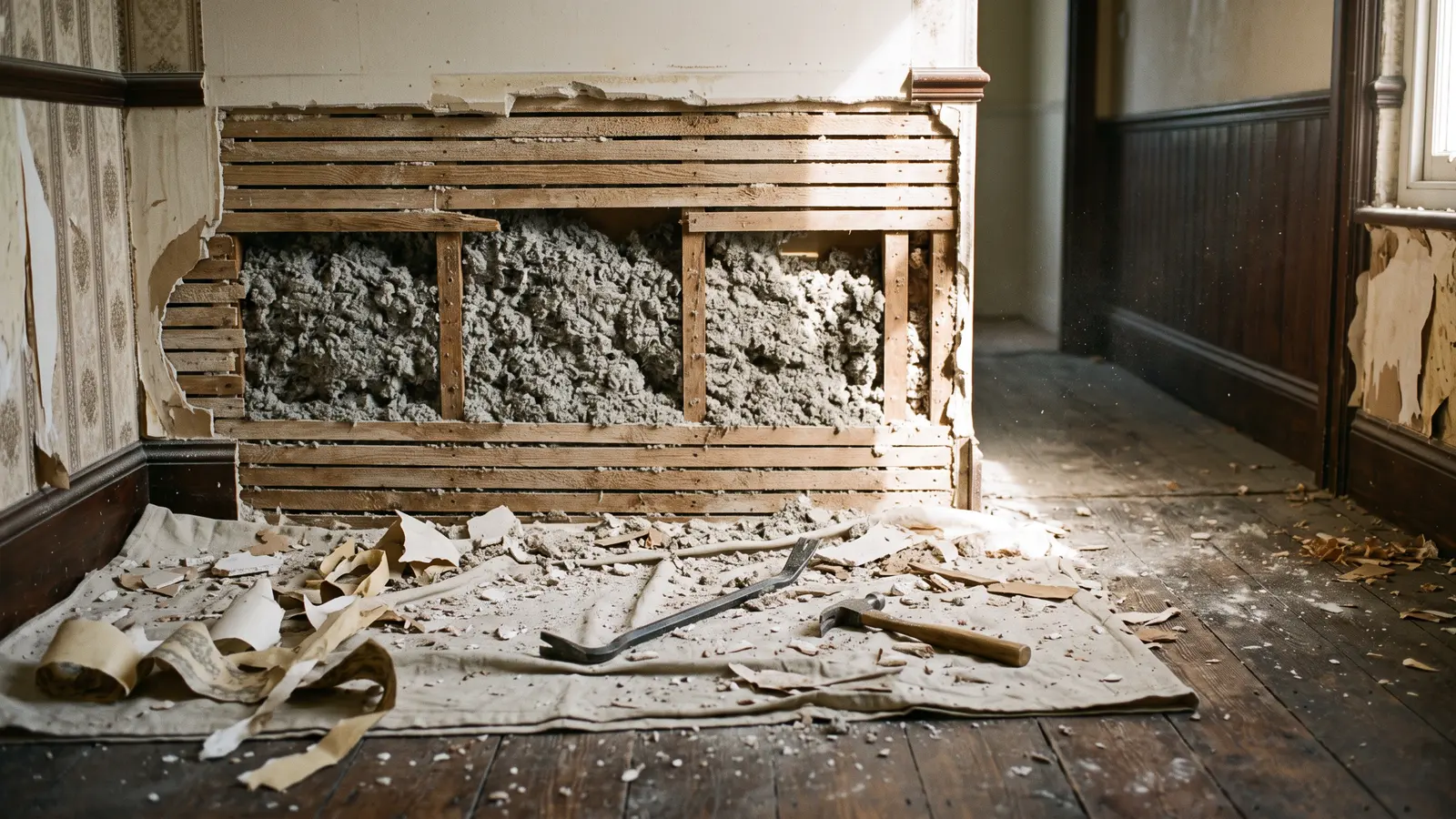
It was a small house: about 1,200 square feet, one bedroom and one bath, the bedroom a later addition that gave the house its L-shaped footprint. The rooms were 13 by 13 feet, the shotgun layout running straight from the front door to the back. Before the storm she had already taken down the wall between the two front rooms to make one open living space, remodeled the bathroom with a claw-foot tub, and turned the dilapidated shed out back into her pottery studio. The flood reached six feet inside. What the house kept was its shell, its layout, and its barge-board walls — made from riverboat wood salvaged in the 1800s — which she liked enough to leave exposed.
What the show did
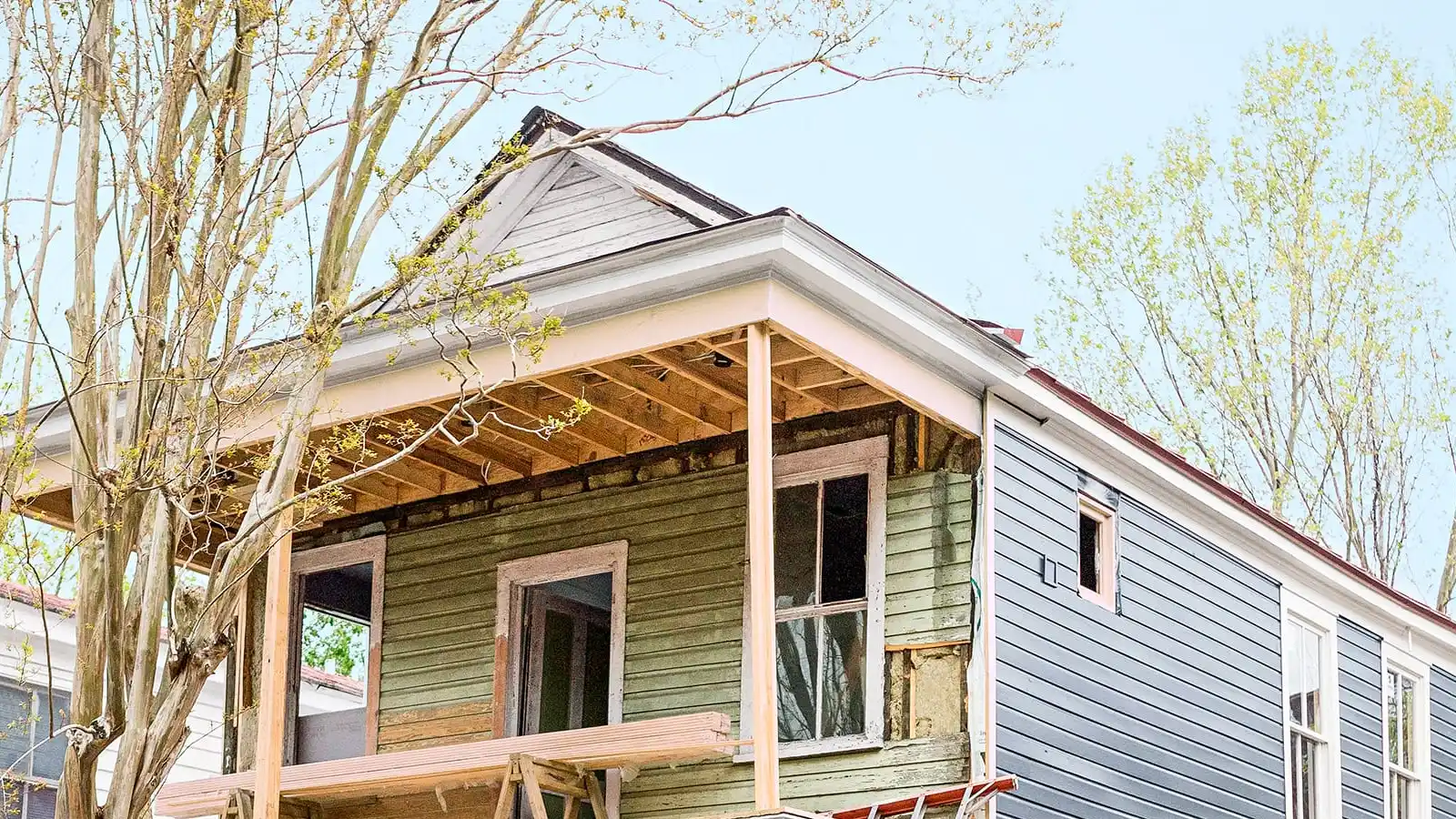
Local architect Rick Fifield drew the plan, and the idea was to keep a small house small: nearly double the space without making the house look bigger. The original 1,200 square feet gained about 1,000 more — a 15-foot extension at the back, with a one-room-wide "camelback" second storey stacked above one side, and a long side porch recalling the galleries of antebellum houses. One bedroom and one bath became three bedrooms and two baths, with the master suite upstairs and its balcony looking out over the river. Every new room kept the original 13-by-13 proportions and the same trim and door heights, so you can still stand at the front door and see clear through to the back porch. The front of the house, Fifield said, looks just as it did when it was built in the 1890s.
It didn't go smoothly. The first builder fell through midway — E21 is literally titled "First Builder Falls Through" — and Ferdinand hired a new general contractor, Larry Schneider, while filling in herself to keep the inspections moving. The finale, E26, "One Small Corner Restored," aired on 27 March 2008, with the house ready for occupancy — about a month after the February move-in she had hoped for.
Where the house is now
And that is, more or less, where the house's public record ends. I found no later sale, no listing, no revisit, no follow-up piece about the house itself. Whether Ferdinand still lives in it, or still owns it, is not publicly known — I've looked, and I'm not going to guess. The house is not on the market, so I'm not printing its house number, the same rule as the other posts in this series. What I can say is that the homeowner's next eighteen years are all on the public record, and they are the reason this post exists.
The homeowner now
In 2008, the year the show finished her house, Ferdinand founded the Sankofa Community Development Corporation, to rebuild the Lower Ninth Ward's health, environment, and economy. The name is a West African word — sankofa — for the idea of reaching back to move forward, and the work has followed that shape: start with what the neighborhood had, and build from it.
It started with food. In 2008 Sankofa opened a monthly community marketplace; that became a weekly farmers market, then an open-air produce stand in 2017, and in 2024 the Sankofa Fresh Start Market — a permanent 1,600-square-foot green grocery at 5029 St. Claude Avenue, with a teaching kitchen and café and free cooking and nutrition classes. It is the only green grocery in the Lower Ninth Ward, a neighborhood the U.S. Department of Agriculture calls a food desert, where the nearest full-service supermarket is nearly four miles away in St. Bernard Parish. Sankofa says the market serves more than 800 households a month.
The other project is land: the Sankofa Wetland Park & Nature Trail, 40 acres of deteriorated natural area on Florida Avenue, next to the Bayou Bienvenue Wetland Triangle, being restored as wetland habitat, flood protection, and a walking trail. Sankofa began working on the legal agreement with the city in 2014; the full 40 acres were projected to be complete by 2026.
Her mother is part of the story too: Dr. Daphne Ferdinand, a registered nurse who runs the Healthy Heart Community Prevention Project, now advises Sankofa.
On 18 September 2025, Sun Life and DentaQuest named Ferdinand one of the year's Health Access Hero Award winners — an individual award, for the healthy food hub and the free classes around it, carrying a $10,000 donation to the winner's chosen charity. The citation reads like a summary of the previous seventeen years: affordable, locally sourced produce, cooking and nutrition education, diabetes prevention, and cardiovascular health classes, in a neighborhood that had none of it.
My take
This is the post in the series where the "now" outgrew the house. The show rebuilt 1,000 square feet of shotgun house; the homeowner rebuilt a food system. If you only know Ferdinand from the 2008 episodes — the ceramicist on the porch with the search-and-rescue markings still on it — the 2025 record is the update that matters: same neighborhood, same street, and a grocery store where there wasn't one.
A separate story from the same season: Musicians' Village
One more thread from Season 29, kept separate because it is a different story with different people. The show spent five months following Habitat for Humanity's Musicians' Village — 72 homes in the Upper Ninth Ward for musicians displaced by the storm, conceived by Harry Connick Jr. and Branford Marsalis. In the finale, the show held the dedication ceremony at saxophonist Calvin Johnson's house there. Johnson went on to a recording career — a debut album, Jewel's Lullaby, in 2012, Native Son in 2013, and Notes of a Native Son in 2022 — and now teaches at the Louis Armstrong Summer Jazz Camp and sits on the Music and Culture Coalition's board.
The Village's own "now" is harder. In September 2025, Habitat sold 52 of the Village's units — eight subsidised rentals and 44 others — to a Metairie landlord, Sam Madi, for about $33,000 a unit, roughly $1.7 million in total. Rents that Habitat had held at $200 to $400 a month rose to $1,100 by December. One of the tenants is the bluesman Little Freddie King, 85, who paid $375 a month for nearly 20 years and was handed the keys to his house, along with a Bible, when he moved in. He lives on $1,800 a month in Social Security and uses a wheelchair after falling off his electric bicycle. He said Habitat never told him about the sale; he found out from the new landlord's letter. "Like the rug had been pulled out from under me," he said. On 11 December 2025 the City Council called for transparency from Habitat, and the Housing Authority stepped in to cover rent for four households — King's among them — for a year. Habitat said its mission is building homes that can be owned, and "managing and servicing a rental portfolio is not our core mission." Whether Johnson still lives in his Village house is not something I could verify — his music career is public; his address isn't.
What I couldn't verify
- Whether Rashida Ferdinand still lives in, or still owns, the Holy Cross house. There is no later sale or listing I could find, and no follow-up piece about the house itself.
- Whether Calvin Johnson still lives in his Musicians' Village house. His recording career and teaching are public; his address is not.
- What Norm Abram and Kevin O'Connor found at the 1990 Algiers Point house in S29 E20. The episode took them across the river to see how the Goldens' shotgun double fared in Katrina; I could not find a written account of what they found there.
- How many generations of Ferdinand's family lived in the Lower Ninth Ward. This Old House calls her a third-generation resident on its project page and a fourth-generation resident in its video portrait; the wire coverage says fourth-generation. I have not asserted a number.
- The current condition of the Holy Cross house. The show's "after" photos are from 2008, and there is no public record of the house since.
Bottom line
Eighteen years on, the New Orleans house is a finished story with no sequel — and the homeowner is a sequel the show couldn't have predicted. The house got its camelback and its river views in March 2008. The neighborhood got a grocery store, a wetland park, and a nationally recognised community developer. If you're looking for the house, the honest answer is that its public record stops in 2008. If you're looking for the homeowner, the market she founded is at 5029 St. Claude Avenue, and it's still open.
Sources
- New Orleans Rebuilds: Before — This Old House, 10 December 2007
- New Orleans Rebuilds: After — This Old House, 19 May 2008
- A Bittersweet Return: Getting Started in New Orleans After Hurricane Katrina — This Old House, 21 May 2008
- New Orleans Rebuilds Video Portrait: Rashida Ferdinand — This Old House, 17 August 2007
- The New Orleans House — This Old House, Season 12, Algiers Point
- Season 29 — New Orleans Rebuilds Episodes — This Old House
- ‘This Old House’ focuses on New Orleans rebuilding — Associated Press, 27 December 2007
- Rashida Ferdinand — DentaQuest, Health Access Heroes 2025
- Sun Life U.S. and DentaQuest announce 2025 Health Access Hero Award recipients — Sun Life media room, 18 September 2025
- From food to future: Sankofa’s path to renewal in New Orleans' Lower Ninth Ward — I Am New Orleans Voices (W.K. Kellogg Foundation), 21 August 2025
- From seed to supper — Every Child Thrives (W.K. Kellogg Foundation), 21 October 2025
- Wisdom and wonder: Young people and elders leading the way — Every Child Thrives (W.K. Kellogg Foundation), 7 July 2026
- 20 Years Later: Sankofa Creates a ‘Trail’ for Sustaining & Developing New Orleans’ Lower Ninth Ward — Sankofa Community Development Corporation, 22 April 2025
- Fresh Foods Signal a Fresh Start for New Orleans' Lower Ninth Ward — U.S. Department of Agriculture
- ‘Culture is the New Cotton’: The failed promises of the Musicians’ Village — Lede New Orleans, 16 May 2026
- City Council Calls for Transparency From Habitat For Humanity On Musicians’ Village Property Sale — New Orleans City Council, 11 December 2025
- Calvin A. Johnson Jr. — Wikipedia (albums, teaching, MaCCNO board)
- This Old House — Season 29 (2007) — Moviefone (episode dates: E20 14 February 2008, E26 27 March 2008)
Market details change. The Fresh Start Market figures are from Sankofa and the W.K. Kellogg Foundation pieces; the Musicians' Village rents and sale are as reported in May and December 2025.
The weekly recap
Get each new recap the day it's posted.
Get each new This Old House and Ask This Old House recap by email, the day it's posted. No spam, unsubscribe anytime.
Keep reading
Related recaps
Also about Historic Homes
Project note