
How to Date an Old House by Its Nails
Hand-wrought, machine-cut, and wire nails mark rough eras. How to read the shank, head, and taper, and when a reused nail lies about the year.
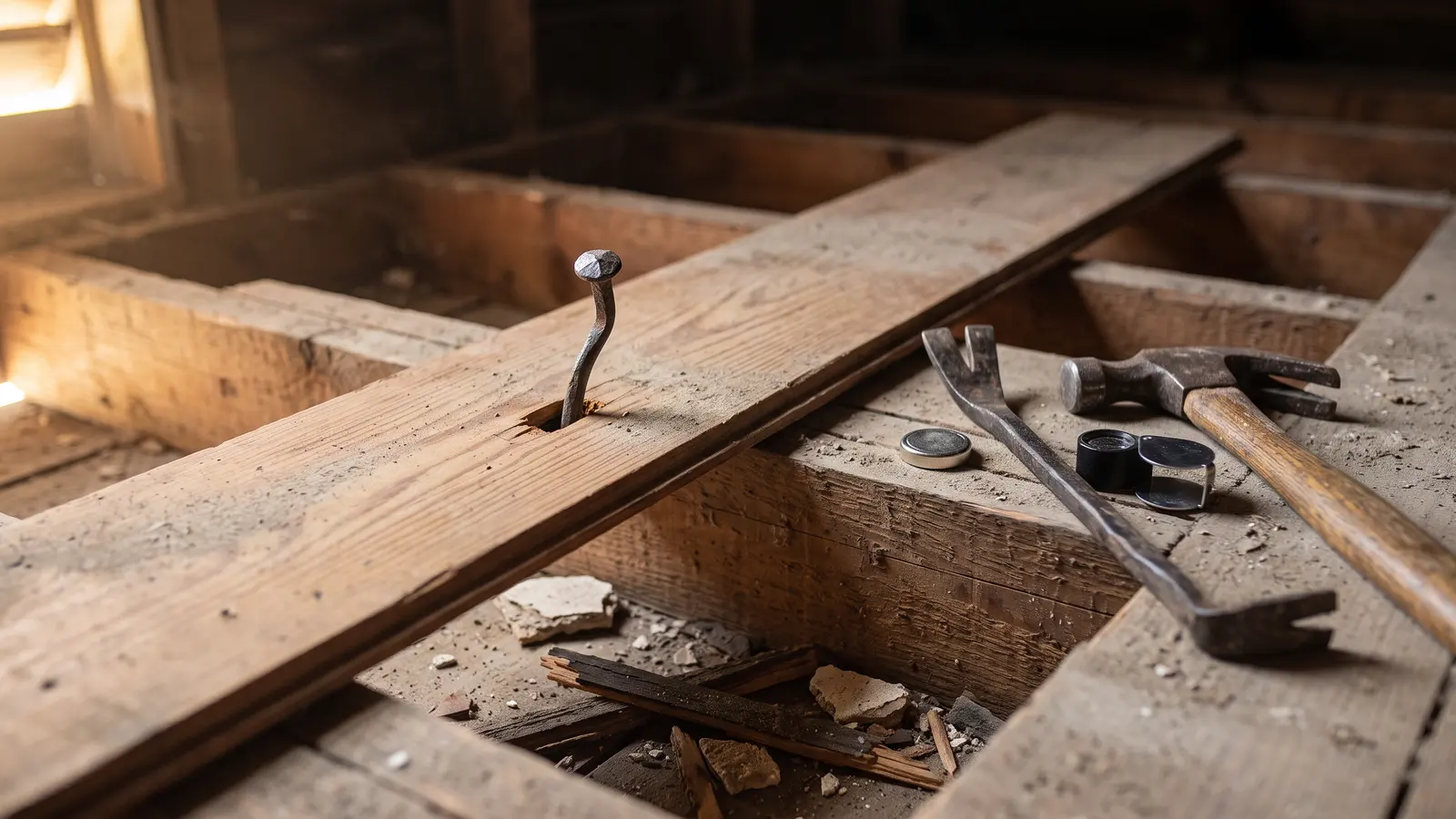
A nail can put an old house in the right century. It cannot give you the year the house was built. Hand-wrought nails, machine-cut nails, and wire nails arrived in that order, and for long stretches they were all for sale at once. The companion note on cut nails versus wire nails is about shape and grip. This one is about time, and about the reasons a single fastener lies.
The chronology below follows Lee H. Nelson's "Nail Chronology as an Aid to Dating Old Buildings" (American Association for State and Local History, Technical Leaflet 48, 1968), written for the National Park Service. Nelson's own warning is the useful one: dating from nails is not precise, and it only works when you look at enough of them, from enough parts of the building, to see a pattern.
Three rough eras
Hand-wrought nails
A blacksmith made these one at a time. In American houses they run through the seventeenth and eighteenth centuries and into the early nineteenth. Nelson is blunt about the limit: for that long span, moldings, hardware, and the rest of the finish are better clocks than the nail. Wrought nails also did not vanish when cheaper cut nails showed up. Philadelphia advertisements in the 1820s still priced wrought and cut nails side by side, and smiths kept making wrought nails for clinching and for trim. A wrought nail in a board can mean the board is early. It can also mean someone wanted a nail that would bend over on the back.
Machine-cut nails, about the 1790s to the 1890s
Cut nails are sheared from iron plate. Nelson could point to machines in the 1780s, including a Harrisburg works in 1789, but he had not found a cut nail he could date with confidence before the early 1790s. After the late 1790s the references pile up. Thomas Jefferson bought a nail machine in 1796. From there to the 1830s the fastener itself changes, which is the part worth learning if you are trying to separate one early house from another:
- About the 1790s into the 1820s, the shank was cut and the head was still hammered on by hand.
- From about 1815 into the 1830s, machines started forming crude heads. Simpler machines stayed in use, so the types overlap.
- By the late 1830s, machine-made heads were perfected. Nelson's line after that is the uncomfortable one: cut nails made after about 1830 are virtually indistinguishable from cut nails made today.
Early cut nails also tend to have the iron fibers running across the shank, which is why they clinched badly and why wrought nails hung on for that job. Later cut nails have the fibers running along the shank. That is a shop clue, not something you can see from the hallway.
Wire nails, taking over about the 1890s
Wire nails were not born in 1890. Nelson traces American factories to New York in the 1850s, after earlier work in England, France, and Germany, and those first nails were small goods: pocketbook frames, cigar boxes, not house framing. Machinery for builders' sizes was worked out in the 1860s and 1870s and shown at the 1876 Centennial. An 1888 trade article already called steel wire nails a newer type that was superseding cut nails for many purposes. They did not become the dominant building nail until the 1890s, and plenty of carpenters kept buying cut nails well into the twentieth century. Nelson's practical reading of a wire nail is modest: it usually marks a late-nineteenth-century repair, alteration, or bit of maintenance, not the birthday of the frame.
How to tell them apart
Look before you pull. Attic rafters, the underside of floorboards, and the back of trim that is already off the wall will tell you more than a nail you have bent into a hook.
Shank cross-section
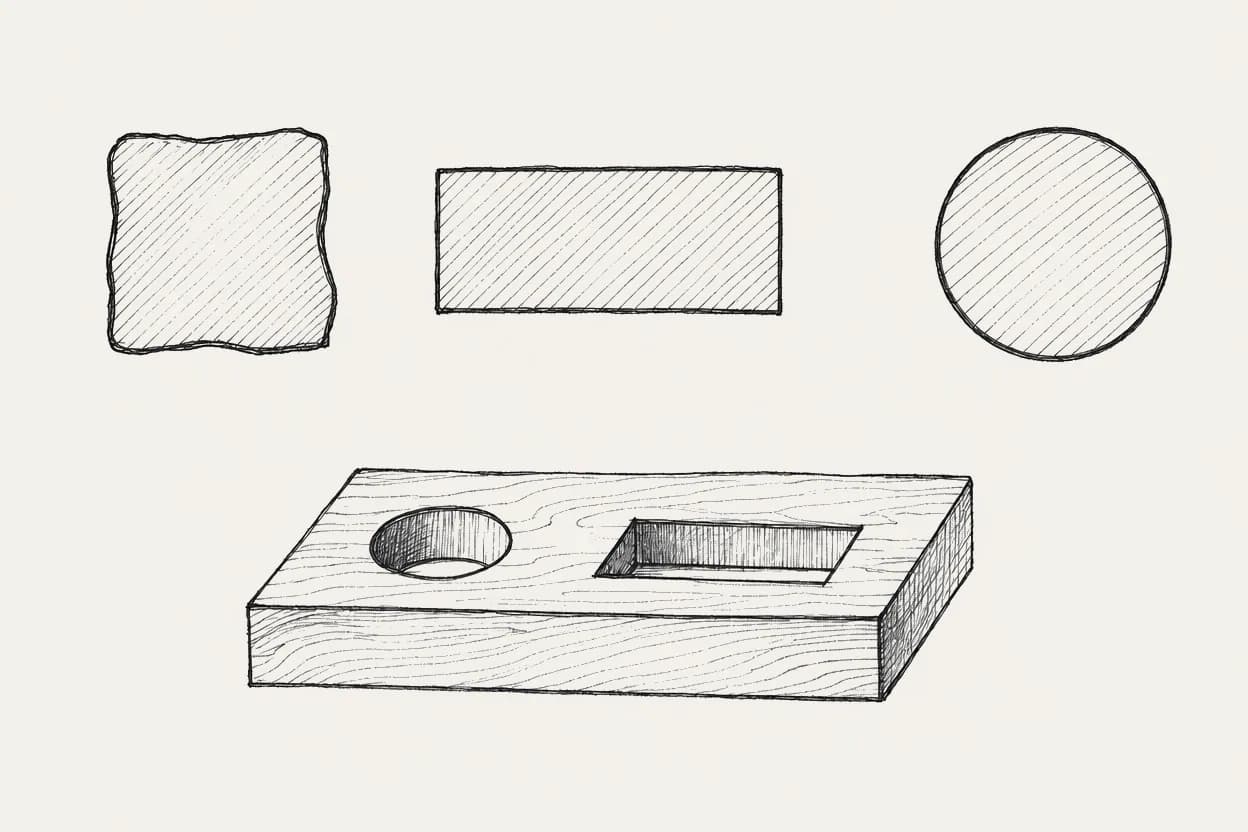
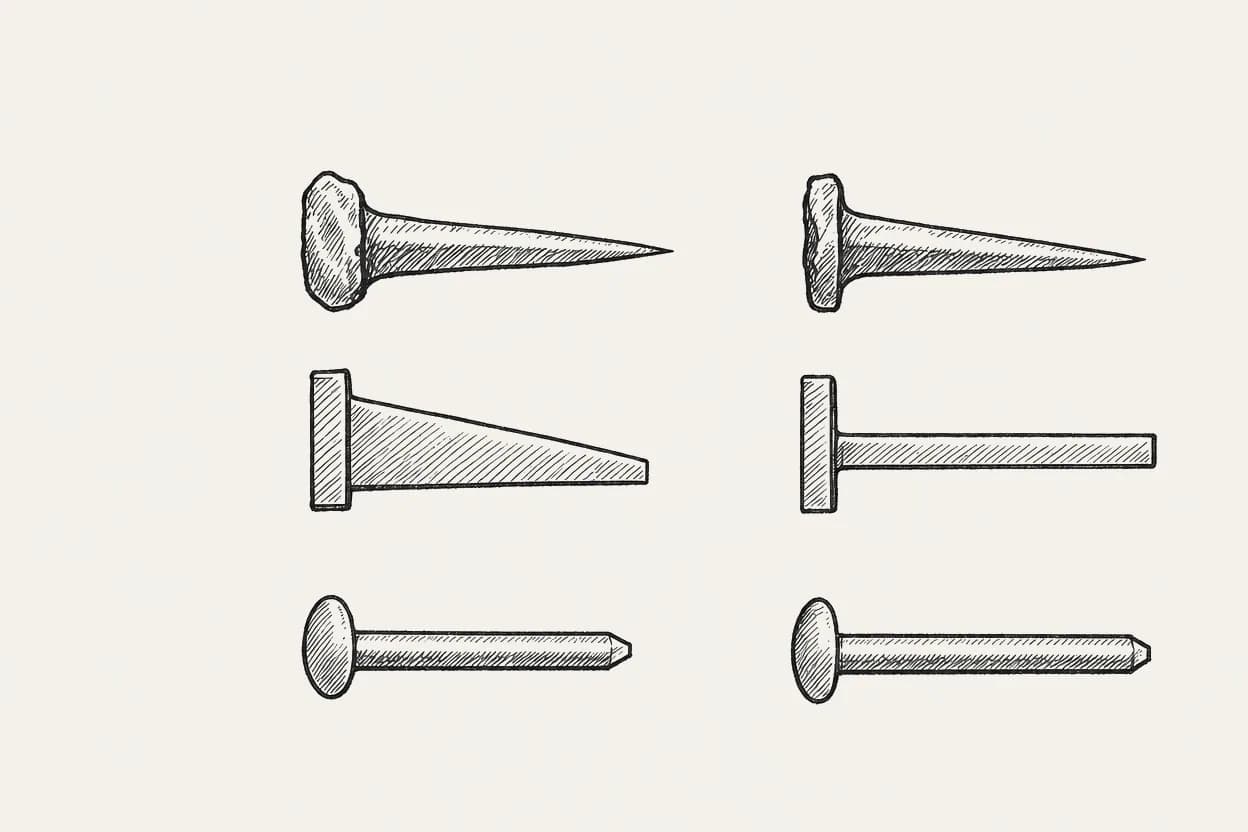
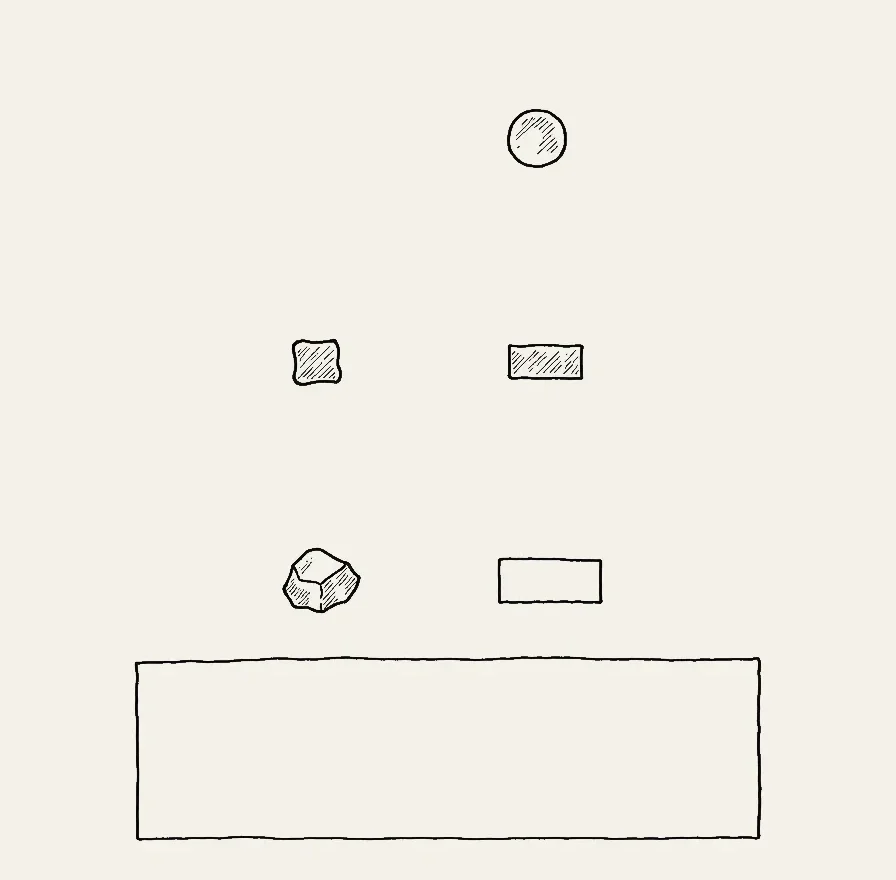
A wrought nail is forged, so the shank is four-sided and irregular. A cut nail is a rectangle in section: two faces are the faces of the plate, and the other two are the cut. A wire nail is round, because it started as wire. If you can only see the hole left behind, a round hole is a wire nail and a rectangular scar is a cut nail or a wrought one.
Head shape
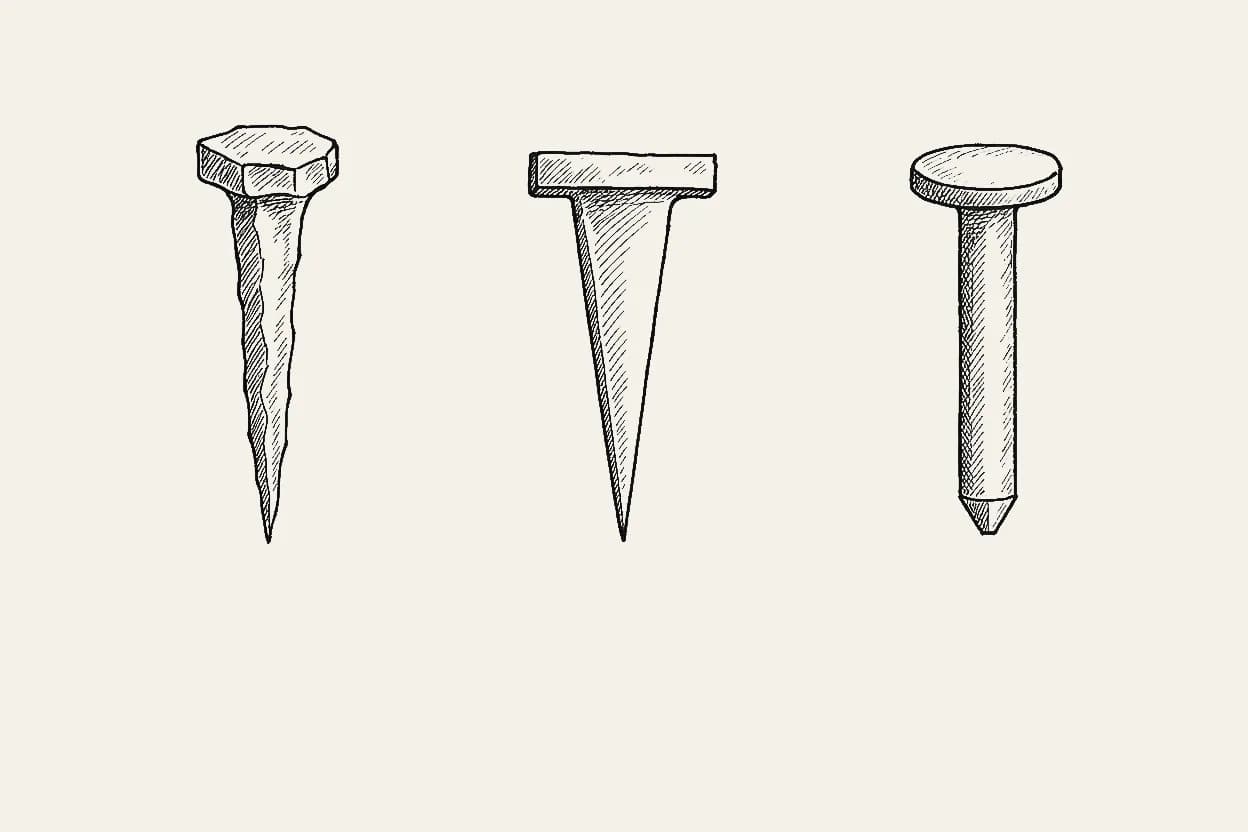
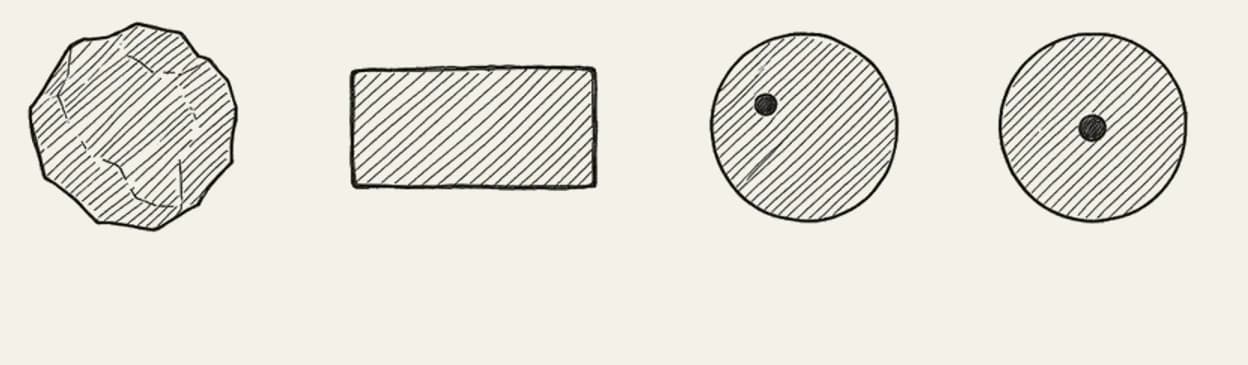
A wrought head was hammered. It is lumpy, often faceted, and rarely matches the next one. Early cut nails still have that hand-hammered head on a sheared shank. Later cut nails have a machine-made head, a squat rectangle rather than a disk. A wire nail has a round head. Nelson adds one finer wire-nail mark: the earliest ones have heads that are bulbous and usually off-center on the shank. A clean, centered, round head is the modern version of the same idea.
Taper
A wrought nail generally draws in on all four faces toward a point. A cut nail is a wedge. The plate was flipped as it was fed so each nail tapered, which is why two opposite faces narrow and the other two stay closer to parallel. A wire nail is nearly the same diameter until the point. The wedge is also why a cut nail can split a board if you drive the wide face across the grain. That orientation lesson, and the holding-power argument, lives in the cut nail and wire nail comparison. This page only needs the taper as a date mark.
How they come out
If a board has already let go, the nail that comes with it is evidence. A cut nail often bends, or it tears out a rectangular plug, because the wedge was locked into the fibers. Tests at Watertown Arsenal in the 1880s, which Nelson cites, found that this grip was real, and it is one reason builders were slow to switch. A wire nail more often slides out round and relatively straight, or the head snaps off and the shank stays behind. A wrought nail was the one people chose when they meant to clinch it, bent over on the far side. Early cut nails, with fibers running across the shank, did that job badly. None of this is a reason to start prying. It is what you notice on a board you were already taking up.
When the nail is lying
Nelson lists the traps. They are the whole method.
- One nail is not a date. He says so twice. A pattern across framing, floors, lath, and finish can show an original campaign or a later one. A single nail from the junk drawer on the sill cannot.
- Reused nails are older than the work. Salvaging nails is older than the Republic. A 1645 Virginia statute tried to stop people burning buildings down to get the nails out, and Nelson notes an early Delaware courthouse ordered destroyed in 1691 for the same reason. A careful carpenter in 1850 could drive an eighteenth-century nail into a new board.
- Later repairs use whatever the keg holds. Wire nails in an older frame usually mark a patch, a porch rebuild, or a squeak someone chased on a Saturday. They do not move the house into the 1890s.
- The countryside lagged the city. Nelson's tenth caution is that urban shops picked up a better nail sooner than rural ones. Some naileries were also simply ahead of their neighbors. A date that is fair for Philadelphia can be early for a village twenty miles inland.
- Cut nails never fully left. After about 1830 they look like the cut nails still made for flooring, masonry, and boat work. A bright cut nail in old wood is often a restoration, not a survivor. The shank will not tell you which.
- The types overlap on purpose. Wrought and cut nails share the years around 1790 to 1820. Cut and wire nails share the 1880s and 1890s, and cut nails remain common in some framing after wire nails "won." Several types in one house can mean the building went up during a changeover, or that someone altered it. You need the rest of the fabric to decide.
Is this a DIY project?
DIY confidence: learn first. Comparing nails you can already see, or nails that fell out of a board you are reusing, is approachable. Assigning a construction year from them is a hypothesis you check against the molding, the saw marks, the foundation, and the paperwork. Opening structural framing, a roof, or a braced wall to hunt for a prettier sample is not the project. If the connection is still carrying load, leave it and read the other note before you pull anything.
Where this shows up on the site
The clearest on-air example is also the caveat. In Season 47, Episode 1, Tom Silva finds cut nails throughout 1920s worker houses in Swannanoa, spaced about six inches apart in thick novelty siding, along with diagonal bracing. Wire nails were already the dominant type by then. Those houses are what Nelson's gradual changeover looks like in the field: cut nails still doing the work a generation after the trade press had moved on. When the bathroom wall of that same bungalow comes apart in Episode 2, the recap comes back to those nails because the framing being cut is the framing Tom had just praised. The tools index keeps the Episode 1 note on cut nails with the other materials from that hour.
Sources
- Lee H. Nelson, "Nail Chronology as an Aid to Dating Old Buildings," AASLH Technical Leaflet 48 (1968)
- Cut nails vs. wire nails: shape, grip, and where they show up in old framing
- Season 47, Episode 1: cut nails and diagonal bracing in the Swannanoa houses
- Season 47, Episode 2: that same cut-nailed wall, opened up
The weekly recap
Get each new recap in your inbox the week it airs.
One email the week the new episodes are up, with links back to the full write-ups. Confirm once. Unsubscribe any time.
Keep reading
Related recaps
Also about Cut Nails
This Old House · S47 E1
This Old House S47 E1: Five Families, One Hurricane, and the 1920s Construction That Refused to Quit
Also about Historic Homes
Project note