
This Old House S48 E5: Essex County Colonial: Bigger Isn't Better
Essex County Colonial: Bigger Isn't Better. A sewer model shows why four-inch pipe beats the old six-inch clay, the stair is blocked tight, and the pocket doors leave the floor.
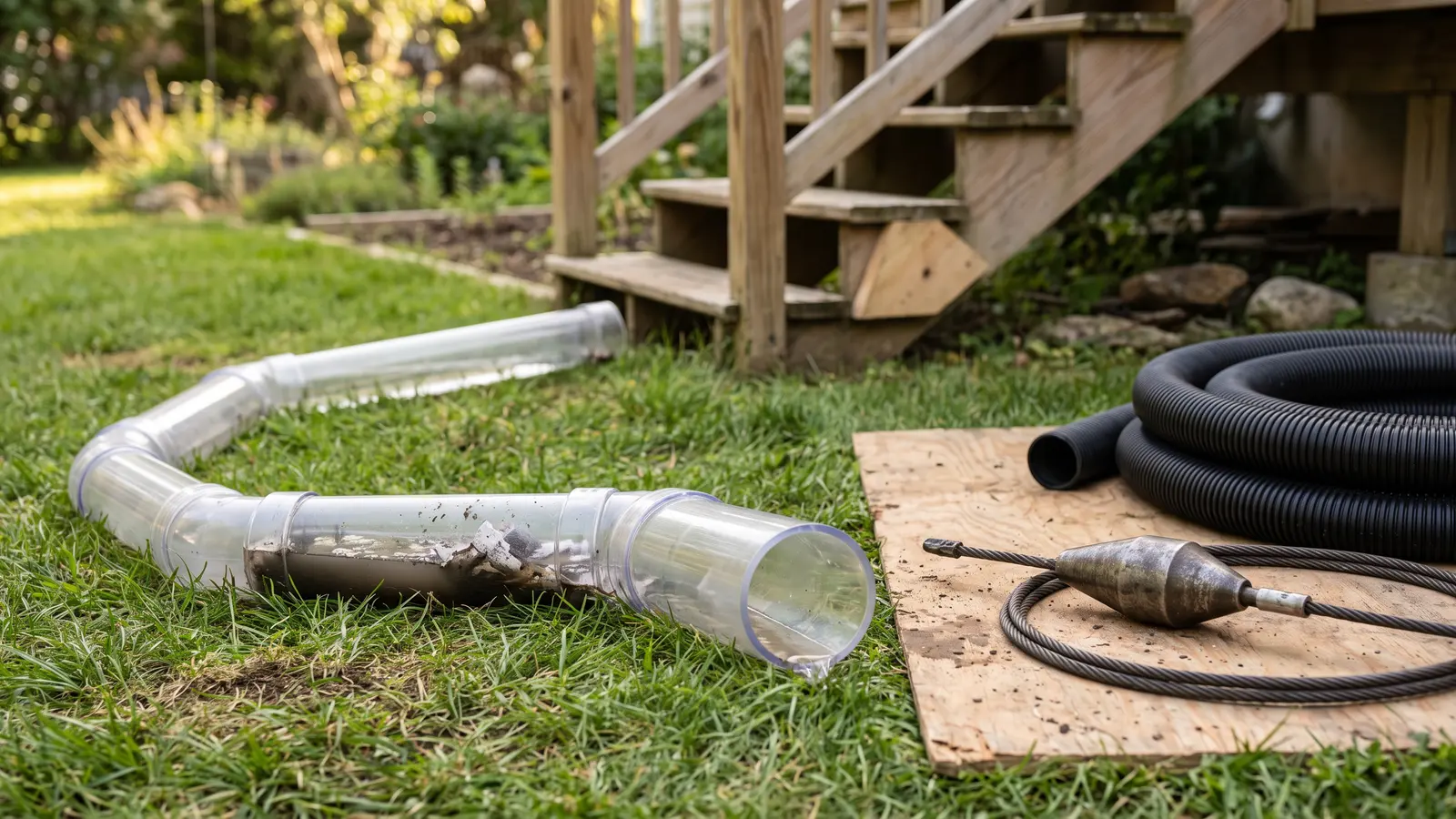
Season 48, Episode 5 of This Old House is called Bigger Isn't Better, and the name is the plumbing lesson. At the Essex County Colonial, a late-1800s Dutch Colonial in New Jersey, Zack Dettmore and plumber Craig Scott build a full-scale sewer in the yard before they replace the line to the street. The old pipe outside is six-inch clay. The new one is four-inch. The rest of the hour is the main stair, which has started to move, and the original pocket doors, which are leaving a floor track that cannot be saved. Homeowners Ethan and Harley are moving from across town.
Since Essex County Colonial: Making Connections, Kevin O'Connor says the rough plumbing is finished and the electricians are well along. The HVAC crew is running first-floor ductwork. The house already had air-conditioning upstairs and never had it downstairs. The family room has a new framed roof and a couple of skylights, and a back door will open into a new mudroom. The subject of the hour is what a flush does when the pipe gets wider.
The old clay line is not worth saving
The sewer used to leave the back of the house, take a 90-degree turn, and run all the way to the street. Zack is bypassing that run. The old pipe is clay, it has roots in it, and he says it is not salvageable. The new trench is shorter. Kevin asks whether digging through the concrete, then down a foot and a half, is easier than using the pipe that already exists. Zack's reasons are the roots, a close property line, and the HVAC condensers they would have had to move. He calls this less work, and still a good bit of work. They expect the outside connection today and the inside work tomorrow or the next day. Quinten, a summer intern and a senior at Montclair High School, is in the ditch. He is on the site for the summer and headed to engineering in the fall. The lesson is the pipe, which is why Craig has a model in the grass.
Three pipe sizes, and three flushes
The mock-up is a working sewer: sweeps, turns, and clear sections so the water shows. Craig built it to show volume and velocity from the toilet, point A, to the city main, point B. A stand-in for the second-floor bowl comes down a three-inch line, the size he says would typically be inside a house. Underground, inside the house, the model steps up to four-inch. A house this age would then go to six-inch, and that piece is in the model too.
Kevin asks what was in the house when it was built, more than 100 years ago. Craig's answer is four-inch cast iron inside and six-inch clay outside. The remodel goes the other way: three-inch through the house, then four-inch out to the street. Smaller inside, and smaller on the line that used to be the big one. Craig says everybody thinks bigger is better, and here it is not. The plumbing reason is the one Kevin says he has heard from Richard Trethewey. The liquid moves the solids, and a steeper pitch can send the water off too fast and leave the solids behind. Craig agrees. A pipe that gets wider does something similar, because the water disperses. He wants the flush moving slowly, with as much water in the pipe as he can get.
They start around the 1890s with a five-gallon flush, a non-toxic sewer tracing dye, and paper standing in for solids. The three-inch has what Craig calls nice volume and flow. The four-inch still moves, solids out front, and Kevin says the water is almost halfway up that pipe at the max flow. The six-inch still carries a good amount of water. Craig says that is what you would typically find in 1890 with a five-gallon toilet. Keep that sewer and put a smaller flush on it, and he thinks the picture changes.
The next dump is 3.5 gallons. Craig places that flush somewhere in the 1970s, and he thinks it ended around the 1990s with the Water Conservation Act. He says he thinks so, so this recap will not turn the remark into a citation. Kevin calls the bucket a 1977 flush and calls 1977 a good year. That year is the joke. The three-inch still rips. The four-inch still pushes the solids, a little lower and a little slower. The six-inch still moves, solids still out front. At 3.5 gallons, six-inch still works.
Then they go to 1.28 gallons, which both of them call what most toilets are now. The three-inch still moves. The four-inch is considerably slower, and Craig says it is still moving. In the six-inch, with that 1.28 flush, the water is just trickling, and they have not seen the paper start to come through. Kevin asks if that means a backup. Craig says not necessarily. A house also has a sink, laundry, and other water, and if something hangs up, some other water will push it along. The point of the model is narrower than a claim that six-inch always clogs. Six-inch does not help these low-flow toilets, and four-inch works. That is what they are putting in, a four-inch sewer in place of the six-inch.
The new line follows the old one
The crew is set up out front so the new line can run from the street to the house. Because they are going through the old six-inch clay, they will not dig up the lawn. Craig says the pipe is about 80 feet. One end goes into a bursting head. Kevin sees no glue and no mechanical fasteners. Craig says it works by pressure. A mechanism inside expands as you pull, locks in the old pipe, and smashes that pipe to the outside. A cable already in the clay pulls the new four-inch pipe toward the house, splitting the old pipe out of the way and dragging the new one behind it.
On the other side, a 30-ton hydraulic piston works the pull, about a foot at a time. Kevin describes a foot or two, then a reset, and Craig agrees. The next 60 or so feet, Craig says, is that same pull through the old line. With the outside four-inch in place, they push the pipe through the hole in the wall so the crew can make the connections outside. Craig describes the run they are going to have: four-inch from inside the house, underground, all the way to the city sewer. He is saying it as they push the pipe through, not over a joint the camera has already shown made up. Inside, Kevin says the fixtures are on the three-inch stack, and that stack is what gets tied to the four-inch.
The stair is loose, not just noisy
On the main stairs, Zack says 130 years of traffic have made them creaky. The treads are coming away from the risers, and the nails that join them travel in and out of the wood underfoot. That travel is the squeak. Worse, a tread has come out of the stringer. Zack can move the whole thing in and out, and he calls that pretty dangerous. The plaster under the stair came off in demolition, which is why they can reach it. This is carpentry on a stair already open from below.
Justin Taylor is holding the stair. Two jobs: resecuring the riser to the tread, and the broken stringer. They take off three nailers, and Zack cuts through them so they come out. Underneath, he does not think there is anything to fix. Nothing is holding that piece together. Justin slides a two-by up under the stair and screws it to either stud. With that blocking in, Zack adds an inch-and-a-half spacer and a triangular piece of wood where the stringer was compromised, screwed with a little glue, to carry the tread and the riser.
The squeak fix pulls the riser back to the tread. Zack countersinks so the wood does not split, and he blows the dust out of the gap so crumbs do not keep the joint open. The fasteners are three-inch structural screws. Blocks go on the bottom of the tread and the face of the riser. He drills through each block so the screw slides and the threads pull the joint in. Glue goes on the underside. Justin screws the blocks. Zack says the blocks bind the tread and riser into one piece, which is what stops the squeak. He screws the nailers back up for drywall. Justin walks the steps and says they sound much better. Once the glue dries, he bets the squeaks are gone. The bottom, Zack says, lines up the way it did. A floor board is a different job. Ask This Old House Season 24, Episode 12 is a hardwood floor. This tread has left the riser and the stringer.
The pocket doors come off the floor
Charlie Marshall is still on the original pocket doors. Ethan and Harley wanted them saved, and they were not working. The pocket was full of debris, and the doors were hard to pull. This will be the family room, there are young kids, and the crew wanted doors that function. The doors are five-panel. The track is what goes. Charlie has not seen this system before. The doors rolled on a bottom track: wheels in the bottom of the door, which he compares to train wheels, on a brass track inlaid in the floor. The wheel he takes out spins, and it has play back and forth. The track is damaged. They are not saving it.
The replacement is a top trolley with a soft-close mechanism. The door hangs from it, in a track already installed. Charlie set the track height from the door and from the floor buildup, and he had to open the wall to do it. Kevin asks if there is a way without opening the wall. Charlie says no. If you have to open a hole, he says, make it big enough to work in. A small one gets bigger, or you stay frustrated. He set 2x4s level across the opening, perpendicular to the existing framing, and figured in 3/4 plywood as a build-down so the track has something to screw to.
He does not lift the door while he tunes the hardware. The door, he says, is 60 pounds or whatnot. The stand-in is a 2x4 cut to 30 1/2 inches, the width of the doors. He sets the trolleys, stops, and limits on that, then moves the brackets to the real door. Order in the track matters. The stop that lives in the wall cavity goes in first. Then a trolley, in the right direction, which is the front one. Then the bumper, which is fixed and is what the door hardware hits. An offset wrench locks the mechanism. The far stop should leave the stand-in flush with the side jamb, and the center stop should put it on the center line. On the other side, Charlie says the stop needs to move about 2 7/8. They hang both doors on that hardware. For the finished floor height he has 1/2-inch plywood over the subfloors, then 3/4 over that, and the door bottom meets that plane. After Ethan and Harley pick the stop molding, he can make a last adjustment, and the drywallers close the walls. Kevin calls them 130-some-odd-year-old pocket doors saved.
The vanity was on site before demolition
Camille Dettmore says late decisions, and material that shows up after the crew needed it, are usually one of her biggest problems. Ethan and Harley went the other way. The vanity was on site weeks before demolition, so they could set it in the room. It is a little too big. It would hide the mosaic floor going into that bathroom, and once the toilet is in, the room would feel too tight. Zack says changes like this happen all the time. At the end of a job they mean opening a wall to move plumbing. Early, there was time to talk with the designer and pick another vanity, with no hit to the schedule. The new one is already on site. Camille calls it a console sink, a better use of the space, more historically accurate to the age of the house, with brass legs and a place on the side for a towel. She is sending Ethan and Harley a picture.
DIY Confidence Scale
2 out of 10. The model is the part worth understanding. Pulling about 80 feet of four-inch pipe through old clay with a 30-ton hydraulic piston is the plumber's machine. The stair looks familiar, and it is not a loose tread you can ignore. Zack can push it in and out of the stringer, the underside was already open from demolition, and the repair is blocking, a new triangle of wood, and structural screws. A stair that moves sideways is a carpenter. The pocket-door hardware goes in only after the wall is open, and Charlie's answer to doing it closed was no. If a toilet was downsized and the sewer was not, ask the pipe size and the flush volume. Craig's six-inch was a trickle on a 1.28, and the paper had not come through. Other water in the house can still push a hang-up, which is his caveat, not a reason to leave an oversized line. If a finish is big enough to move plumbing, get it in the room before the wall closes. The episode cites no code section, and this recap will not add one.
Additional Resources
The previous hour finished the rough plumbing this sewer leaves from: Essex County Colonial: Making Connections. The preview after this episode is wallpaper that can take minutes or days, 130-year-old lumber turned into southern yellow pine floors, rough inspections, and insulation in the roofs and walls, including noise attenuation Zack says is already around the bathrooms. Those are the next hour. The episodes already up are on the Season 48 episode guide.
The weekly recap
Get each new recap the day it's posted.
Get each new This Old House and Ask This Old House recap by email, the day it's posted. No spam, unsubscribe anytime.
From the captions
Spotted on the job
Tools, materials, and techniques the episode actually showed or discussed. Names stay generic unless the episode said a brand. A name links to an Amazon search only when it is something a person could buy.
As an Amazon Associate, This Old Recap earns from qualifying purchases.
Tool
Pro-only
drill
Amazon search for drill (opens in a new tab)
Zack drills through the stair blocks so the structural screws slide and the threads pull the tread to the riser.
Material
Pro-only
structural screws
Three-inch structural screws fasten the stair riser back to the tread.
Product
Pro-only
sewer tracing dye
Craig adds a non-toxic sewer tracing dye so the flush shows up in the clear pipe.
Tool
Pro-only
bursting head
The bursting head locks inside the old clay pipe and splits it as the new four-inch line is pulled through.
Product
Pro-only
pocket-door trolley
A top trolley with a soft-close mechanism replaces the damaged brass floor track on the original pocket doors.
Keep reading
Related recaps
Also from the Essex County Colonial
This Old House · S48 E3
This Old House S48 E3: Essex County Colonial: Knock on Wood
Also from the Essex County Colonial
This Old House · S48 E2
This Old House S48 E2: Essex County Demo Day, Knob-and-Tube Wiring, and Lumber That Arrives in Order
Also about Plumbing
Ask This Old House · S24 E4
Ask This Old House S24E4: Hearing Protection, a 120-Decibel Hammer, and Moving Laundry Upstairs
Also about Carpentry
This Old House · S47 E20