
Ask This Old House Season 23 Episode 14: Airless Painting Wainscoting, All-Electric Heat, and a Pressure-Treated Sandbox, or Prep Work Is the Whole Job
Mauro Henrique sprays wainscoting with an airless rig and a room full of masking, Kevin O'Connor, Ross Trethewey, and Heath Eastman compare heat pumps with fossil fuels using a levelized cost chart, and Nathan Gilbert builds a pressure-treated sandbox with two brothers who take digging seriously.
Season 23, Episode 14 of Ask This Old House moves from an interior spray job to a utility-rate discussion to a backyard build. The three segments do not share a trade, but they all reward the same instinct: decide what the finished thing needs, then work backward through the messy parts.
Mauro Henrique Paints Wainscoting With an Airless Sprayer
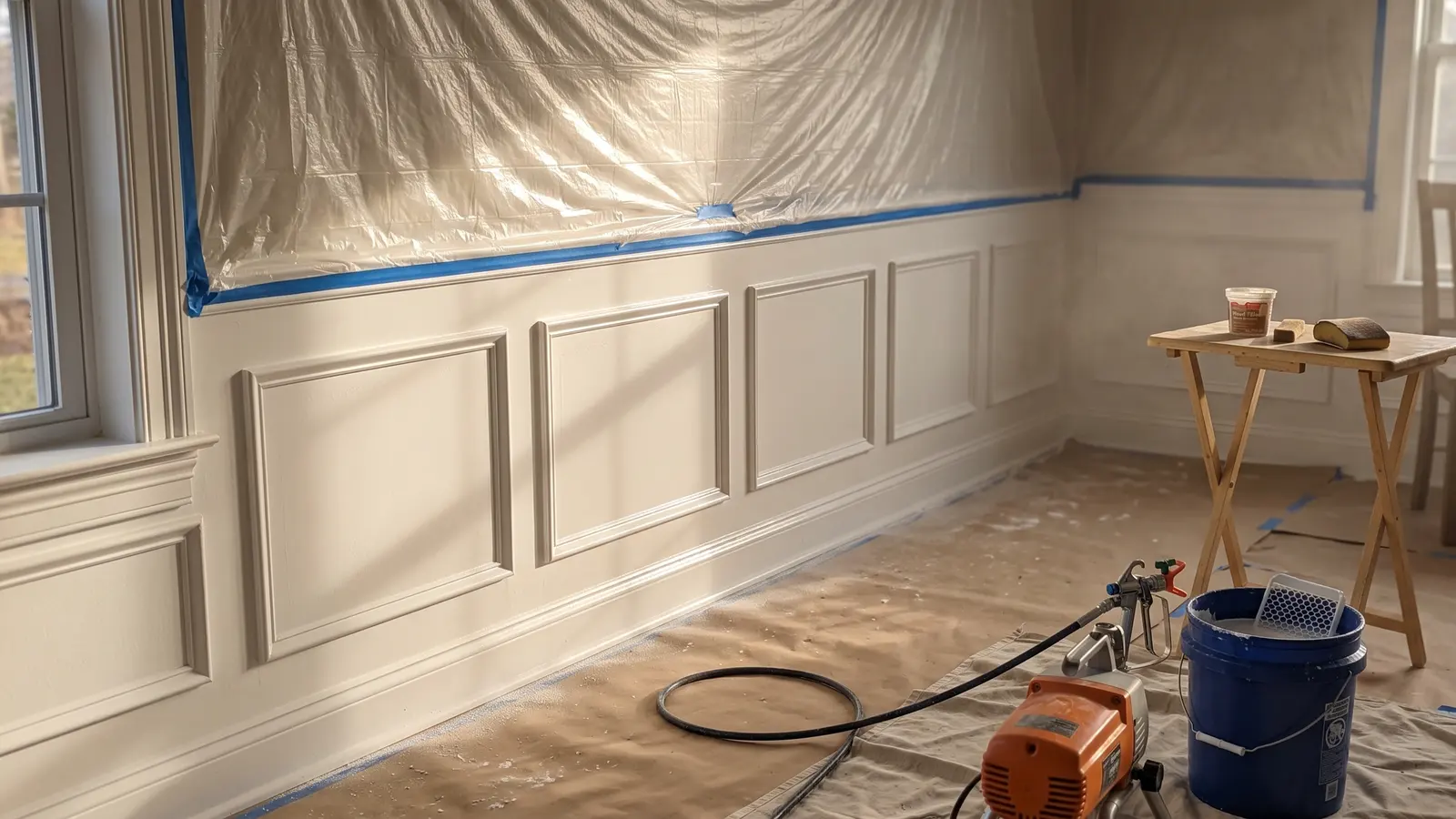
David has already done the noisy work in a kitchen renovation. He removed a wall between the kitchen and dining room, stripped wallpaper, and sanded the door and window trim. Now he wants the wainscoting painted white in semi-gloss to match the rest of the molding, and he wants no brush marks or roller texture. That last requirement is what changes the plan.
Mauro Henrique explains that a brush or roller will leave some texture, then chooses an airless sprayer for a uniform finish. Airless means the machine pressurizes the paint itself, so there is no separate compressor. The sprayer is the fast part. The prep is the job. Mauro vacuums the wainscoting and walls, has David follow with a tack cloth, covers the floor with paper and drop cloths, protects the walls with pre-taped mask and film, and blocks the doorway. That is all overspray control. If you have ever found paint mist on a light fixture you forgot to cover, you understand why the masking takes longer than the spraying.
The primer is water-based, which lets them keep moving as it dries. Mauro uses a 315 tip. His rule of thumb is to multiply the first number by two, giving roughly a six-inch spray fan. He tells David to overlap each pass by 50% and to move a little faster so the paint does not clog. He also warns that a sprayer uses more material than brushing or rolling, roughly 30% more because of overspray loss.
After the primer, Mauro fills holes and cracks with wood filler. He does that after primer because the defects show up better. He caulks, then sands between coats with a sanding block for flat surfaces and sponge sandpaper for profiles and curves. The topcoat is a durable, scuff-resistant latex meant for high-traffic areas. The result is the sheen David asked for: no brush marks, and trim that reads as if it had just been installed.
If you saw Mauro spraying shutters in Episode 8, this is the indoor version of the same lesson. The airless rig earns its keep only when the room is ready for it. That earlier job was about volume and drying space; this one is about overspray and finish quality. And if you remember Nathan Gilbert installing flat panel wainscoting in Episode 12, that was the carpentry stage. Here the panels are already up, and the work is finishing. The install post is useful context, but it is a different trade.
A homeowner can do this, but only if they are honest about the prep. If you will not mask the room, sand between coats, and clean the machine, a brush and roller may be the better choice. The sprayer does not hide sloppy prep; it amplifies it.
Heath Eastman and Ross Trethewey on All-Electric Homes and the Cost Math
Kevin O'Connor meets Ross Trethewey and Heath Eastman in a barn for a conversation about electrification. Heath says more municipalities are requiring electric heating, electric cooling, and EV readiness in new construction. He also points out that most electricity still does not come from renewable sources. That does not kill the argument for heat pumps, but it should keep the conversation honest.
Ross lists the common fossil fuels: propane, oil, and natural gas. Each has its own risks, including backdrafting and pipe leaks. Electricity has the appeal of one energy source for lights, receptacles, and heat pumps. The hard part is comparing cost, because the billing units do not match. Electricity comes in price per kilowatt hour. Propane and oil come in price per gallon. Natural gas comes in price per therm. The chart they show uses a levelized price per kilowatt hour to put those numbers on one playing field.
With a national average of $0.16 per kilowatt hour and an average heat-pump seasonal efficiency of 2.5, the net price is about $0.06 per kilowatt hour. Heat pumps often beat propane and oil on that basis. Natural gas can still be cheaper depending on where you live. Heath says that if you are making the decision on cost alone, natural gas may be the practical answer for some homes.
New construction is the easier case. A tight, well-air-sealed envelope paired with solar can approach net zero. Existing homes are messier. If you have baseboard heating designed for 160°F to 180°F water, a heat pump that supplies around 120°F may not keep up on its own. That leads to dual-fuel hybrid systems: the heat pump runs as stage one for most of the season, and the existing boiler supplements below the balance point, the outdoor temperature where the heat pump can no longer match the building's heat loss. A deep energy retrofit on an 1860s house is technically possible, but Ross and Heath do not pretend it is cheap.
This connects to Heath's Level 2 EV charger install in Episode 9. That job involved load calculations and service capacity. The charger post showed how electrical work scales from one circuit to the whole house. Here the scale is heating, cooling, and utility rates. A homeowner should not treat the chart as a design. It is a starting point for a conversation with a qualified pro who knows the existing system.
Nathan Gilbert Builds a Pressure-Treated Sandbox
Liana wrote in because her sons Anthony and Alexander love to dig. They pick a shady spot where grass already struggles and the toys live. Nathan Gilbert likes the location because the grade is fairly level, so they will not need to dig down much or bring in fill. That is the first good decision: put the sandbox where the ground is already close to right.
Nathan uses pressure-treated 4x6 stock and cuts three kits for three courses. The material is heavy, but it will last. He fastens the corners with timber screws. Then he checks level and square. The diagonal measurements both read 102 inches, which confirms the box is square. He also checks the distance off the fence panel: 31 inches on both ends, so the reveal looks even. Those checks are not glamorous, but they are why the finished box will not look crooked from the kitchen window.
After raking the grade, they roll out weed fabric. Nathan says the point is not weeds so much as keeping the play sand from mixing with the mulch and soil below. The second course overlaps the first, with the ends longer and the sides shorter. The boys help drive screws. Nathan adds a seat in the corner, then routes a roundover on the edges to reduce splinters. The sand arrives, the toy excavator goes to work, and Nathan leaves one rule: keep the sand in the box.
Alexander gets a line that sounds like every DIY project I have ever started: This is a lot of work, though. Nathan asks if he is stopping. He is not. The sandbox is a simple build, but 4x6 pressure-treated stock is not light, and the square and fence-reveal checks are what separate a neat sandbox from a leaning pile of lumber.
What the Edit Makes Look Easy
The wainscoting segment compresses a lot of drying, sanding, vacuuming, caulking, and masking into a short stretch of television. The sprayer is fast only after the room is protected. The electrification conversation is a chart-based starting point, not a full design; local utility rates, equipment specs, and the existing heating distribution still matter. The sandbox looks like a weekend project, but the heavy stock and the layout checks are the reason it sits square against the fence.
DIY Confidence Scale
Airless wainscoting: 7/10. The spraying itself is not the hard part. Masking, cleanup, and sanding between coats are. If you will not do that prep, do not spray.
Sandbox: 4/10. Simple cuts and assembly, but 4x6 stock is heavy, and level and square checks decide whether it looks right.
All-electric conversion: 1/10 DIY. Utility-rate math, heat-pump performance, and existing hydronic systems need a qualified pro. This is a research-and-hire job, not a weekend swap.
Additional Resources
Which prep step would you rather pay someone else to do: masking a room for overspray or running the load and rate math on a heat-pump conversion?
From the captions
Spotted on the job
Tools, materials, and techniques the episode actually showed or discussed. Names stay generic unless the episode said a brand. A name links to an Amazon search only when it is something a person could buy.
As an Amazon Associate, This Old Recap earns from qualifying purchases.
Tool
DIY-friendly
airless sprayer
Mauro used an airless sprayer to apply primer and latex paint to the wainscoting for a smooth, uniform finish.
Material
DIY-friendly
water-based primer
The water-based primer was sprayed onto the wainscoting first because it dries fast and prepares the surface for paint.
Material
DIY-friendly
latex paint
Mauro sprayed a durable, scuff-resistant latex paint made for high-traffic areas over the primed wainscoting.
Material
DIY-friendly
pressure-treated 4x6 stock
Nathan used pressure-treated 4x6 stock to build the sandbox courses so it would last outdoors.
Material
DIY-friendly
timber screws
The crew fastened the sandbox corners with timber screws.
Material
DIY-friendly
weed fabric
Nathan laid weed fabric under the sandbox to keep play sand from mixing with mulch and soil.
Tool
DIY-friendly
router
Amazon search for router (opens in a new tab)
Nathan used a router to add a roundover to the sandbox edge so kids would not get splinters.
Material
DIY-friendly
play sand
The kids spread play sand into the completed sandbox.
The weekly recap
Get each new recap in your inbox the week it airs.
One email the week the new episodes are up, with links back to the full write-ups. Confirm once. Unsubscribe any time.
Keep reading
Related recaps
Also about Finish carpentry
Ask This Old House · S23 E26
Ask This Old House Season 23 Episode 26: Mudroom Cubbies, Mulch Math, and a Burgundy Spray Finish
Also about Painting
This Old House · S47 E19
This Old House S47 E19: Needham Victorian Finishes, a 130-Year-Old China Cabinet, and a Front Door Mortise
Also about Finish carpentry
This Old House · S47 E20
This Old House S47 E20: Needham Suburban Victorian Move-In, a Mortise Lockset, and an Attic Heat Pump
Also about Painting
This Old House · S47 E18