
Ask This Old House Season 23 Episode 9: Uneven Paver Patio, Ladder Safety, and a Level 2 EV Charger, and a Pandemic Patio That Wouldn't Stay Flat
Mark McCullough rebuilds a self-installed pandemic paver patio by fixing the base, the pitch, and the drainage path. Nathan Gilbert walks Kevin O'Connor through fiberglass and aluminum ladders, and Heath Eastman adds a Level 2 EV charger to Nadia's garage without a service upgrade.
Season 23, Episode 9 of Ask This Old House runs three house calls that don't share a trade but do share a habit: figure out where the water, the weight, and the electrical load are actually going before installing anything. Mark McCullough rebuilds a paver patio a homeowner laid himself during the pandemic. Nathan Gilbert empties his truck to talk ladders with Kevin O'Connor. Heath Eastman puts a Level 2 EV charger in a garage without touching the service size. Two of those three are things a careful homeowner can do. Guess which one isn't.
The Pandemic Patio, Diagnosed From a Pulled Paver
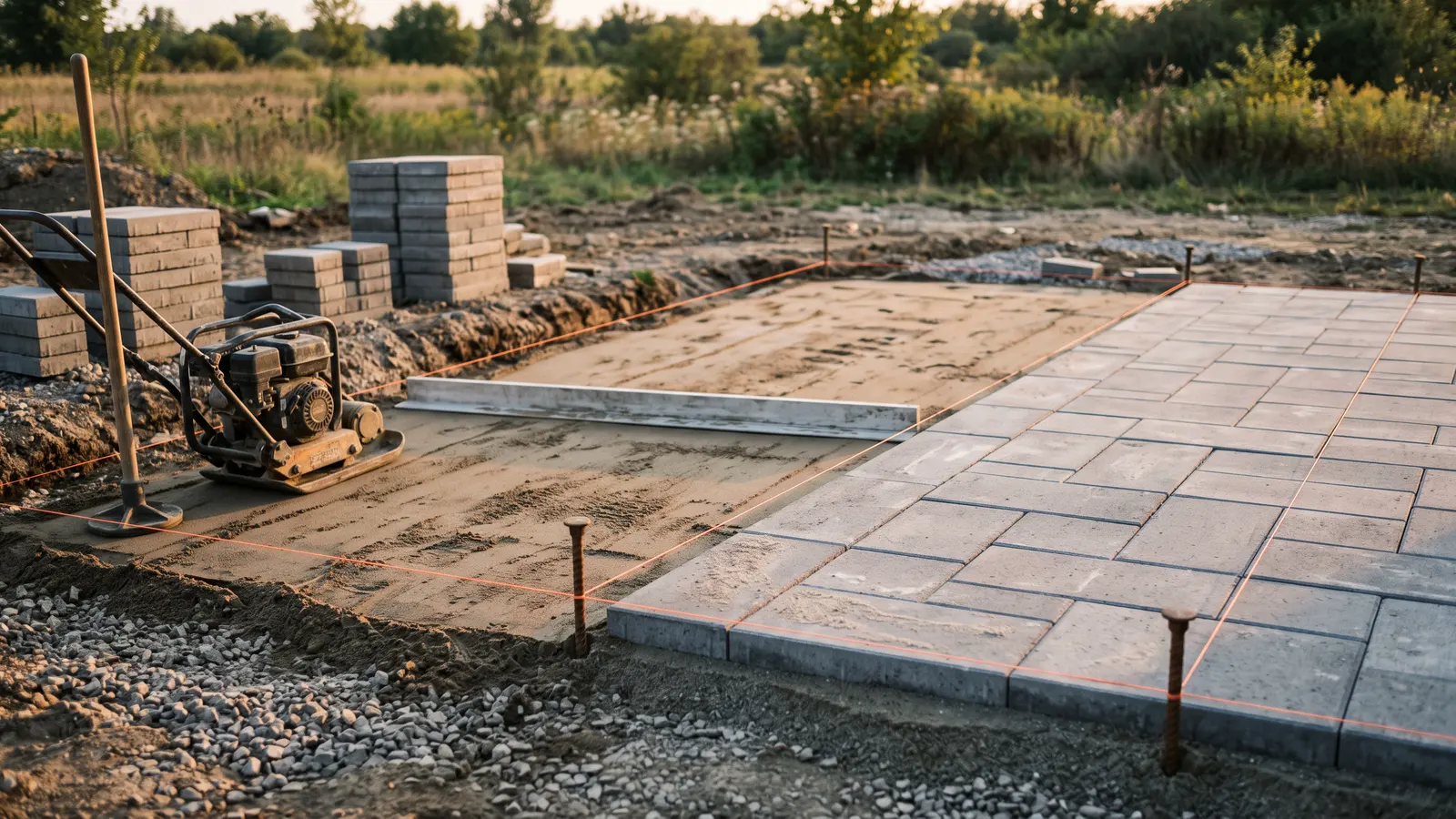
Emmanuel and Shannon built their paver patio themselves during the pandemic, on a bed of gravel and sand they compacted before setting the pavers. It has the look of a job done carefully and the behavior of a job done without a plan for water. Mark McCullough, who opens by admiring the raised beds, pulls one paver and finds sand where sand belongs and dirt where it doesn't. Then he looks behind the patio and finds the rest of the story: the walkway is pitched the wrong way, so runoff travels under and behind the pavers instead of away from them.
What follows is not a re-lay. The pavers come up. The old sand bed comes out. Mark judges the gravel underneath to be in decent shape, gives it a C-plus, and then adds more gravel anyway because the whole patio needs to come up a couple of inches to fix the pitch. That new gravel gets compacted, wetted down, and compacted again. Water helps the particles bind together, which is the kind of small step that separates a base that lasts from a base that migrates.
The grade is where the segment earns its keep. Mark runs string from front to back, sets metal posts to the finished height, adds a dummy paver to establish his reference, and screeds clean sand rail to rail across the whole field. Before any paver goes back down, he squares the layout with the 3-4-5 method, which gives him a true 90-degree corner and lets him run the pavers in two directions and fill in the middle.
Two production details are worth stealing. Mark photographs the existing pattern before a single paver moves, and the crew stacks the 12-by-12s, the eight-inch units, and the six-inch units in separate piles. That's the sorting job that eats an afternoon if you skip it, and it's the reason the rebuild looks orderly on camera.
Shannon runs the plate compactor and Emmanuel works the screed alongside Mark. Emmanuel's line at the end, that it's the same ingredients with a different chef, is a fair summary. He had the right materials and the wrong grade. If you've read the drainage call from earlier this season, where Jenn Nawada spent her time redirecting surface water rather than planting over it, you already know the theme: drainage determination only works when the water has somewhere specific to go. Same question here, just measured in inches of fall across a patio.
Should you attempt it? The paver pattern is the easy part. The base is not. You need a plate compactor, a screed, string lines you trust, and enough patience to tear out work that looks finished so you can fix what's under it. The episode compresses a couple of days into a few minutes, and every one of those compressed minutes is lifting.
Nathan Gilbert's Ladder Inventory: Fiberglass, Aluminum, and the Setup That Decides Everything
Nathan Gilbert brought what Kevin O'Connor calls the ladder store, and the first useful fact is an absence: no wood. Wood ladders stopped being manufactured a few years back, though Nathan says serviceable ones can stay in rotation. What's left is fiberglass and aluminum, and the choice comes down to conductivity and weight.
Fiberglass doesn't conduct electricity, which is why electricians favor it and why Nathan uses it for siding work where a service drop may be running down the side of the house. Aluminum is lighter, and painters like it for exactly that reason. The tradeoff is the one you'd expect, and Kevin's framing of fiberglass as an abundance of caution is about right.
The labels on the side of a ladder matter more than most shoppers realize. Nathan points out the duty ratings, a 300-pound ladder versus a 225-pound one, and the type designations that tell you whether you're looking at a lighter-duty unit. Homeowners buying a ladder for gutters and paint don't need the heaviest rating in the aisle, but they do need to read what they're buying instead of grabbing the one that feels sturdy.
The walkthrough covers step ladders, a 6-foot A-frame that lives in Nathan's truck, a 10-footer that doesn't come out often, multi-position ladders that articulate for stairs and chandelier work, and extension ladders at 24 and 28 feet. Then come the accessories, and this is where the segment is genuinely useful. A stabilizer on an extension ladder makes window work and gutter cleaning feel much more secure. Built-in levelers on both legs handle grade that tapers away from the house. One ladder has a cable assist that takes roughly half the effort out of raising and lowering it, plus a transport strap and a side lock so it doesn't telescope on the roof of a truck. Add-on gear includes ladder jacks that clamp over the rungs to hold a plank, rubber bumpers for the top of an extension ladder, and a separate leveler you can retrofit onto a ladder you already own.
Setup gets the attention it deserves. Stand at the base and put your palms out; if they land comfortably on the rungs, the distance is about right. You can also sight down the flat spots on the rungs against the grade to check the angle. The feet flip to expose spikes you drive into soil so the ladder can't kick out. And the rule that applies to every ladder in the pile: don't reach out to the side. Move the ladder, or add the accessory that lets you work without stretching. If you want the full context on how this show treats ladder work as a tooling problem rather than a nerve problem, the ladder content pairs naturally with the roof tools discussion from Episode 3.
Heath Eastman Installs a Level 2 EV Charger Without a Service Upgrade
Nadia drives a plug-in hybrid. At work she charges on a Level 2 unit and gets the car topped off without thinking about it. At home she's been using the cord that came with the car, which Heath Eastman identifies as Level 1: a few miles of range per charging hour, with the cord dragged across the garage and around the stairs to reach the car.
Before any parts come out, Heath looks at how she actually uses the garage. The charger goes on a wall away from the door with a cord hook below it, which is the kind of placement decision that determines whether a charger gets used or becomes an obstacle. Then they go to the basement, and this is where the job stops being a homeowner project.
The house is a 2013 build with what Heath reads as 100- or 125-amp service. The main breaker is mounted outside, and the panel looks full. Heath shuts the main off, installs a lockout device so nobody can flip it back on, tags it to warn the household, and then verifies the feed is dead with a noncontact tester and again with a meter. He says plainly that noncontact testers aren't foolproof and the label on the outside breaker can be wrong. That double check is the part of this segment worth rewinding.
Inside the panel, the manufacturer's tag reads 30 spaces and 40 circuits, which means tandem breakers are permitted. That's the difference between adding a charger and adding a subpanel. Heath rearranges a few existing breakers to open up a slot, then installs the Level 2 charger along with an energy-monitoring kit. Current transformers in the panel watch how much power the house is drawing; if the total climbs too high, the system cycles the charger off and turns it back on when the load drops. That's how Nadia gets Level 2 charging without paying to upgrade the service, and it's a load-management approach rather than a bigger pipe.
Two more choices stand out. Heath wires a receptacle and plugs the charger into it instead of hardwiring, so Nadia can swap chargers later by unplugging, unmounting, and plugging in a new one. And he runs MC cable because of the physical protection it provides in a garage wall. On the install itself, Nadia uses a magnet to find a stud rather than relying on wall anchors, the charger lands about four feet up, and Heath measures 108 inches from the corner in the basement plus wall thickness, then drills up from below to confirm the cavity is clear before cutting the garage side and creating a patch job.
The app that comes with the system gives Nadia control over charging behavior, but the app isn't the story. The story is that a 2013 house with a full panel got faster home charging without a service upgrade, and that outcome depended on reading a panel label, verifying a remote shutoff, and installing monitoring equipment most homeowners have never heard of.
DIY Confidence Scale
Paver patio: 3/5. Laying the pattern is approachable. Removing and rebuilding the base, wetting and recompacting gravel, screeding sand to a consistent grade, and squaring with 3-4-5 is where homeowner patios fail the first time. Rent the compactor, buy the string, and expect the prep to take longer than the pavers.
Ladders: 2/5 to buy and set up, 4/5 to work from at height. Reading a duty label and checking base distance is easy. Doing siding or gutter work 20 feet up without reaching sideways is a skill that takes repetition, and the accessories Nathan shows are cheaper than a fall.
EV charger: hire it out. Lockout at a remote main, panel capacity, tandem breakers, current transformers, and protected cable in a garage wall. This is an electrician's job, and the load-management kit is the reason it may not need to be a service upgrade too.
Additional Resources
Mark spent his time on string lines and compactor passes instead of pavers, and Heath spent his on a panel label and a lockout device instead of the charger. Both jobs look finished in the last two minutes of the segment, and both were decided in the twenty before it.
From the captions
Spotted on the job
Tools, materials, and techniques the episode actually showed or discussed. Names stay generic unless the episode said a brand. A name links to an Amazon search only when it is something a person could buy.
As an Amazon Associate, This Old Recap earns from qualifying purchases.
Material
DIY-friendly
pavers
Mark and the homeowners peeled up the pavers, stacked them by size, and re-laid them after fixing the base.
Material
DIY-friendly
gravel
Mark brought in more gravel, spread it, and compacted it to raise the patio base.
Material
DIY-friendly
sand
Mark removed the old sand, replaced it with clean sand, and screeded it to the final grade.
Tool
DIY-friendly
compactor
Mark and Shannon ran the compactor over the gravel and sand to make a stable base.
Technique
DIY-friendly
3, 4, 5 method
Mark used the tape to check a 3, 4, 5 triangle so the patio was square before laying pavers.
Tool
DIY-friendly
multi-position ladder
Nathan showed how it can be opened as an A-frame or adjusted for use on stairs.
Tool
DIY-friendly
ladder jack
Nathan slid it over an extension ladder rung and adjusted it to create a level surface for a plank.
Product
Pro-only
level two charger
Heath installed it on a receptacle so Nadia could charge her plug-in hybrid at home.
The weekly recap
Get each new recap in your inbox the week it airs.
One email the week the new episodes are up, with links back to the full write-ups. Confirm once. Unsubscribe any time.
Keep reading
Related recaps
Also uses sand
Ask This Old House · S25 E1
Adobe Bricks, a Miter Trick That Doesn’t Need Caulk, and a Garden Revisited 10 Years Later
Also uses pavers
Ask This Old House · S24 E23
Ask This Old House S24E23: Paver Walkway in Spokane, Lawn Mowing 101, and Zack's Contractor Dating Analogy
Also uses sand
This Old House · S47 E9
This Old House S47 E9: River Sand in Concrete, Soil Testing After a Flood, and Kevin Goes Antiquing
Also about Electrical
Ask This Old House · S25 E2