
Ask This Old House Season 23 Episode 18: Red Pine Fungal Disease, a Lab Report, and a Detroit Home Checklist, or The Mulch Pile Was the First Clue
Lee Gilliam brings in arborist Brandon Maltby to diagnose a red pine that has been browning out for years, and the treatment starts with mulch, fabric, and dead needles before any spray schedule. Nathan Gilbert then walks a first-time Detroit homeowner through a top-to-bottom maintenance checklist, from shingles and gutters to the water shutoff, the gas meter, and a house binder.
Season 23, Episode 18 of Ask This Old House splits its time between a sick red pine and a first-time homeowner in Detroit, and both halves are really about the same thing: nobody can fix anything until somebody identifies what is wrong. Lee Gilliam handles the tree. Nathan Gilbert handles the house. Both spend most of their screen time looking before they touch a tool.
That is a useful pattern to notice, because neither problem here was going to be solved by the obvious purchase.
Two Needles Per Bundle, Two Diseases, One Lab Report
Chris has been fighting this tree for five or six years. Every year it turns orange, drops most of its needles, and then comes back green a couple of months later. He has tried more water. He has tried less water. He tried a basic fungicide and, one year, tomato fertilizer, on the theory that if it worked in the garden it might work on the pine. Most recently he has been driving fertilizer spikes into the ground a couple of times a year.
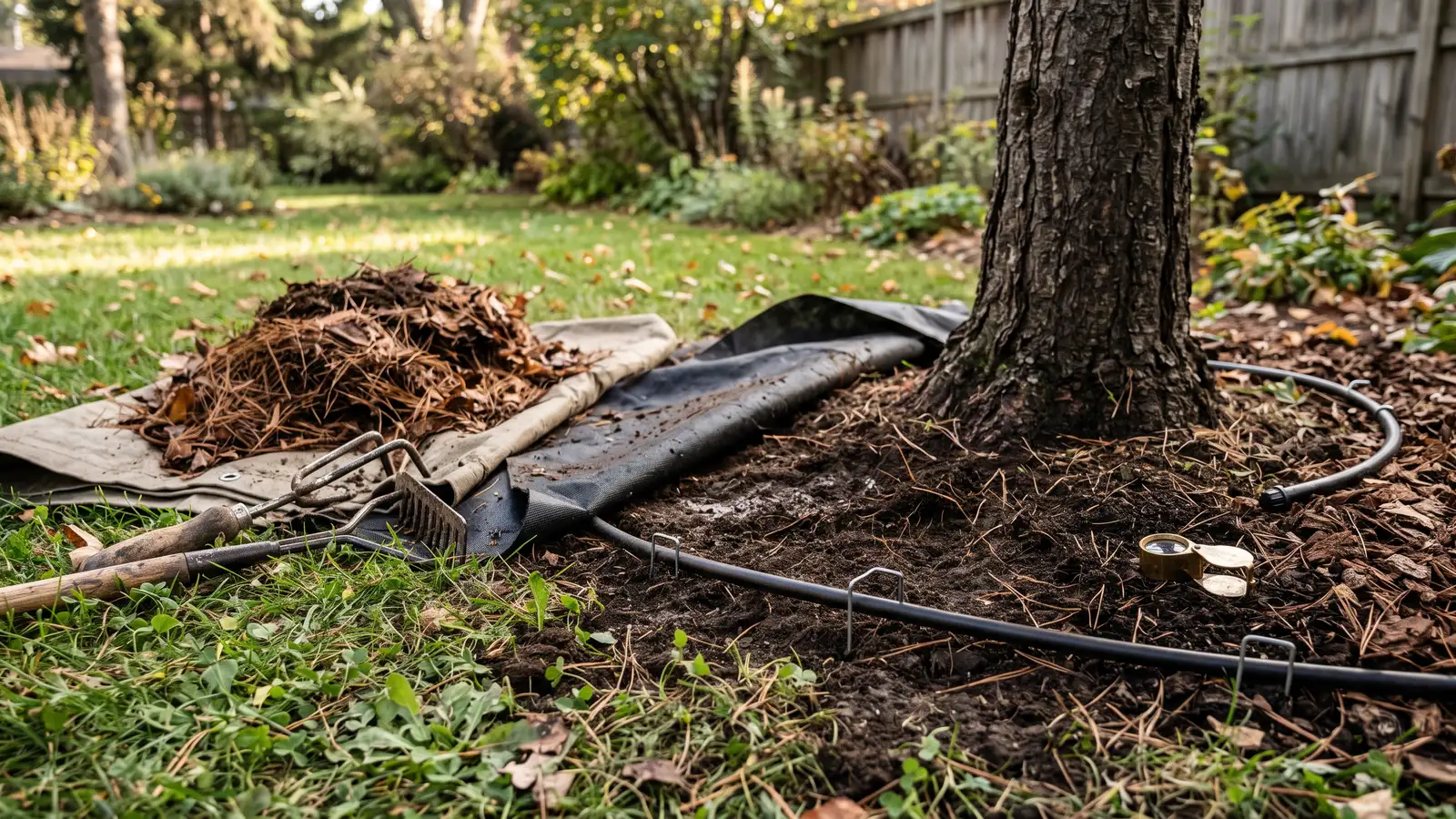
Lee spots two things before anyone opens a reference book: mulch piled high against the base of the trunk, and landscape fabric under the mulch.
Then arborist Brandon Maltby arrives and starts with identification. He counts needles per bundle — pines have two, three, or five, and this one has two, which makes it a red pine. That matters because two-needle conifers are especially susceptible to needle blight and needle cast. Next comes a 10x hand lens, looking for lesions and small black fruiting bodies on the needles. Those black dots are fungal spores. Brandon takes a sample, sends it to a diagnostic lab, and says the answer takes about two weeks.
It comes back with needle blight and needle cast. Not one disease. Two.
The counting trick is genuinely learnable in an afternoon. The diagnosis is not. Brandon can look at a browning needle tip and know what to sample; a homeowner with a hand lens is mostly going to find black dots and guess.
Cleanup Before Chemistry
The advice starts with the stuff Chris could have done himself. Fabric weed barrier is a problem here for a specific reason Brandon explains: weed seeds arrive airborne, so the fabric never really stops them, and it does block water and fertilizer from reaching the root zone. The mulch mounded against the trunk doesn't help either — Lee notes it keeps the base of the tree from breathing.
So the work is unglamorous. Pull the fabric out. Pull the excess mulch back. Rake up as many dead needles as possible. The key instruction is disposal: all of it leaves the property. Not composted, not piled in the back corner. Spores overwinter in dead needles and twigs and will blow right back in.
The fertilizer spikes are the part worth circling. High nitrogen pushes new, tender growth, and that is exactly the tissue a fungus attacks first. Chris has been feeding the problem for about seven years while believing he was helping. Brandon hands the spikes back, and Chris says he will throw them away. Lee described the situation evenly, but you could hear the relief in Chris's voice at having a reason his seven years of effort made things worse instead of just a mystery.
If there is a prior-episode lesson that applies here, it is the one from the Cape Cod outdoor shower in Episode 17, where the visible cedar and bluestone mattered far less than the pitch and gravel under them. Same idea, different kingdom: the mulch and the drip line are what you notice, but the dirty work of removing overwintering spores is what gives the fungicide a chance.
Drip Irrigation and the Root Zone
Lee replaces spray watering with drip tubing. The pipe is pre-drilled, so water weeps out along its length instead of landing on the needles. Given that the fungus needs wet conditions to spread, keeping the foliage dry is not a small detail — it is the point.
The connection method is the satisfying part of the segment. Apply a little heat to the tube, it expands, slide the fitting in, let it cool, and it bonds. No separate coupling required. Tees and 90s work the same way. Lee staples the line down, keeping it at least 10 to 12 inches off the trunk where the root system is active, and notes that staples keep it from becoming a tripping hazard, which matters with kids in the yard.
The mulch goes back on thin — roughly a quarter-inch to half-inch of leaf mulch, organic, and left off the trunk flare. Lee prefers running the drip line on top of the mulch so he can see it working. That is preference, not code. Below the mulch works too.
Before any of this, though, Chris has already tried a fungicide with no result, which is worth mentioning because the order of operations here is the whole lesson. Surface spray on a tree with a mulch volcano and a fabric mat trapping moisture is a wasted afternoon.
The Follow-Up, and Three Diseases Worth Knowing
When Kevin O'Connor and Lee catch up with Brandon later, the pine is showing new growth — just new growth, on the bottom, which is the goal. Brandon recommends continuing the program another two to three years: applications roughly every two weeks in spring as the needles emerge, then once in the fall.
That is the part television compresses. One visit, one spray, and a before-and-after photo implies a fix. What actually happened is a lab report, a multi-year schedule, and a homeowner who now has to keep raking needles.
Brandon also walks through three common diseases:
- Apple scab. Infects apples and crab apples — leaves, fruit, and flowers. The best long-term management is planting a resistant variety. On an existing tree, pruning to thin the canopy improves light and airflow and cuts down leaf wetness in spring.
- Cedar apple rust. Needs both an apple and a cedar to complete its life cycle, which is why removing one of the two host trees eliminates the disease locally. The cedar itself mostly just looks alarming — those orange gelatinous galls are the memorable visual of the segment.
- Beech leaf disease. Caused by a nematode, a microscopic worm that works into the bud and distorts the leaves. There is no cure right now. Management is monitoring and keeping trees as healthy as possible while research catches up.
Nathan Gilbert's Detroit Checklist
Armisha bought her first house and wrote in asking what she should be checking. Nathan's answer is a walk from the roof down, done in the order water would travel.
Roof first. Shingles look good. A few granules in the gutter are normal; a heavy accumulation suggests the shingles are deteriorating and warrants a roofer. He spots one real issue — flashing on the back side of a gutter isn't lapping out over it — and tells her to call a gutter or siding contractor. He also gives the ground-level alternative for anyone who isn't getting on a ladder: check the downspouts. Granules collecting at the discharge point tell the same story.
The siding walk covers brick joints by name — bed joints horizontal, head joints vertical — plus a loose piece of vinyl that snaps back into place and gets secured with a siding nail. Keeping siding tight is pest control, which is the reason to bother.
Attic next: no water damage, no pests, clean insulation, but on the thin side. Nathan mentions upgrading the R-value and points her toward state rebate programs, which he says typically bring the cost well below an open-market retrofit. Chimneys are on his exterior checklist, along with shingles and gutters.
At the windows, one pane is fogged. Nathan explains it plainly: the seal failed, the gas escaped, moisture got in. He defines what a sash actually is, notes that these are double-hung with upper and lower sashes, shows the tilt-wash feature that lets you clean exterior glass from inside, and covers sash stops and sash locks. His tip about keeping the locks engaged when the window isn't in use is the kind of small habit that keeps the middle seal tight.
Downstairs, the electrical panel is labeled, has a main breaker, and includes surge protection. Nathan explains how to identify a circuit and shut it off for a kitchen project, then adds that an electrician will usually handle that. Worth keeping straight: finding the right breaker for an outlet is homeowner work. Opening a panel to do anything but flip a switch is not — that is licensed electrician territory, and the episode's framing supports that.
The water main gets the same treatment. Gate valve, meter, ball valve. Ball valve in line means flow; turn it down and you've cut it off. His advice is to buy or make a big sign that says shut off, so anyone in the house during an emergency knows where to go. The scenario he gives is a failed water heater dumping into the basement.
Gas gets the shortest and best rule of the episode: if you smell it inside, get out, call 911 or the gas company, and let them shut off the meter. He shows the meter outside so she knows what they'll be doing when they arrive.
Then the tool kit — screwdrivers, utility knife, nail set, pry bars, flashlight, silicone lubricant for sliding doors, hammer, water pump pliers, level, tape measure, Allen keys, caulking gun, quarter-inch ratchet set, electrical tester, stud finder, cordless drill and impact driver with bits. And a three-ring binder for the floor plan, contractor contacts, manuals, and a maintenance log for smoke detectors, CO detectors, and filters.
That binder is the least expensive item in the segment and probably the one that saves the most money. Which is exactly the kind of thing that shows up in a tool library, as we saw back in Episode 15's Detroit tool library. Detroit keeps getting the education-and-access segment of this season.
The prep-work theme from Episode 14's wainscoting spray job applies to both halves here. Masking a room and raking out infected needles are not the photogenic parts. They are the parts that decide whether the finish coat or the fungicide does anything.
DIY Confidence Scale
I rate these separately because the tree segment is really two jobs.
- Pine tree cultural work — removing fabric and mulch, raking needles, installing pre-drilled drip line: 3/10. The heat-and-slide fitting is forgiving, staples go by hand, and the main requirement is patience about spacing the line away from the trunk.
- Diagnosing the fungus and running the fungicide program: 1/10 for a homeowner, and it is arborist work by design. Identification, lab sampling, and timed applications during needle elongation are not something to improvise. Tampering with the nitrogen on a tree like this without understanding the disease does active harm.
- The Detroit home checklist: 2/10. Most of it is looking, photographing, and writing things down. The roof and panel opinions are worth having because they tell you when to call a roofer, a gutter contractor, or an electrician. The window, water main, gas meter, and binder portions are pure homeowner education.
Additional Resources
The tree got a two-week lab turnaround and a two-to-three-year spray schedule. The house got a binder and a flashlight. Which of those would you keep up with?
From the captions
Spotted on the job
Tools, materials, and techniques the episode actually showed or discussed. Names stay generic unless the episode said a brand. A name links to an Amazon search only when it is something a person could buy.
As an Amazon Associate, This Old Recap earns from qualifying purchases.
Material
DIY-friendly
fabric paper
Lee removed the fabric paper from around the tree because it blocked water and fertilizer.
Material
DIY-friendly
leaf mulch
Lee installed leaf mulch around the tree after removing the old mulch and fabric paper.
Tool
DIY-friendly
cultivator
Lee used a cultivator to get oxygen into the mulch and help it decay.
Technique
DIY-friendly
drip irrigation
They installed drip irrigation with pre-drilled pipe, fittings, and staples to water the tree.
Product
DIY-friendly
fertilizer spikes
The homeowner had used fertilizer spikes a couple times a year, but the arborist said the high nitrogen could hurt the tree.
Product
Pro-only
fungicide
The arborist used timed fungicide applications in a disease program to protect the tree's new growth.
Tool
Pro-only
hand lens
Brandon used a 10-times hand lens to inspect the pine needles for lesions and fungal fruiting bodies.
Material
DIY-friendly
siding nail
Nathan snapped the vinyl siding back in place and secured it with a siding nail.
The weekly recap
Get each new recap in your inbox the week it airs.
One email the week the new episodes are up, with links back to the full write-ups. Confirm once. Unsubscribe any time.
Keep reading
Related recaps
Also uses drip irrigation
Ask This Old House · S23 E21
Ask This Old House Season 23 Episode 21: Austin Drip Irrigation, PEX vs Copper, and a Stripped Hinge Screw Fix, or A Bigger Screw Only Goes So Far
Also uses leaf mulch
Ask This Old House · S24 E20
Ask This Old House S24E20: Top-Down Shades for a Barking Dog, a Toilet Tank Autopsy, and a Steep Yard That Needed a Swale
Also uses leaf mulch
Ask This Old House · S23 E26