
Ask This Old House Season 23 Episode 21: Austin Drip Irrigation, PEX vs Copper, and a Stripped Hinge Screw Fix, or A Bigger Screw Only Goes So Far
Lee Gilliam helps Kristen add a dedicated drip zone for container plantings in Austin, licensed irrigator Aaron ties into the mainline, Richard Trethewey weighs PEX against copper, and Nathan Gilbert repairs a door hinge with dowels, epoxy, and longer slotted screws.
Season 23, Episode 21 of Ask This Old House is a lesson in adding capacity to systems that already exist. An irrigation controller gets a new zone, a plumbing debate gets a more useful answer than a favorite brand, and a hinge gets its stripped screw holes rebuilt instead of merely ignored. The house calls do not share a trade, but they share a question: what does the existing assembly need before you start attaching things to it?
Austin irrigation: a new zone for containers, not a quick tee-in
Lee Gilliam meets homeowner Kristen in Austin, where plants face triple-digit heat and occasional freezes. She has tried a range of plants, and one that has held on is a tangerine beauty crossvine. She wants privacy along the back fence, and Lee suggests lightweight fiberglass containers that look like concrete. The visual plan is straightforward, but the water plan is the real job.
Kristen asks how water gets to the containers. Lee's answer is a new drip zone, because drip irrigation sends water to the plant instead of spraying it into the air and losing it to evaporation. That matters in Texas. Lee also points out he is not licensed in the state, so Aaron, a licensed irrigator, handles the mainline tie-in and valve work. That division is not a formality. Irrigation mainline work is regulated trade work, and the episode treats it that way.
Aaron uses a tree analogy to explain the system. The meter is the base, the main line is the trunk feeding all valves, a valve location is where a branch begins, the lateral runs past that valve, and the heads and nozzles are the leaves and acorns. Kristen's controller has five zones and room for a sixth. The new zone gets a 40-psi drip kit with a pressure regulator, filter, and solenoid. The regulator and filter protect the drip lines from failed fittings and bubblers, and the solenoid is what the clock tells to open.
Why not just tee drip into the existing spray zone? Aaron calls the principle matched precipitation, and Texas uses that term. Drip and spray heads need different run times. Put them on the same zone and one area drowns while another starves. A separate valve and zone is the clean fix. Austin water restrictions also treat drip as a controlled form of irrigation, which generally makes it less regulated than sprays or rotors, but Aaron still tells Kristen to check local guidelines because restrictions change.
Lee has made this argument before. In the red pine episode, he preferred running drip line on top of mulch so he could see it working. The Austin job extends the same logic to containers and a dedicated zone: keep the water delivery visible, separate, and matched to the plant.
Containers, root flare, and air pockets
Before planting, Lee lines the drainage holes with paper towels. It looks like a small trick, but without it the potting soil washes out the bottom. The containers get lightweight potting soil with nitrogen and phosphate, plus compost. Lee breaks up clumps and packs the soil to remove air pockets. Kristen asks why air pockets matter, and Lee explains that water cannot move into them, so roots can dry out even in a container that gets watered.
The planting details are the difference between a container that survives and one that sulks. The bamboo stake stays in place so the vine has support and does not flop. Lee breaks up the root bump so roots can spread into good soil. He keeps the root flare at the same level it had at the nursery and stays slightly below the container rim. Compost can be top-dressed rather than fully mixed when it is all staying in the pot. Spacers under the containers allow airflow and make it easier to check underneath for mold.
None of this is complicated, but it is also not the same as digging a hole and dropping in a plant. The irrigation system can be perfect and the planting can still fail if drainage, depth, and soil structure are wrong.
Richard Trethewey on PEX vs copper: the honest answer is depends
Kevin O'Connor brings Richard Trethewey a question that fills inboxes: PEX or copper? Richard refuses the binary. Copper is time-proven, rigid, and logical to run through a building with fittings at every turn. It is corrosion-resistant, and modern solder connections no longer contain lead. PEX is cross-linked polyethylene, not a simple plastic. It is flexible like wire, corrosion-resistant, and properly manufactured PEX should last as long as copper and then some.
The flexibility changes the skill set. Copper wants to go this way, then that way, then up and over, with a fitting at each change in direction. PEX comes in coils and can be fished through a building like electrical wire, which means fewer fittings inside walls. Fittings are potential leak points, so fewer of them is a real advantage. Richard notes copper costs more for both pipe and fittings. PEX fittings are often about half the cost, and the connections are faster to make.
The expansion tool demonstration is the part that surprises people who still think PEX belongs only to proprietary pro tools. A sleeve goes on the outside, the tool expands the tubing and sleeve, and the material's memory pulls it back tight. It is solderless. Richard says the manual version now costs about what a torch kit costs and never runs out of gas. That does not make a whole-house repipe a homeowner project, but it does make the tool economics less lopsided than they used to be.
Richard still finds places for copper. Northern urbanized areas have a lot of it. Remodeling often makes it sensible to tie into existing copper. Around a shower valve, copper's rigidity helps secure the valve to the building. He also shows an ice maker box, one of the growing number of accessories that let PEX interface with fixtures and the building. The Cape Cod outdoor shower from Episode 17 used PEX and a licensed plumber for a frost-proof hydrant. That is the pattern: the material is flexible, but the trade work still has rules.
Nathan Gilbert fixes a stripped hinge screw hole
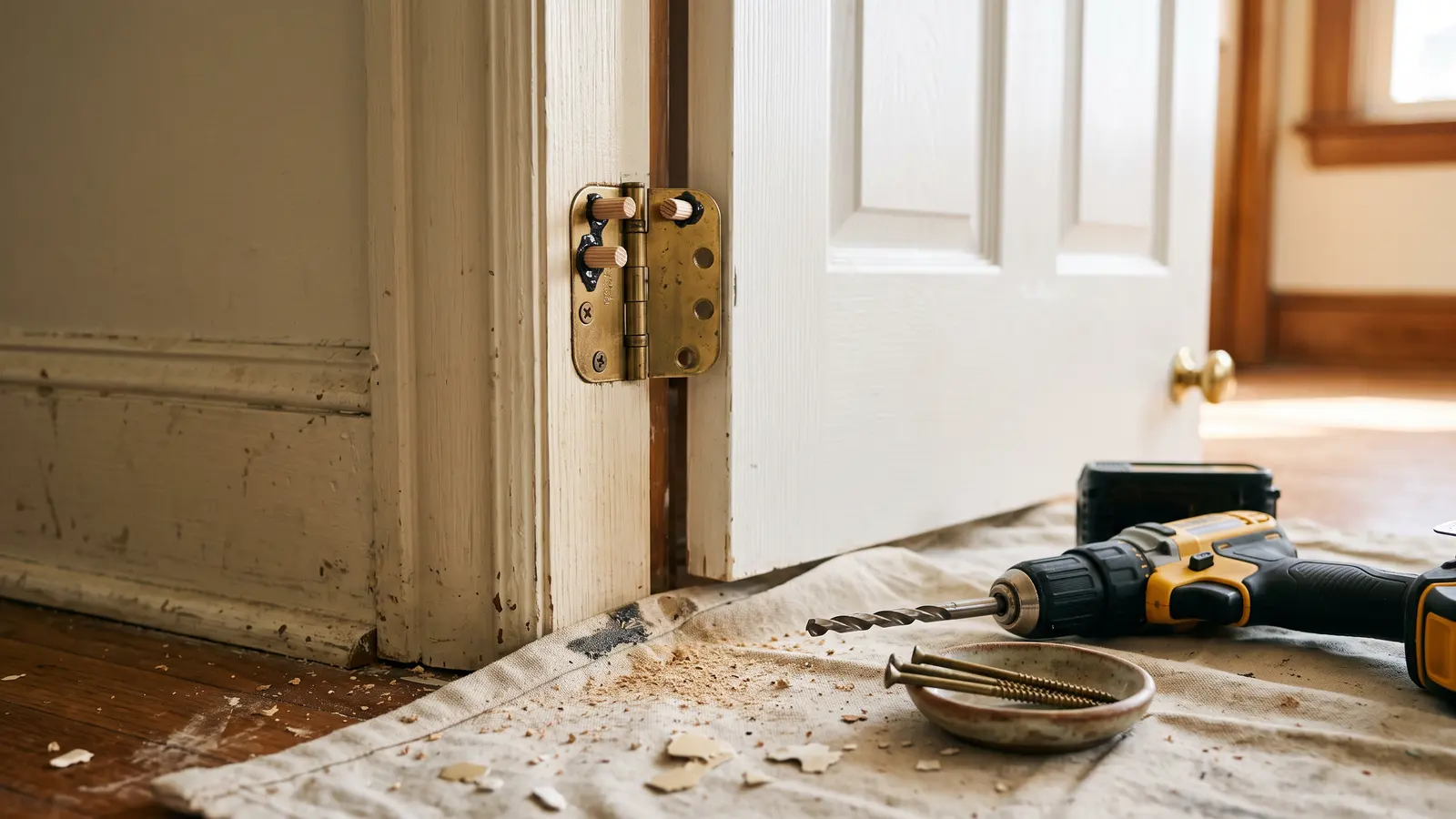
Courtney's door hinge fell on her while she was taking out the trash, which is one of those homeowner stories that sounds funny until you picture the door. Nathan Gilbert identifies the top hinge as the usual first failure because it carries so much of the door's weight and motion. The screw holes in the jamb are stripped.
Nathan lays out three fixes. First, use a longer screw to reach deeper or grab the jack stud, but watch the screw head. A larger screw often has a larger head, and if it protrudes past the hinge leaf it can bind when the door closes and change the alignment. Second, fill the hole. Toothpicks, golf tees, wooden dowels, wood glue, or two-part epoxy can all work. Third, use newer insert kits, including a snap-off insert and a brass threaded insert. The brass insert is rugged, but it needs a pre-drilled hole and a Torx bit, and its smaller supplied screw may not suit older hinges with larger holes.
For Courtney's old door, Nathan combines methods. He drills the screw holes uniform with a 1/4-inch bit, keeping the drill square. He vacuums out the holes, cuts 1-inch dowel pieces, coats them in two-part epoxy, and taps them in. After the epoxy cures, he cuts the dowels flush and sands them level with the mortise.
Then he supports the door with a new construction jack while Courtney watches the hinge leaf fit into its mortise. A self-centering drill bit starts the pilot holes squarely, which matters because freehand drilling can wander when it hits grain. He follows with a bit slightly smaller than the screw, drilling deeper through the jamb and shim space until he feels the jack stud. That is the meat he wants the longer screws to reach.
Nathan switches from 1-inch screws to 2-inch slotted brass screws. He waxes the first several threads to reduce resistance and prevent stripping the slot or breaking the screw. Then he lines up the straight slots in the same direction. The door closes without rubbing, and the repair is both structural and aesthetic. It is a good example of restoration over replacement, though it helps that Nathan has a stash of old brass screws from his grandfather.
What the edit makes look easy
The irrigation segment compresses a licensed irrigator's mainline work, valve installation, controller adjustment, and a future drip line into a short visit. The container planting looks like a casual afternoon, but drainage, soil choice, planting depth, and root flare all affect whether the plants survive Austin's weather. Richard's PEX versus copper answer is not a slogan, because building type, local practice, access, existing material, and fitting count all matter. Hinge repair is forgiving, but not carefree. The wrong screw head can bind, freehand pilot holes can wander, and a stripped old hole needs material added back rather than just a bigger screw.
DIY Confidence Scale
- Austin irrigation add-on: 1/10 for the mainline and valve work. Texas licensing and irrigation mainline tie-ins belong to a licensed irrigator. A homeowner can observe, ask about zones and pressure regulation, and manage the controller.
- Container planting: 3/10. Manageable, but drainage holes, potting soil, root flare, planting depth, and air pockets are the details that decide whether the plants thrive.
- PEX vs copper: 3/10 to understand the trade-offs. Much higher to plumb confidently. PEX expansion is not hard to watch and difficult to master, and a whole-house repipe is not a weekend DIY.
- Stripped hinge screw repair: 5/10 with patience, a self-centering bit, two-part epoxy, and respect for old screw heads. The steps are simple, but alignment and pilot-hole depth matter.
Additional Resources
The drip zone, the PEX decision, and the hinge repair all ask what the existing system needs before you add to it. Which one would you trust yourself to handle, and which one would you call in?
From the captions
Spotted on the job
Tools, materials, and techniques the episode actually showed or discussed. Names stay generic unless the episode said a brand. A name links to an Amazon search only when it is something a person could buy.
As an Amazon Associate, This Old Recap earns from qualifying purchases.
Technique
Pro-only
drip irrigation
Lee proposed adding drip irrigation to containers so water goes directly to the plants instead of spraying and evaporating.
Product
Pro-only
valve
Aaron tied into the main line and added a valve to supply the new drip zone for the planters.
Material
Pro-only
PEX
Richard discussed PEX as flexible cross-linked polyethylene tubing used for plumbing.
Material
Pro-only
copper
Richard compared copper as a rigid, time-proven plumbing material.
Tool
Pro-only
expansion tool
Richard demonstrated a manual expansion tool to expand PEX tubing and a sleeve for a solderless connection.
Material
DIY-friendly
two-part epoxy
Nathan used two-part epoxy to glue wooden dowels into the stripped screw holes in the door jamb.
Material
DIY-friendly
wooden dowel
Nathan inserted wooden dowels coated with two-part epoxy into the drilled-out screw holes to rebuild the jamb.
Tool
DIY-friendly
self-centering drill bit
Amazon search for self-centering drill bit (opens in a new tab)
Nathan used a self-centering drill bit to start pilot holes centered in the hinge holes for the brass screws.
The weekly recap
Get each new recap in your inbox the week it airs.
One email the week the new episodes are up, with links back to the full write-ups. Confirm once. Unsubscribe any time.
Keep reading
Related recaps
Also about Plumbing
This Old House · S47 E2
This Old House S47 E2: Why the Mountains Flooded and the Slow, Muddy Work of Starting Over
Also about Carpentry
Ask This Old House · S24 E8
Ask This Old House Season 24 Episode 8: A Lawn Regrade, Shade-Tolerant Plants, and a Solid-Core Door That Actually Hits Different
Also about Plumbing
This Old House · S48 E3
This Old House S48 E3: Essex County Colonial Bathroom Tile, a Story Pole, and the Beam That Was Cut
Also about Plumbing
This Old House · S47 E24