
Ask This Old House Season 23 Episode 7: Grass Cloth Wallpaper, a Sump Pump, and Sprinkler Heads That Earn Their Keep
Carmen Gonzalez hangs grass cloth on a Miami accent wall, Lee Gilliam sorts pop-up, rotary, drip, and hose-end sprinklers, and Richard Trethewey cuts a submersible sump pump into a wet basement floor. Same question in all three: where do you want the water to go?
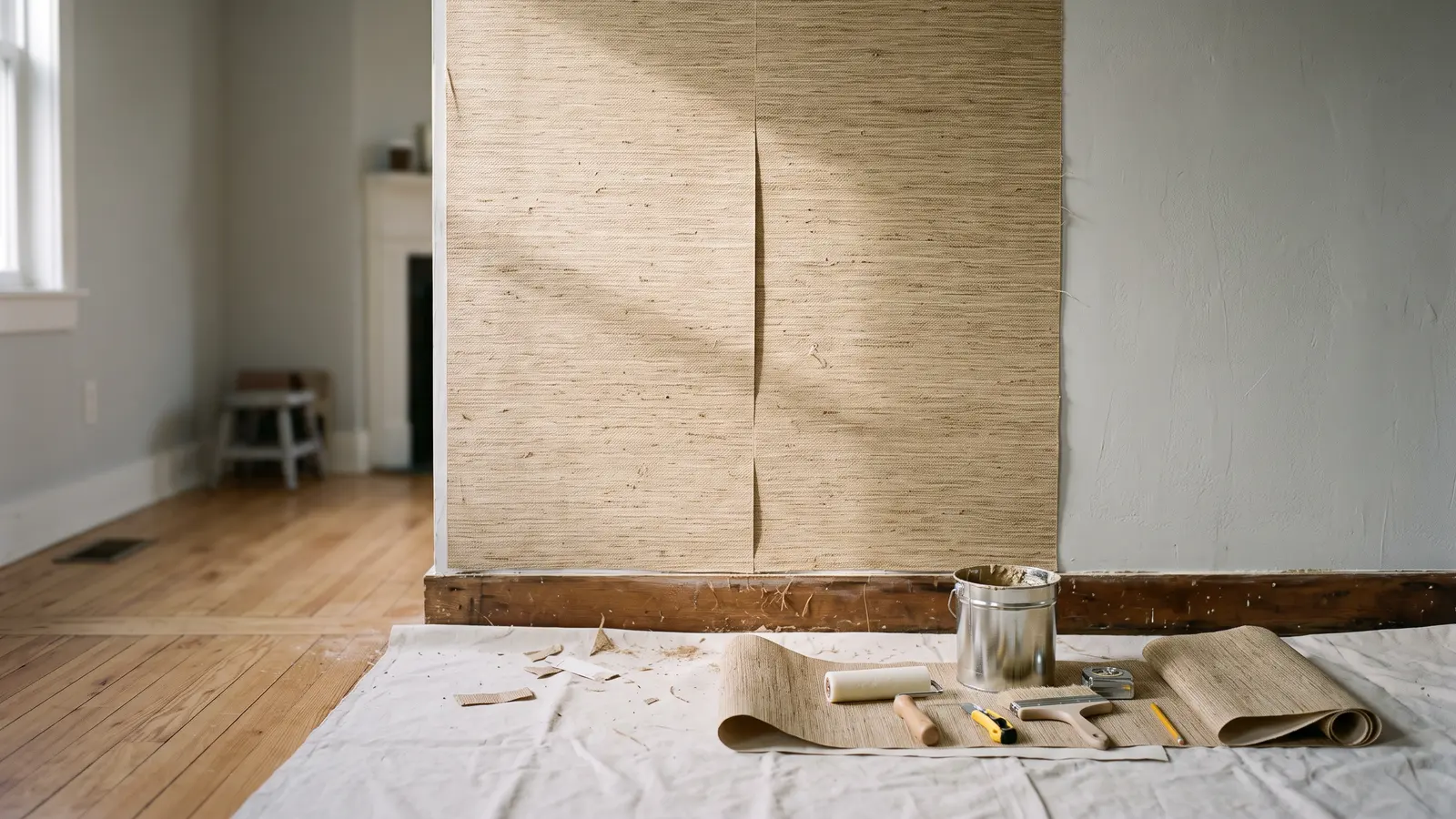
Season 23, Episode 7 of Ask This Old House sends the crew in three directions, and the thread tying them together is water: keeping it off the wall, on the plants, and out of the basement. Carmen Gonzalez hangs grass cloth on a Miami accent wall, Lee Gilliam sorts sprinkler heads by the job each one actually does, and Richard Trethewey cuts a sump basin into a wet basement floor. Three trades, one question. Where do you want the water to go, and what stops it from going somewhere else?
Miami Accent Wall: Grass Cloth, Seams, and a Primer That Isn't Optional
Kevin meets Karline in a neighborhood she describes as cookie-cutter, where exterior changes are limited, so she's personalizing the inside. The room is mostly white and gray, and her earlier attempt at a saturated color reads too subtle to count as a focal point. She wants blue, texture, and a wall that pops.
Carmen opens sample books and narrows the field fast. Grass cloth is the look Karline already researched, but Carmen flags the tradeoff before anyone commits: natural fibers can't be matched from panel to panel, so the seams stay visible. Kevin asks the obvious question, and Carmen confirms it. You are, in effect, buying paneling. Vinyl paper can imitate the look, cleans more easily, and runs roughly half the price, with pattern that carries across the wall so the seams disappear. A cork sample gets the line of the night from Kevin (cork with bling) and a polite pass from Karline.
Carmen also rules out high-humidity rooms. Grass cloth on a kitchen-adjacent wall is fine; a bathroom is not. That's the kind of limitation you want to hear before falling for a sample square, not after the adhesive is mixed.
Layout First: Six Panels, a Center Seam, Glue on the Backing
The prep step is a wallpaper-specific primer, rolled on before anything else. Carmen's explanation is plain: it creates a barrier so the moisture in the adhesive doesn't soak into the wall. Skip it and you're gluing paper to drywall that's drinking the paste.
Kevin measures with a digital tape, roughly 185.3 inches wide by 137 inches high. Carmen calculates six 36-inch strips, with about an inch of extra at top and bottom. She starts with panel 3 at the middle of the wall so the layout stays symmetrical, then works outward in both directions. Kevin asks why the third one goes first, and the answer is the whole point: start at one end and you chase your error across the room.
The adhesive goes on the backing, not the wall, per the manufacturer. Carmen folds the strip glue-to-glue and carries it over, which keeps the paste off the face. Extra gets trimmed at ceiling and floor after the strip is seated. Sewing the seams together is the part that looks effortless on camera and won't be the first time you try it.
Then there's the instruction most recaps skip. Carmen tells Karline to keep the air conditioner running at 70 degrees all day. That's drying time, and it's why a wallpaper job that takes an afternoon to watch is not necessarily an afternoon to do.
Lee Gilliam on Sprinkler Heads: Match the Head to the Zone
The irrigation segment is less about products than about matching hardware to what's growing where. Lee starts with in-ground heads because that's where design decisions actually get made.
A pop-up head that rises above low perennials handles a mixed bed, reaching down past the front row of hostas instead of soaking the mulch. A different pop-up is sized for a narrow lawn strip. The rotary head throws 15 to 20 feet and belongs on turf, not in a border, because that throw will knock the heads off your black-eyed Susans. Kevin frames that as a hypothetical. Lee admits it is not.
Arc control comes from color-coded nozzles: 45 degrees, 90, or 360. The insert pops out and swaps without replacing the whole head, which is the kind of detail that makes a system tunable instead of all-or-nothing. Drip pipe with factory perforations puts water at the plant, but placement matters. Lee runs it off to the side of the trunk so roots chase the moisture outward instead of balling up at the base. The supply line and push-on compression fittings are the unglamorous connective tissue.
The hose-end options are the familiar ones: a small mushroom sprinkler for a courtyard, an aggressive one for lawn distance, and the oscillating sprinkler everyone's grandparents owned. Lee picks one as his favorite because it's easiest to dial in. Kevin does an impression of a sprinkler that is apparently also a dance move. I'll leave that there.
The realistic takeaway: swapping a nozzle is a five-minute job. Designing zones so the right gallonage lands on the right plant at the right pressure is the part that saves your investment. Random heads from a shelf won't produce that.
Richard Trethewey and a Basement That Leaks Every Time It Rains
Jeison has lived in the house a few years, loves the neighborhood, and has a three-year-old who has taken over the place. The plan is to promote her to the basement. The basement, unfortunately, leaks in heavy rain, gathering in one corner and traveling across the floor.
Richard diagnoses before he digs. Downspouts need to be shedding water away from the building. The block foundation has grout lines that can leak. And groundwater can rise under the slab. Jeison already runs a dehumidifier, which he summarizes accurately: Mother Nature always wins.
The pump itself is a submersible with a cast-iron volute, an impeller, and a stainless-steel motor housing built to sit in water for its entire life. The float rises with the water level and trips the switch. Jeison asks the sharp question: what happens when the pump shuts off, doesn't the water just come back?
Richard's answer is the best teaching moment in the episode. The check valve has a flapper that only lets water move one direction. Without it, the column of water falls back, the basin refills, and the pump cycles on and off until the motor burns out. That little fitting is doing more work than the pump's spec sheet.
Installation is not a quick cut. Richard perforates the top third of the basin so water under the floor can enter, wraps it in landscape fabric, sets it in the hole, covers it, and packs gravel between the fabric and the dirt so water gets in without dirt clogging the openings. He's upfront that the hole was not the easiest he'd dug, and the edit compresses the labor considerably.
The front of the house gets fixed too, and it's arguably the more important half. The downspout was dumping roof water right at the foundation. Richard adds a Y fitting that ties the downspout and the sump discharge together and routes both toward the driveway, which keeps the front looking intentional. A sump pump that recirculates water next to the foundation is a very expensive way to stay wet. This connects directly to the wooden gutter work from Episode 1, where a lead dam forced roof water toward the downspout instead of into the end of the gutter. Same principle, different century of house.
And it extends the drainage thread from Episode 6, which dealt with surface water in real storm conditions. Episode 7 moves the fight below grade.
What the Edit Leaves Out
Three things worth naming. First, the sump hole. Richard says plainly it wasn't easy digging, and the episode still makes it look like an afternoon. Breaking a floor, excavating a basin-sized cavity, and backfilling with gravel is a full day of hard physical work before the pump goes in.
Second, wallpaper speed is a function of Carmen's experience. Layout, booking the strips, trimming, and closing seams are skills, not chores. A first-timer should budget for measuring twice, working slowly, and giving the adhesive the full drying window.
Third, the sump segment covers the water path and stops there. Electrical supply for the pump, discharge freeze protection in cold climates, and whatever your local authority requires are all real parts of the job that didn't make the cut. Those belong in a conversation with a licensed plumber or electrician, not in a first-timer's weekend plan.
DIY Confidence Scale
- Wallpaper installation: 6/10. Achievable with patience, a helper, and realistic expectations about seams. Grass cloth's unmatched fibers make it less forgiving than vinyl for a first attempt.
- Sprinkler head and nozzle swaps: 3/10. Pop the insert, match the color code to the arc you need, and press it back in. Zone design is the harder conversation.
- Sump pump installation: 9/10. Digging, breaking floor, basin perforation and fabric wrapping, discharge routing, and power. Watch and learn, then hire.
Additional Resources
The check valve gets maybe thirty seconds of screen time and prevents the entire system from destroying itself. Any other part in a house doing that much work while looking like a short section of pipe?
From the captions
Spotted on the job
Tools, materials, and techniques the episode actually showed or discussed. Names stay generic unless the episode said a brand. A name links to an Amazon search only when it is something a person could buy.
As an Amazon Associate, This Old Recap earns from qualifying purchases.
Tool
DIY-friendly
digital tape measure
Kevin used a digital tape measure to get the wall width and height for the wallpaper panels.
Material
DIY-friendly
special primer for wallpaper
Carmen applied a special primer for wallpaper to create a barrier between the wallpaper and the wall.
Material
DIY-friendly
grass cloth
Karline selected blue grass cloth as the wallpaper for her accent wall.
Material
DIY-friendly
glue
Carmen applied glue to the backing of the wallpaper strips before installation.
Product
DIY-friendly
pop-up heads
Lee showed pop-up heads for perennial beds or narrow lawn strips and explained they rise when the system runs.
Material
DIY-friendly
drip pipe
Lee explained that drip pipe has holes and places water directly on plants and trees without evaporation.
Product
Pro-only
submersible sump pump
Richard installed a submersible sump pump in a basin to pump basement water outside.
Product
Pro-only
check valve
Richard explained that the check valve prevents water from flowing back into the pump when it shuts off.
The weekly recap
Get each new recap in your inbox the week it airs.
One email the week the new episodes are up, with links back to the full write-ups. Confirm once. Unsubscribe any time.
Keep reading
Related recaps
Also about Plumbing
Ask This Old House · S25 E3
Ask This Old House S25E3: PEX Hose Spigot, Cover Crops, and Richard's Cutaway Habit
Also about Plumbing
This Old House · S47 E26
This Old House S47 E26: Walpole Ranch ADU Move-In, Propane Hydro-Air, and a C-130 Homecoming
Also about Plumbing
This Old House · S47 E21
This Old House S47 E21: Walpole Ranch ADU Begins, a 38-Inch Frost Problem, and a Mechanical Room in Exactly the Wrong Place
Also about Plumbing
Ask This Old House · S23 E17