
Ask This Old House Season 23 Episode 1: Bath Accessibility, Wooden Gutters, and the House Peter Wanted to Keep Original
Richard and Nathan install grab bars and a hand shower for Margaret, who wants to stay in her 1890 house. Tom and Nathan replace rotten wooden gutters on Regina's 1882 home, sistering rafter tails, scribing a new gutter profile, and sealing with lead and boiled linseed oil.
Season 23 opens with Nathan Gilbert as the scarcest resource in the workshop. Richard needs him for a bathroom accessibility project, Tom needs him for a wooden gutter replacement, and Kevin offers to help until it becomes clear that Nathan is the only person both jobs actually require. The two house calls look unrelated, but they share a premise: old houses stay usable when someone pays close attention to water, anchoring, and the details that are easy to hide behind finish work.
Margaret's Bathroom: Grab Bars Need More Than a Drill
Margaret lives in an 1890 house she grew up in, and she wants to stay there. Her kitchen was renovated about 20 years ago, and the layout already supports one-level living. The risk zone is the bathroom. Richard and Nathan arrive to make the existing cast-iron tub and shower safer without tearing the room apart.
Nathan brings a 24-inch grab bar and a 36-inch grab bar, but he does not start drilling. He talks through placement first. Vertical bars help with the transition in and out of a tub. Horizontal bars give you steadying real estate while you are standing in the shower. Diagonal bars can help you lower yourself into a tub. Margaret says she takes more showers than baths, so the plan follows her habits instead of a generic installation diagram.
The anchoring matters as much as the bar. Nathan would rather hit studs. If the wall cavity is hollow, he does not want to rely on a soft toggle bolt that can rust or pull loose. The episode shows a manufacturer's anchoring system designed for the grab bars: drill a 1 1/4-inch hole, insert a piece that flips and ratchets against the back of the wall, add a plate, and use a machine screw to sandwich the wall. Nathan says the system is ADA-compliant and rated for up to 300 pounds of pull weight. That number is not a substitute for proper placement, but it explains why this is not the moment to improvise with whatever anchor is rolling around in a coffee can.
Nathan also cites ADA guidance of 33 to 36 inches off the floor or tub base, then checks the height with Margaret. She initially thinks the horizontal bar should sit on the second course of tile, then decides she wants it a little lower. Nathan adjusts. A grab bar at the wrong height is still a bad grab bar, even if the anchor could hold a small horse.
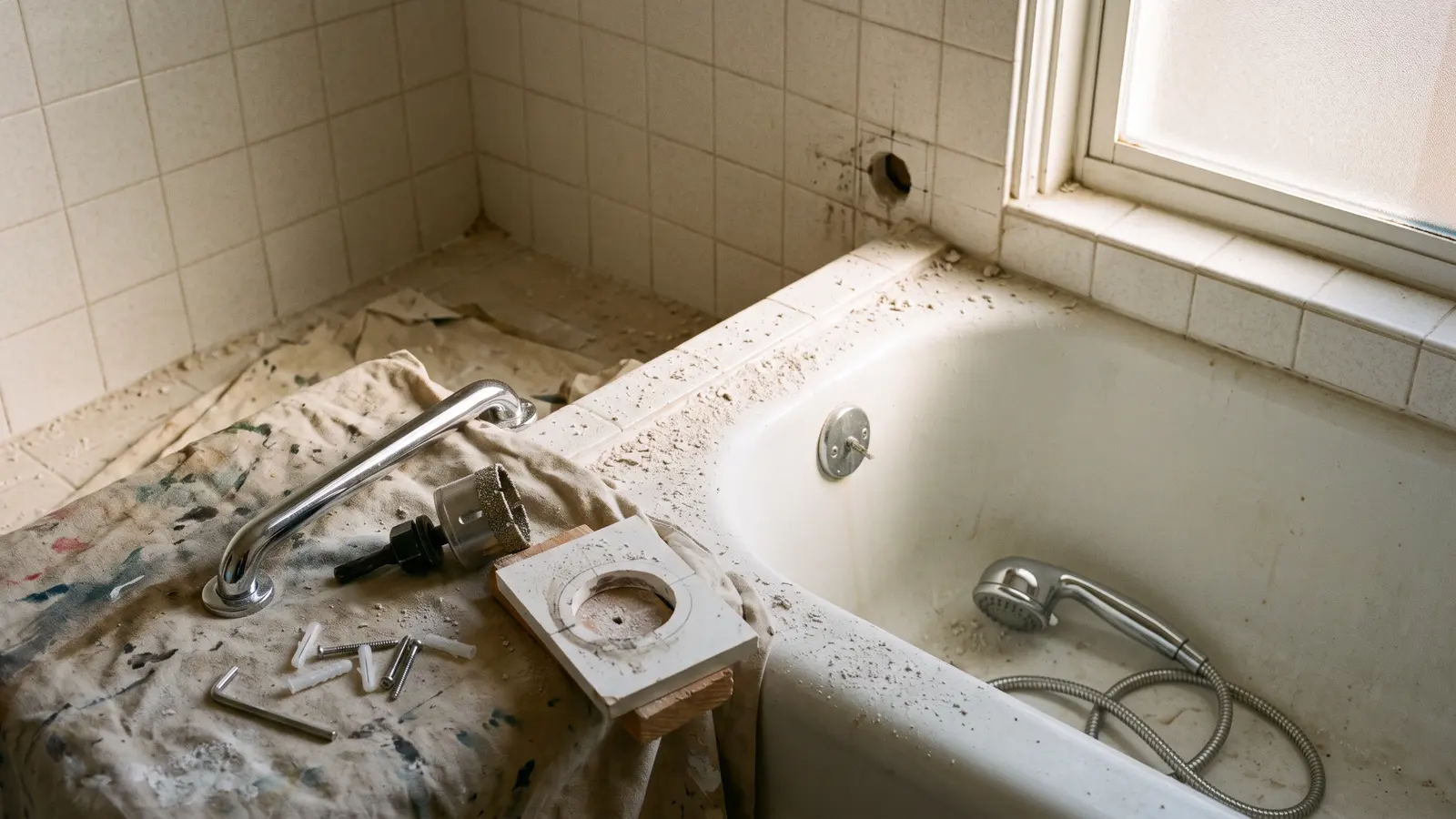
Drilling into finished tile is where a simple job can go sideways. Nathan makes a jig from PVC with a 1 1/4-inch hole cut out, sticks it to the tile, and uses it to guide a diamond-tipped hole saw. The jig keeps the bit from walking across the glaze. He also wants the hole centered on a solid tile, not on a joint. That is the kind of preparation the show compresses into a few seconds, but it is most of the reason the finished installation looks clean.
Richard handles the hand shower. He attaches it to the existing shower arm and base, so Margaret gets a new shower head plus a hand spray with a selector. It is not a remodel, and Richard says as much. It is an affordable way to make the existing tub safer and more flexible. For someone aging in place, that combination of grab bars and a hand shower can matter more than a cosmetic bathroom overhaul.
Regina's Wooden Gutter: Authenticity Has a Maintenance Bill
Tom Silva goes to Regina's 1882 house to look at wooden gutters that have been leaking. Regina's late husband, Peter, wanted to keep the house original. A contractor had proposed aluminum gutters, but Peter wanted wood. After Peter died, Regina kept asking around for someone who would replace the wooden gutter. When she could not find anyone, she emailed Ask This Old House. Tom had already visited months earlier and told her the work could not happen in cold weather. He waited out the winter, then came back to assess the rot.
Tom notes that wooden gutters are hard to find tradespeople for today. He also knows the material from experience: years ago, he and his brothers had a gutter machine and rolled aluminum gutters. Aluminum did not need painting or much maintenance, which is exactly why people liked it. Wooden gutters require more attention. They need to be oiled at least once a year and cleaned. That maintenance is the price of keeping the original detail.
Nathan and his father, Bill, are already on site. Nathan reports that an old repair is failing and the ends of the gutter are punky and soft. The gutter needs to come down. What follows is not a simple swap. The gutter sits on the face of the rafter ends, with a small fascia board underneath and two pieces of fascia above it. Tom traces the old profile onto bendable paper so he can transfer it to the new wood. He has to match the outside miter, the ogee, and the corner where the gutter dies into the fascia and rake trim. He marks two points with a straightedge, cuts the profile, then fine-tunes with sanding and rasping. This is custom carpentry, not a parts-counter transaction.
On the back side, Nathan finds a heavy nail on each rafter tail. He pulls them so the old gutter can come off. He also removes a large piece of lead that had been formed into a dam in the corner. The lead dam stopped water from running into the end of the gutter and forced it back toward the downspout. That detail is easy to miss when you are looking at a leak from the ground.
Four rafter tails are iffy. They are not bad enough to cut out, but Tom wants to sister pieces beside them so the new gutter and fascia have solid nailing. The roof has a 12 pitch, so Tom sets his square to 12 and marks the angle. He cuts the sisters about 6 1/2 inches long. The new fascia is a 1x12 exterior-grade board that comes primed. Tom cuts a 45-degree angle and primes the cut end before installation. He also uses a template to scribe the transition where the gable end meets the gutter, then makes a rough cut and fits it tight.
Nathan drills the hole for the 2 1/8-inch drop. The measurement is 15 1/4 inches back off the long point, then 2 inches back because the gutter is 4 inches wide. Tom puts tar in the hole before sliding the gooseneck in, then screws it down. He uses a sheet of lead over a high spot so water rolls back toward the downspout instead of sitting against the wood. The gutter-to-fascia joint along the top gets sealed with acrylic caulking. Finally, the inside of the gutter gets a coat of boiled linseed oil.
This is water management in old-house clothing. The same principle showed up in the drainage project from Season 23 Episode 6, where the point was not just to talk about drainage but to see a solution handle actual storm water. Here, the water is coming off the roof, and the enemy is the fascia, the rafter tails, and the corner where a small leak can rot a lot of wood.
Tom leaves the staging up for the painter. That is a practical handoff, and it admits what the episode cannot show: the exterior finish still has to happen. The crew primed what they could reach, including surfaces that would be nearly impossible to prime later. The painter gets a safer, easier setup. Regina gets a wooden gutter that matches the house, along with a maintenance instruction she cannot ignore.
That priming step connects to the mudroom cubbies project from Season 23 Episode 26, where preparation and primer were not glamorous but did the real work. Tom's fascia board arrives primed, and he primes the cut ends before installation. No finish carpenter gets excited about that step. It still decides how long the repair lasts.
What the Edit Skips
The grab bar segment makes the job look like measuring, drilling, and snapping on covers. The tense part is choosing the location and finding an anchor that will not fail when someone actually leans on the bar. If you miss a stud and use the wrong hollow-wall anchor, you may not find out until the bar pulls out of the tile.
The gutter segment makes custom woodwork look linear. Tom traces a profile, cuts it, and it fits. In reality, old houses are not square, rafter tails are often soft, and the corner transitions take repeated fitting. The show also skips the painting, which is a full phase of the project, and the annual oiling that keeps the gutter alive.
What the episode does not do is pretend this is a cheap permanent fix. The bathroom work is targeted accessibility, not a remodel. The gutter work is high-skill exterior repair with ongoing maintenance. Both are reasonable choices for an old house if you understand what you are signing up for.
DIY Confidence Scale
- Grab bar installation: 5/10. Doable if you can find solid anchoring, drill tile without cracking it, and follow a tested system. If you cannot locate framing or you are guessing at anchors, stop.
- Hand shower swap: 3/10. This is a straightforward plumbing fixture change on an existing shower arm, but you still need to check for leaks and avoid cross-threading.
- Wooden gutter replacement: 9/10. Historic profile work, rotted rafter tails, lead detailing, staging, and exterior priming push this well past a weekend repair. Call someone who has actually worked on wooden gutters.
Additional Resources
The real question is not whether you can install a grab bar or oil a gutter. It is whether you are willing to plan the anchoring, prep the wood, and keep up the maintenance that old-house authenticity quietly demands.
From the captions
Spotted on the job
Tools, materials, and techniques the episode actually showed or discussed. Names stay generic unless the episode said a brand. A name links to an Amazon search only when it is something a person could buy.
As an Amazon Associate, This Old Recap earns from qualifying purchases.
Product
DIY-friendly
grab bar
Nathan installed 24-inch and 36-inch grab bars on the shower walls to give Margaret stability and prevent falls while aging in place.
Product
DIY-friendly
anchoring system
Nathan used a wall anchoring system with a plate and machine screw to secure the grab bars when the holes landed in a wall cavity instead of a stud.
Product
DIY-friendly
hand shower
Richard attached a hand shower to the existing shower head arm so Margaret can use the spray lower.
Tool
DIY-friendly
diamond-tipped hole saw bit
Nathan used a diamond-tipped hole saw bit with a PVC jig to drill a clean 1 1/4-inch hole in the tile for the grab bar anchor.
Product
Pro-only
wooden gutter
Tom and Nathan replaced the leaking wooden gutter on an 1882 house to keep the home original.
Material
Pro-only
fascia board
They installed primed exterior-grade 1x12 fascia board around the gutter and primed its cut ends.
Technique
Pro-only
sister a piece
Tom sistered pieces beside four iffy rafter tails to provide solid nailing for the new gutter and fascia.
Material
DIY-friendly
boiled linseed oil
Tom applied a coat of boiled linseed oil to protect the inside of the new wooden gutter.
The weekly recap
Get each new recap in your inbox the week it airs.
One email the week the new episodes are up, with links back to the full write-ups. Confirm once. Unsubscribe any time.
Keep reading
Related recaps
Also about Historic Homes
Project note
Where Are They Now? Six More This Old House Project Houses, From the 1979 Original to a $29,100 Detroit Rescue

Also about Historic Homes
Project note
Where Are They Now? Six This Old House Properties That'll Make You Rethink Your Weekend Projects
Also about Carpentry
This Old House · S48 E3