
This Old House S47 E9: River Sand in Concrete, Soil Testing After a Flood, and Kevin Goes Antiquing
A nonprofit workshop pours a vanity top with sand from the Swannanoa River, Jenn sends soil samples to the lab, and Kevin finds out that antiquing after a hurricane has a whole different vibe.
Back From the Break
After a holiday hiatus that felt longer than the usual between-episode week, we're back in Western North Carolina with three episodes left in the Carolina Comeback. The rebuilds are visibly approaching the finish line, and Episode 9 gives us a mix of practical finishing work, environmental science, and the kind of meaningful community segment that makes this season special.
Kevin Goes Antiquing (With Purpose)
Kevin meets homeowner Miah at the Antique Tobacco Barn — a local institution that was itself affected by the storm. This is a nice callback to Miah's story from Episode 1: she's a fourth-generation resident who wants to honor her grandparents in the rebuild. Finding the right kitchen table isn't just furniture shopping — it's restoration in the deeper sense.
The Antique Tobacco Barn segment also highlights something important about disaster recovery: it's not just houses that need rebuilding. Local businesses, cultural landmarks, and community gathering places all took hits, and their recovery is intertwined with the residential rebuilds. When Miah buys a table from a local shop that's also bouncing back, that's the circular economy of recovery in action.
Post-Flood Soil Testing
Jenn Nawada does something I've been waiting for since Episode 1: she addresses the soil. When a river floods your yard, it doesn't just bring water — it brings silt, sediment, and potentially contaminants from upstream. Sewage systems overflow, fuel tanks rupture, agricultural runoff mixes in. What's left behind could contain heavy metals, pathogens, or chemicals that make gardening unsafe.
Jenn meets with soil scientist Alison Arnold to collect samples from Jim and Allie's front yard, then travels to the UMass Extension soil testing lab in Massachusetts to see how the analysis works. It's a surprisingly interesting segment — watching soil being tested for pH, nutrient levels, and contaminants is the kind of nerdy content this show does better than anyone.
The results? We won't spoil everything, but Jenn returns to deliver the news to Jim and Allie in person. The takeaway for anyone in a post-flood situation: test your soil before you plant anything edible. State extension services (available in every US state through the land-grant university system) offer affordable soil testing, usually $15-30. It's one of the best investments you can make after a flood.
Making Whole: The Vanity Top Segment You Didn't Expect to Love
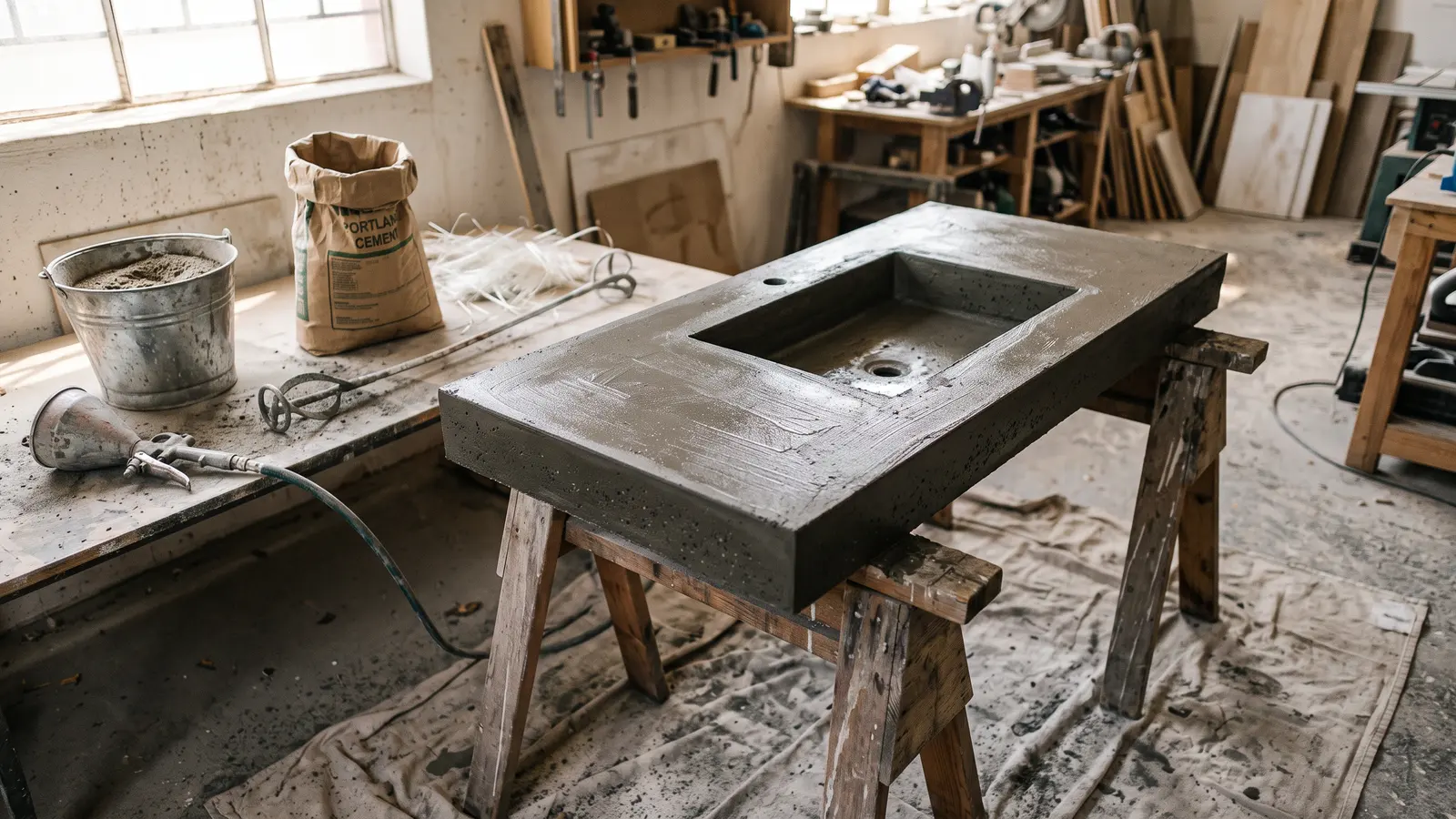
Kevin visits Making Whole, a custom furniture shop run by Jeremy French with a program that helps men in recovery rebuild their lives through hands-on apprenticeships. The shop is crafting a concrete vanity top for Paula — the same Paula whose antique chest became a vanity base back in Episode 6 thanks to Tom's template work.
Here's the detail that elevates this from a nice segment to a perfect one: mixed into the concrete is sand from the Swannanoa River — the same river that flooded Paula's house. The water that destroyed her home is, in aggregate form, now part of her bathroom vanity. If that's not poetry in concrete, I don't know what is.
Concrete vanity tops are an increasingly popular alternative to stone. They're fully customizable (any shape, any color, any aggregate), can be cast with integrated sinks, and have an industrial-meets-organic aesthetic that works in both modern and traditional bathrooms. The trade-offs: they need periodic sealing, they can develop hairline cracks (which some people consider character), and they're heavy. But when your vanity top literally contains a piece of your local river, the trade-offs seem pretty minor.
The French Broad River
Zack Dettmore takes a canoe ride on the French Broad River with Gordon Grant, who explains the environmental damage from the flooding and the steps needed to protect the land going forward. This is the broader ecological context that individual house rebuilds exist within: riverbanks eroded, habitats disrupted, and sediment patterns changed. Recovery isn't just about structures — it's about the landscape itself.
DIY Confidence Scale: Episode 9
- Soil testing: Beginner-Friendly. Collect samples per your state extension's instructions, mail them in, get results. This is one of the most accessible and valuable DIY tasks in this entire season.
- Concrete vanity top: Advanced DIY. Possible with GFRC (glass fiber reinforced concrete) kits, but the mixing, pouring, finishing, and sealing require practice. Your first attempt will teach you a lot. Your second will look good. Making Whole makes it look easy because they've done hundreds.
- Antiquing: Expert-level. Kevin seems like a natural.
Additional Resources
- This Old House — S47 E9 Official Page
- Watch Episode 9 on PBS
- Making Whole (custom furniture / recovery program)
- Antique Tobacco Barn
- UMass Extension (soil testing)
Next time: landscaping takes center stage, Kevin visits the carpet capital of the world in Georgia, and Miah gets her butcher block countertop. Remember when we worried about the soil? Episode 10 shows us what grew. Two episodes to go.
The weekly recap
Get each new recap the day it's posted.
Get each new This Old House and Ask This Old House recap by email, the day it's posted. No spam, unsubscribe anytime.
From the captions
Spotted on the job
Tools, materials, and techniques the episode actually showed or discussed. Names stay generic unless the episode said a brand. A name links to an Amazon search only when it is something a person could buy.
As an Amazon Associate, This Old Recap earns from qualifying purchases.
Tool
DIY-friendly
soil probe
Amazon search for soil probe (opens in a new tab)
Alison inserted the soil probe 4 to 6 inches into the soil to collect samples.
Tool
DIY-friendly
clean bucket
Alison used a clean bucket to collect the combined soil samples.
Technique
DIY-friendly
soil testing
Jenn and Alison used soil testing to establish a baseline after flooding and guide amendments.
Product
Pro-only
concrete vanity with an integral sink
Jeremy and Kevin built a concrete vanity with an integral sink for Paula's main bathroom.
Tool
Pro-only
hopper gun
Amazon search for hopper gun (opens in a new tab)
Jeremy used a hopper gun to spray the finer concrete mix over the sink without slumping.
Material
DIY-friendly
cement
Jeremy's blend used cement with sand as the aggregate for the concrete countertop.
Material
DIY-friendly
sand
Jeremy added sand from the river by Paula's house to the countertop mixes.
Material
Pro-only
glass fiber
Jeremy used glass fiber reinforcement to give the thin concrete slab tensile strength.
Keep reading
Related recaps
Also from the Carolina Comeback
This Old House · S47 E11
This Old House S47 E11: Five Families Come Home — The Carolina Comeback Finale
Also from the Carolina Comeback
This Old House · S47 E7
This Old House S47 E7: Boulder Retaining Walls, Door Staining 101, and Biltmore Village's Comeback
Also about Interior
This Old House · S47 E15
This Old House S47 E15: Round Ducts Win, Spray Foam Goes In, and Tom's Window Flashing Masterclass
Also about Masonry
Ask This Old House · S25 E1