
Ask This Old House S25E4: Sticking Front Door, Insulation, and Thermostats
Ross Trethewey compares six kinds of insulation, Richard and Ross look back at 25 years of thermostats, and Nathan Gilbert rebuilds the hinges, lock, and sweep on an 1890 front door a kick could open.
Season 25, episode 4 of Ask This Old House stays in the shop for two segments and then goes to one house. Kevin O'Connor, Richard Trethewey, and Ross Trethewey look back at how the thermostat changed. Ross walks six insulation materials and what each one is for. Carpenter Nathan Gilbert finishes the hour at an 1890 house, where a front door that would not stay locked gets new hinges, a new mortise lock, and a new sweep. PBS titles the episode "Sticking Front Door; Insulation," dates it October 22, 2026, and lists a runtime of 23 minutes and 42 seconds. WGBH lists the same episode for October 21.
Twenty-five years of the thing on the wall
Kevin says the questions about heating and cooling have stayed put while the answers have moved. The oldest thermostat on the bench is the one Richard calls Old Faithful, a bulb with mercury in it. Before that, Richard says, you went to the basement and shoveled coal or threw on wood. Most of what they find now is digital: an up-and-down button, then a touchscreen where the remaining job is programming the time. He holds up a manual and says it is no harder than a VCR. The man beside him says his VCR has been flashing 12:00 since he got it.
Richard's next step is a Wi-Fi thermostat that might learn how you live in the building, with a motion sensor and a smartphone connection. Ross dates that generation at 10 years ago. The newest units talk to separate sensors, and many use geofencing, so the phone's GPS knows how far you are from the house. Asked where this goes, Ross says the thermostat itself might disappear, with control on a phone, a tablet, or a voice assistant. Kevin asks what the three of them will talk about if it does. Richard says 7 out of 10 Americans hate their heating system. Kevin bargains the number down on camera. The heating system is still the subject.
John in Flemington still does not have a number
The letter is from John in Flemington, New Jersey, written about seven or eight years ago. He asked for the perfect thermostat temperature. Kevin's joke answer is 68 for himself and 72 for his wife. Richard asks whether it is summer or winter. Ross asks whether the system is forced air or hydronic. John did not say, and they never pick a setpoint. Richard says the question always opens a longer conversation than the writer wanted. The episode page frames the segment as that 25-season look back, from bulb-style thermostats to Wi-Fi models. Other heating episodes are on the HVAC topic page.
Six materials, and what the word insulation is hiding
Still at the shop, Ross has a mock-up of each material. The episode page lists six: fiberglass, mineral wool, wood fiber, cellulose, closed-cell spray foam, and open-cell spray foam. Drywall, framing lumber, and plywood, that page says, do relatively little on their own. Filling the bays slows heat transfer. Some of these materials also slow air and control moisture.
- Fiberglass. Glass fiber, often recycled glass that has been melted and spun. He says it has been used for a long time. Later he calls it the lowest cost and the one a homeowner can install.
- Cellulose. Ground-up newspaper or cardboard, typically blown or sprayed into a wall cavity.
- Open-cell and closed-cell spray foam. Both are a two-part liquid, a type A and a type B, that meet at the nozzle, make heat, and expand into the joist bay. Kevin says they work differently, and they come back to that.
- Wood fiber. Relatively new in the United States, and used in Europe for many years. Ground-up wood chips, usually leftover from a lumber mill, made as a batt, a blown-in, or an exterior grade. The episode page says this sample was donated by TimberHP, which it describes as the first company to manufacture wood fiber insulation in the United States, using residual softwood chips from logging and lumberyards.
- Mineral wool. Rock, melted and spun into fiber. Kevin introduces it as the other batt, the one that has been around longer than wood fiber.
R-value, air, and the ridge that condenses
Ross defines R-value as the resistance to heat flow, and he talks about it per inch. Most of the materials on the bench, he says, land about the same, anywhere from 3 to 4 per inch. The exception is closed-cell, about 6 to 7, roughly twice the others. If the wall cavity is small and you want the most R-value per inch, he starts with closed-cell.
Air is the next control. Houses get drafty, and wind moves through walls. Ross points at two of the products and says both do very well at stopping airflow once they are thicker. He gives the thicknesses as 4 or 5 inches for one and 2 inches for the other. The caption track does not name which sample is which, so this recap will not assign those depths. He does say that one of them starts vapor control.
Vapor, as Kevin puts it, is moisture in the air, and it wants to move. Ross calls the material it can pass through vapor open, and the one it cannot pass through vapor closed. The place he wants vapor closed is a cold climate, in an attic with a ridge. Water vapor travels up through the building and can get trapped at that ridge. If it reaches the back of the sheathing on a cold day, it hits a cold surface and condenses, and then you can get mold. Vapor control is how he stops that. He calls it one real advantage of closed-cell over open-cell. The other episodes that stay on this problem are on the insulation page.
Cost, and why the answer is the wall
On price, fiberglass is the bottom: do-it-yourself, lowest cost, around for a long time. Ross steps up through mineral wool, dense-pack cellulose, and wood fiber, then the spray foams. Professional installation is the expensive end. Closed-cell costs more than open-cell because it is doing air control, vapor control, and about twice the R-value. Asked what to pick, he will not name a winner. Hot or cold climate, attic, roof rafters, wall, or under a slab, old house or new house: air and vapor control can live on the outside while fiberglass stays inside, or the outside can be rigid board. The wall is a system. He wants a general contractor, an architect, or an engineer in that conversation.
An 1890 door that opened when it was kicked
Nathan meets Liz at the house she grew up in, an 1890 home. Her father bought it in the 1980s from the son of the original owner, so they are the second family. She has photographs from just after 1900 and a handwritten listing. Nathan reads $6,800 on that listing. That is the old asking price on the paper, not a value for the house now.
They came home from a weekend thinking the door was locked, and her daughter kicked it open. A locksmith found the strike out of line, dug the opening so it would latch, and said the hinges were the larger problem. The door had been hard to swing for a long time. Handles fell off. Sometimes it was hard to open from the inside. Nathan sees hinges that should have had a ball bearing. The knuckles have dropped, the gap runs through the door, and there is a large gap at the top. The hardware will not line up, and the strike will not latch. Hinges first.
Fill the old holes, then hang a hinge that still has bearings
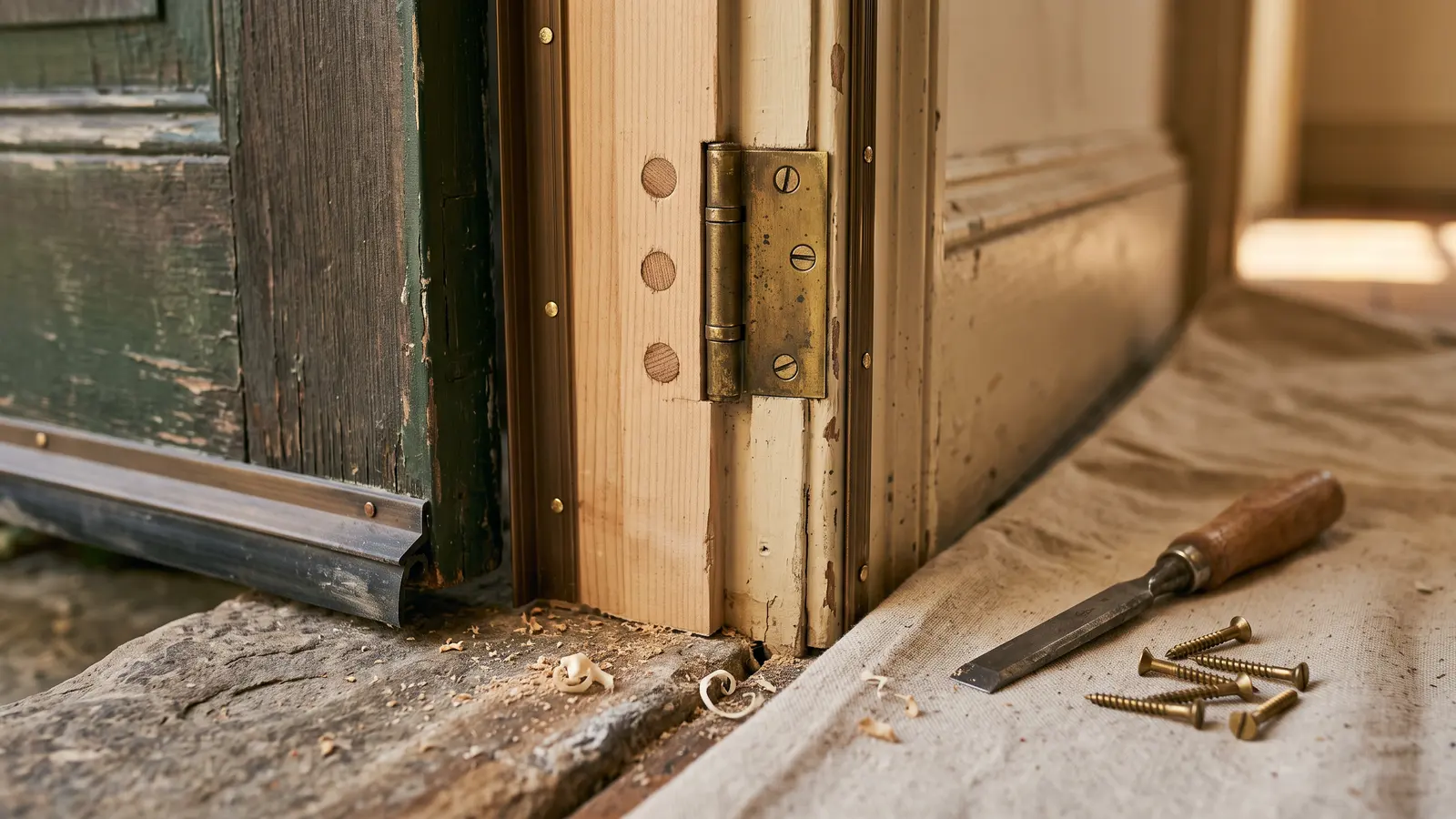
The original hinge is solid brass: leaves, knuckles, a pin, finials top and bottom, and a mix of straight-slot and Phillips screws. The replacement is solid brass too. Nathan calls it a 4x4, 4 inches tall and 4 inches wide, pin down the center, ball bearings in the knuckles. The low-profile finial cap that comes on it gets swapped for a ball. The episode page names it as a Baldwin 4-by-4 solid brass square-corner ball-bearing mortise hinge.
He jacks the door with a construction jack until the gap closes and the left leaf sits where it had been. The old ball-bearing pocket is empty. He would rather the new screw holes miss the old ones, so the hinge comes off and the old holes get filled first. The new leaf is thicker than the mortise. He deepens the jamb side so the hinge sits flush, and makes the door side a little shallower. A 1/4-inch bit opens each screw hole to one size, and an oak dowel goes in, long enough to trim later. Liz asks if the species matters. Hardwood or softwood, he says, you are filling a hole. The episode page lists two-part epoxy with those dowel pins. He waits until the plugs have cured, then chisels them flush. Nobody states a cure time.
Button finials come off so he can see which end is the top and drive the pin out. To take the door off later: finials off, pin up and out, and the pin goes back in from the top. The ball finials are decorative. The kit's solid brass screws strip easily, so a self-centering bit starts each pilot in the middle of the hinge hole, the screw tip gets a dip in wood-screw lubricant (beeswax-based, on the episode page), and he drives it with almost no speed at the start.
Nathan has rebuilt a hinge before by filling stripped screw holes rather than ignoring them. That repair, dowels and epoxy and longer slotted screws, is in the Season 23, Episode 21 recap. This door is the larger version of the same idea. The holes get filled, and the hinge that sagged gets replaced instead of simply rescrewed. Episodes tagged for this kind of fitted hardware are on the finish carpentry page.
The lock, the strike, and a sweep that just kisses the threshold
With the hinges done, the swing is no longer the problem. The lock is. The decorative faceplate, an armor plate or scalp plate, comes off by hand. He keeps power tools out of the removal because this hardware is not going back. A few turns free the cylinder set screw. His rule for a cylinder is the key in about two thirds of the way, then a twist, until a hand can finish backing it out. This one is already loose. The knobs thread off. Liz has been tightening them because the handles fall off, and the threads are worn. The exterior knob is still on the spindle. Trim plates come off with a straight-slot screwdriver. Two screws hold the lock body, and they still bite. The lock box that comes out is big enough that Liz comments on it.
The new lock body fits the same mortise and the same screw holes. He assembles it loose, plumbs the faceplates, then tightens. The cylinder turns clockwise until it stops. He says not to overtighten it, and the armor plate goes back on. The episode page names a Baldwin Baltimore entrance mortise handleset in non-lacquered brass and a Baldwin residential entrance mortise lock. The door opens, closes, and latches. The strike plate does not, so it gets the one from the kit: a dust box mortised into the jamb, a security strike with larger screws in back and smaller screws in front, machine screws holding the strike plate, and the plate covering the rest. The page lists a Baldwin straight-lip strike, a Baldwin dust box, and an oscillating multi-tool for that mortise. Liz says the opening looks clean and even.
The bronze V-shaped weatherstripping is in good shape, and he leaves it. Raising the door showed the sweep, worn from rubbing, so that gets replaced. He wants it to kiss the top of the threshold, not hang so low that a taller rug would catch it, with even pressure behind it. Liz tries the door. It swings smoothly, and the key locks and unlocks. Her daughter will not kick it open, and she will not have to put a shoulder into it. The preview after the credits, gutters, mini-splits, and a foundation skirt, is the next episode, not this one.
DIY Confidence Scale
Picking a thermostat setpoint: the episode refuses the question. Summer or winter, and forced air or hydronic, change the answer. Nobody on the bench will invent one number for John.
Choosing insulation: 4/10 for the decision, if you decide which layer handles air, vapor, and heat. Spray foam is the professional end of Ross's cost list. Fiberglass is the one he calls a homeowner material. His R-values are about 3 to 4 per inch for most of the bench, and about 6 to 7 for closed-cell.
Rehanging a sagging door on ball-bearing hinges: 6/10. Filling the old holes, flushing the leaf, and driving brass screws without stripping them are on camera. Jacking the door, and putting the pin back from the top, is where a first attempt goes wrong. The lock body, dust box, and security strike are a second job. That is why this is a carpenter's house call.
Additional Resources
The previous Ask This Old House hour is the hose spigot and the cover crops: Season 25, Episode 3. Ask This Old House does not have its own season hub on this site. The recaps are indexed under Ask This Old House. If the door sticks and a locksmith has already dug out the strike, the hinge is the next thing to look at.
The weekly recap
Get each new recap the day it's posted.
Get each new This Old House and Ask This Old House recap by email, the day it's posted. No spam, unsubscribe anytime.
From the captions
Spotted on the job
Tools, materials, and techniques the episode actually showed or discussed. Names stay generic unless the episode said a brand. A name links to an Amazon search only when it is something a person could buy.
As an Amazon Associate, This Old Recap earns from qualifying purchases.
Material
DIY-friendly
fiberglass
Ross calls fiberglass the lowest-cost insulation on the bench and the one a homeowner can install.
Material
DIY-friendly
mineral wool
Amazon search for mineral wool (opens in a new tab)
Ross shows mineral wool as rock that has been melted and spun into fiber.
Material
DIY-friendly
wood fiber insulation
Ross shows wood fiber as mill chips made into batts, blown-in, or an exterior grade. The episode page says TimberHP donated the sample.
Material
Pro-only
closed-cell spray foam
Ross gives closed-cell about 6 to 7 R per inch, plus air control and vapor control, and calls it the highest cost.
Tool
DIY-friendly
chisel
Amazon search for chisel (opens in a new tab)
Nathan chisels the cured dowel plugs flush and cuts the mortise for the dust box.
Tool
DIY-friendly
self-centering drill bit
Amazon search for self-centering drill bit (opens in a new tab)
Nathan uses a self-centering bit so the brass hinge screws start in the center of each hole.
Product
Pro-only
mortise lockset
Amazon search for mortise lockset (opens in a new tab)
Nathan fits a new mortise lock body in the existing mortise and reuses the screw holes.
Tool
DIY-friendly
oscillating tool
Amazon search for oscillating tool (opens in a new tab)
The episode page lists an oscillating multi-tool for cutting the mortise that receives the dust box.
Keep reading
Related recaps
Also about Insulation
This Old House · S47 E20
This Old House S47 E20: Needham Suburban Victorian Move-In, a Mortise Lockset, and an Attic Heat Pump
Also about Insulation
This Old House · S47 E24
This Old House S47 E24: A Firewall Recipe, a Hydro-Air Surprise, and a Dorchester Attic ADU That Delivers
Also about Insulation
This Old House · S47 E15
This Old House S47 E15: Round Ducts Win, Spray Foam Goes In, and Tom's Window Flashing Masterclass
Also about Insulation
This Old House · S47 E5