
This Old House S47 E5: Air Sealing Wizardry, FEMA Tree Removal, and the Grove Park Inn's Stonework
Building science experts seal a house with pressurized mist (yes, really), FEMA tackles the hazardous trees still looming overhead, and Mark gets a history lesson at one of Asheville's most iconic hotels.
Halfway Through the Asheville Arc
We're five episodes into the Carolina Comeback, and the rebuilds are hitting that sweet spot where the unglamorous rough work is done and actual progress is visible. Kevin and Richard open the episode with a drive on the Blue Ridge Parkway, which — if you haven't done it — is one of America's great scenic routes. It's also the road where the orographic lifting we talked about in Episode 2 happens. Beautiful mountains. Also excellent at wringing rain out of hurricanes.
Kitchen Cabinets at Miah's: Stock vs. Custom
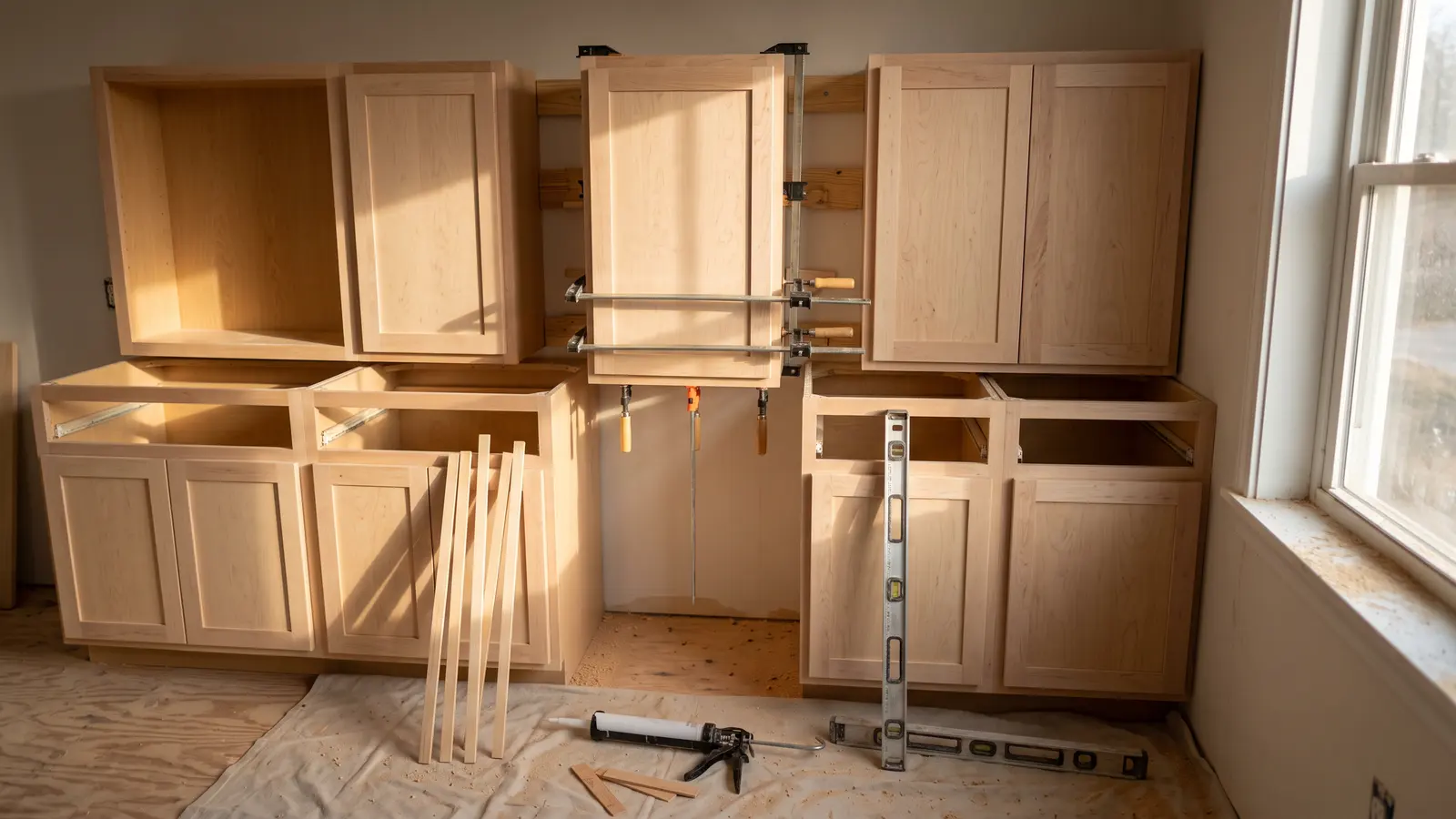
Kevin heads to Swannanoa, where builder Chris Cronin and project manager Noah Swaty are working on Miah's kitchen. They walk Kevin through the planned layout, and then he actually helps install upper and lower cabinets. Kevin Helper Scorecard: 4 for 5 episodes — the man is building a resume.
The interesting detail here is that they're using stock cabinets rather than custom. Stock cabinets come in standard widths (typically 12", 15", 18", 21", 24", 27", 30", 33", and 36") and you have to make them work with your space. Noah explains they need to be mindful about placement because Miah's retro fixtures don't line up perfectly with standard sizes — so they're using filler strips to bridge the gaps and make sure uppers and lowers align.
This is a real-world trade-off that every kitchen renovation faces:
- Stock cabinets: Faster delivery (weeks, not months), significantly cheaper ($100-$300 per linear foot installed), and good enough for most kitchens. The filler strip game Noah's playing is standard practice.
- Semi-custom: Same basic boxes but with more finish, size, and configuration options. Middle ground on price and lead time.
- Full custom: Built to your exact dimensions. Beautiful, expensive ($500-$1,500+ per linear foot), and takes months. In a disaster rebuild with five families waiting to get home, months is a luxury you don't have.
For Miah's house — where the goal is to honor her grandparents' memory while getting her back home — stock cabinets with thoughtful filler and layout work are exactly the right call.
FEMA's Tree Problem
In North Asheville, Jenn meets with National Disaster Recovery Contractor Matt Gierden from AshBritt, who explains how his team works with FEMA to remove hazardous trees that remain from the storm. This is the part of disaster recovery that doesn't make the news but is absolutely critical: before you can rebuild a roof, you need to make sure the trees that destroyed it aren't still leaning over the house waiting for a strong breeze.
Hazardous tree assessment is more nuanced than "is it leaning?" You're looking at root plate integrity, lean angle, species (some trees are more prone to sudden failure), proximity to structures, and whether the tree is alive or dead. A tree that survived the storm can still be compromised — root damage from saturated soil, crown damage from wind — and fail weeks or months later.
Jenn also meets with Melinda to check in on the family's emotional recovery, which is a reminder that living in a construction zone while processing trauma is its own kind of difficult. The work isn't just physical.
The Grove Park Inn
Mark McCullough takes a detour to the Omni Grove Park Inn, where Isabel Miller introduces him to the hotel's extraordinary stonework. Built in 1913, the Grove Park Inn is a masterclass in Arts and Crafts architecture — massive granite boulders, some weighing as much as 10,000 pounds, fitted together with minimal mortar. The craftsmanship is staggering, and it connects to the broader Carolina Comeback story: Asheville has a deep tradition of building things that last.
This segment also sets up a visual vocabulary for the season. We'll see more stonework in Episode 7 when boulders show up in a very different context — as retaining walls in North Asheville's landscape.
Air Sealing: The Building Science Segment You Didn't Know You Needed
This is the segment I'm most excited about. Richard visits Paula's house in East Asheville with building science experts Abe and Caleb, who are going to air seal the house using Aeroseal technology. If you've never seen this process, prepare to have your mind slightly blown.
The Blower Door Test
They start with a blower door test — a calibrated fan mounted in a doorframe that depressurizes the house, then measures how much air leaks in. This gives you a baseline number (typically measured in CFM50 — cubic feet per minute at 50 Pascals of pressure) that tells you how leaky the house is. The tighter the house, the lower the number. A typical older home might test at 3,000-5,000 CFM50. Modern energy code targets are much lower.
If you've ever felt a draft in your house and couldn't find the source, a blower door test would show you exactly where air is leaking — around windows, through electrical outlets, at the rim joist, through recessed lights, around plumbing penetrations. Air finds every gap.
Aeroseal: Sealing From the Inside
Here's where it gets interesting. Instead of caulking and foam-sealing every individual crack by hand (which is effective but incredibly labor-intensive), Abe and Caleb use pressurized air to spray a fine mist inside the house. The mist particles are carried by air pressure to every leak point — the same places air is escaping — and accumulate at the gaps, gradually sealing them. The mist hardens into a durable seal.
Think of it like this: imagine running a humidifier in a room with tiny holes in the walls. The moisture would naturally migrate to the holes where air is moving. Same principle, except the mist is a sealant.
The results are typically dramatic — 50-90% reduction in air leakage. For Paula's house, which was built in 2001 with a mix of manufactured and stick-built construction, this could significantly reduce her energy bills and make the house more comfortable year-round. In Western North Carolina's climate — hot, humid summers and cold winters — air sealing is arguably the single most impactful energy efficiency improvement you can make.
Why Air Sealing Matters More Than You Think
Here's the counter-intuitive truth of building science: air leakage is a bigger energy problem than insulation in most houses. You can pile insulation to R-60 in your attic, but if warm, moist air from your living space is leaking through gaps around light fixtures, ductwork, and plumbing penetrations, that insulation is doing a fraction of its job. The air carries moisture that condenses inside the building assembly, potentially causing mold and rot.
If you remember our Episode 2 discussion about HVAC in the attic, air sealing is the companion conversation. A tight building envelope means your HVAC system works less hard, your ducts matter less (because conditioned air stays conditioned), and your house is more resilient against moisture problems.
DIY Confidence Scale: Episode 5
- Stock cabinet installation: Intermediate. Totally doable with a level, some shims, and patience. The filler strip technique is learnable. Just make sure your first upper cabinet is dead level — everything else references off that one.
- Hazardous tree assessment: Hire a Certified Arborist. This is literally a life-and-death judgment call. The International Society of Arboriculture certifies professionals for this.
- Aeroseal air sealing: Hire a Professional. This is specialized equipment and training. However, a DIYer can do a blower-door-directed manual air sealing with caulk and spray foam for a fraction of the cost — it just takes a weekend and a lot of crawling around.
Additional Resources
- This Old House — S47 E5 Official Page
- Watch Episode 5 on PBS
- Aeroseal — Envelope Sealing Technology
- AshBritt (FEMA disaster recovery contractor)
- Omni Grove Park Inn
- Ferguson HVAC
Next time: Kevin visits a high school carpentry program building tiny homes for storm victims (bring tissues again), an electrician installs a new meter, and Tom helps Paula turn an antique chest into a bathroom vanity — which is either brilliant or a Pinterest fever dream. The Piper Watch continues. The Kevin Helper Scorecard is getting impressive.
The weekly recap
Get each new recap the day it's posted.
Get each new This Old House and Ask This Old House recap by email, the day it's posted. No spam, unsubscribe anytime.
From the captions
Spotted on the job
Tools, materials, and techniques the episode actually showed or discussed. Names stay generic unless the episode said a brand. A name links to an Amazon search only when it is something a person could buy.
As an Amazon Associate, This Old Recap earns from qualifying purchases.
Technique
Pro-only
air sealing
Richard and Abe demonstrated sealing a building by pressurizing it and spraying a mist that hardens in gaps and cracks.
Material
Pro-only
caulk
Abe described the system's sealant as a caulk that can be aerosolized into a fine mist.
Tool
Pro-only
nozzles
Four nozzles were placed around the space to spray the aerosolized caulk inside the house.
Product
Pro-only
energy recovery ventilator
Richard said they added an energy recovery ventilator to bring fresh air in and exhaust air out in a controlled way.
Product
Pro-only
heat pumps
Richard noted air conditioning condensers for heating and cooling were heat pumps, with separate systems for upstairs and downstairs.
Product
DIY-friendly
cabinets
Chris and Noah installed kitchen cabinets, starting with the uppers in the out-of-plumb corner.
Material
DIY-friendly
filler
Noah measured for filler to center the retro range in the cabinet layout.
Material
Pro-only
stone
Mark learned that the Grove Park Inn's stone was locally sourced from Sunset Mountain.
Keep reading
Related recaps
Also from the Carolina Comeback
This Old House · S47 E7
This Old House S47 E7: Boulder Retaining Walls, Door Staining 101, and Biltmore Village's Comeback
Also from the Carolina Comeback
This Old House · S47 E3
This Old House S47 E3: Cracked Chimneys, Storm-Beaten Siding, and the Army Corps Shows Up
Also about Insulation
This Old House · S47 E24
This Old House S47 E24: A Firewall Recipe, a Hydro-Air Surprise, and a Dorchester Attic ADU That Delivers
Also about Insulation
This Old House · S47 E20