
Ask This Old House S25E5: Cracked Foundation Skirting, Gutter Mistakes, and a Smart Mini-Split
Tom Silva hoses down a gutter mock-up to show why water runs behind it, Ross Trethewey adds a Wi-Fi kit to an old mini-split, and Mark McCullough rebuilds a 100-year-old stucco foundation skirt a downspout froze apart.
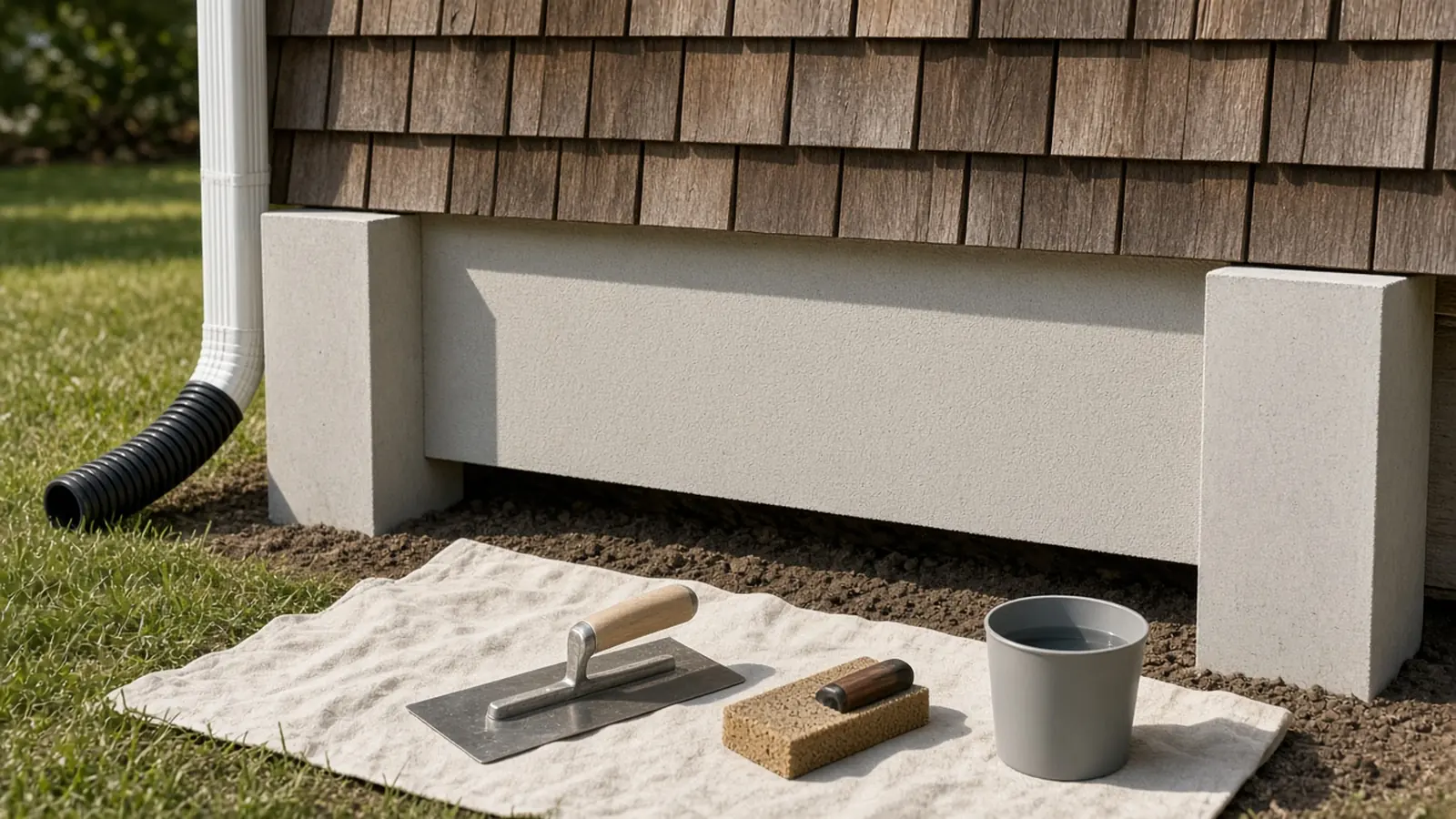
Season 25, episode 5 of Ask This Old House is about water that goes where nobody planned for it to go. Tom Silva builds a gutter demonstration at the shop and turns a hose on it. Ross Trethewey plugs a Wi-Fi kit into an old mini-split so it answers to a phone. The crew sits through a reel of its own Boston accents. Then mason Mark McCullough goes to a 100-year-old house where a downspout has been dumping into a foundation skirt until the stucco blew apart. PBS titles the episode "Cracked Foundation Skirting," dates it October 29, 2026, and lists a runtime of 23 minutes and 42 seconds. WGBH lists the same episode for October 28.
Jenn's client, and water that runs behind the gutter
The setup is quick. Jenn Nawada walks into the shop and says she has a problem with one of her clients: the water goes in between the seam of the house and the gutter. Then she leaves Kevin O'Connor with what he calls the gutter guru. Tom has a prop with two roof edges side by side, one done the way he wants and one done the way he says roofers keep doing it. He says the subject is surface tension and adhesion of water, and that is what is causing Jenn's problem.
He gets height out of the way first. If you lay a tape measure flat on the roof, parallel to it, the tape should pass by the leading edge of the gutter. In a climate where ice and snow melt, that lets the melt run off without ripping the gutter away. At the low end, the outlet end, the gap is bigger, about 1/2 to 3/4 of an inch. His pitch is 1/4 inch for every four feet. On a 40-foot house he puts the crown in the middle, so 20 feet of run puts the outlet end about an inch and a quarter lower than the high end. Tom says the height is not what sends water behind the gutter. Something else is.
Drip edge off the fascia, shingles past the drip edge
The good side of the prop has an inch and a half of roof overhang. Tom wants an inch and a half to an inch and three quarters, or even two inches. Kevin asks whether the drip edge is supposed to handle that. It should, Tom says, if it is done right. The drip edge has a kicker at the bottom, and it should stand away from the fascia board by about the thickness of his fingers. Kevin confirms on camera that the fingers are fat. The shingle starter strip and the shingle itself should run another quarter to half an inch past the drip edge.
The bad side is what Tom says he finds on houses: drip edge tight to the fascia and shingles with no overhang at all. The kick is still there, but in a heavy rain the bead of water is thicker than the space it is supposed to clear. The water clings to the fascia board and runs down behind the gutter. Then he makes it rain. On the correct side the water drops straight into the center of the gutter and never touches the face of the house. On the other side it sucks itself to the shingles, then the drip edge, then goes in and runs out the back. Kevin points out that it does not fail every time. Tom's answer is that when it rains, 90% of the time it is windy too, and the wind pushes the water against the house. The drainage topic page collects the episodes that start at the roof edge and end at the foundation, which is where this episode ends.
A thank-you about stairs
Between segments, a viewer named Eric wishes the show a happy anniversary. The crew came to replace his stairs, and they only got through three because it took all day. He finished the rest himself and says the visit gave them the confidence to fix their own house. They have done lots of projects since. It is the shortest segment in the hour and the clearest statement of what the show is for.
A mini-split that no longer needs its remote
Ross starts with the complaint: a mini-split is usually run from a remote, like a TV. Lose the remote, or leave the house, and you cannot turn the temperature up or down. Manufacturers now sell a Wi-Fi interface kit, also called a dongle, that lets the unit talk to an app on your phone. He calls it a really easy, homeowner-friendly project. He bought his at The Supply House. The This Old House episode page names a SmartKit Wi-Fi USB adapter and lists the controller as SmartKit AI.
The first step happens before any screws come out. Check with the manufacturer that the indoor and outdoor units are compatible with a Wi-Fi kit. Ross checked, and all of his were. Then kill the breakers. Every manufacturer opens its unit a little differently. On this one:
- Filter first. It is held down magnetically. Ross says it is a good moment to wash it. A small kickstand holds the panel up so it will not fall back down.
- Test for power. A voltage tester confirms the unit is dead before he touches the board.
- Display board. One screw holds the display control board. With the screw out, the board slides to the left and flips down, exposing the Wi-Fi dongle port.
- Plug in and close up. The dongle connects to that port and slides into place. The unit goes back together exactly the way it came apart: set screw, kickstand folded in, panel down, filter back, power on.
Pairing, and the one thing the app will not do
Next comes the manufacturer's app, an account, a username, and a password. Holding the LED button puts the unit in AP mode, which Ross explains means access point. In the app he hits add device, picks the AC unit, and selects the Wi-Fi network. Each indoor unit pairs separately and shows up on its own line. He gets the living room and the bedroom paired, turns the living room on, and it reads 74 degrees with a Wi-Fi logo to show it is communicating.
The remote still works, and Ross says not to throw it away. The unit obeys whatever command it received last, from the app or the remote. The limit is mixed modes. He cannot run one unit in cooling while the bedroom unit is heating, even with the app. Keep them in the same mode, or turn the other one off. In exchange, with an internet connection he can turn units on and off and change temperatures from anywhere, check the status of the house, and set schedules to pre-heat or pre-cool before he gets home. His total for the install is five minutes. The basement ceiling cassette in the This Old House S47 E23 recap is the other end of mini-split work, the part that needs a licensed installer. More heating and cooling episodes are on the HVAC topic page.
Twenty-five seasons of "cornah"
Kevin's setup is that the show travels the whole country but its home base is the Commonwealth of Massachusetts, where one accent reigns supreme. The reel is wall-to-wall dropped Rs: one in each "cornah," "let's start with the lawnmowah," a side "cuttah." Then come the added ones, a nice "idear" and baking "soder." Asked whether they hear it, Mark and Lee both ask, "Hear what?" Kevin says plenty of places would tell them to get rid of it for a national audience. He thinks it makes them sound authentic. Richard gets the last word on a clip of someone else: "I don't know what he said. Can we get subtitles?"
A foundation skirt, a downspout, and a pan with nowhere to go
Will bought his house about a year ago. He has done the bathroom, the floors, and the kitchen, and now he is starting on the outside. The cracking along the foundation is what he wrote in about. Mark sees the cause from the yard. Any time he sees this type of damage, he says, he ties it back to poor water management. The downspout empties into a pan with no room for the water to run. In winter the water builds up, turns to ice, and explodes the stucco veneer.
From the crawl space in the basement, the picture changes. This is not a full foundation. It is a foundation skirt, and it is not structural. A big concrete pier on the left and one on the right hold up the porch. Mark can see a little daylight, which means water is getting in. The wire lath behind the stucco is rusted, and he calls rusted wire very brittle and a weak point. The slats holding up that wire are in poor shape too. The house is 100 years old, and Mark does not see anything worth saving. They will start fresh. The Season 24, Episode 22 recap has Mark reading two cracks that look alike and are not. This is the same habit: find out what the masonry is doing before deciding what it needs.
Demo day, and two colors of old stucco
Tents go up first, to keep the sun off the crew and off the work, then drop cloths. Mark uses a small hammer to break through the stucco and roll the material off. He says he is not big on gloves, but wire cuts you without your knowing it, so both of them wear gloves for this part. Inside the broken pieces are two colors. The lighter coat has more lime, which Mark says gives it stickability, and the original crew would have let it set up for a few days. The darker material is Portland cement.
Pressure-treated framing and cement board instead of three days a coat
The rotted slats come out and the new framing is pressure-treated, so it will stand up to the weather. Mark explains what was there: a two-coat stucco system, a scratch coat and a brown coat, over wire lath. There are two-coat and three-coat systems, he says. The original lath was not galvanized because galvanized lath was not available then. It is now, but he is not using lath at all. He uses an exterior-grade cement board, which he describes as compressed cement, with ridges and pores that grab the finish coat. The old way was labor-intensive and expensive, about three days to cure the scratch coat and three more for the brown coat. The board comes already cured, so those six days drop out.
- Cutting. An angle grinder with a diamond-tipped blade, hooked by hose to a HEPA vac that pulls the dust out of the air.
- Grade. Interior-grade board shows up on bathroom floors and kitchen backsplashes. This job gets exterior grade.
- Placement. The board tucks up under the shingles above it. That row of shingles is padded out, so rain running down the shingle face kicks away from the new work.
- Fasteners. The board comes with a specific screw. Mark says if you do not use it, the board can crumble, so go with the manufacturer's suggestion.
Hydrate the board, skip the dye, bury the tape
Mark runs a hand across the board and holds it up covered in dust. He washes the board with a sponge and a bucket of water for two reasons. One is the dust. The other is that cement board pulls a lot of water out of the mix, so he hydrates it before anything goes on, and you can see the board drinking it in. He makes the same point about thirsty masonry and a fresh mix in the hearth repair from Season 24. For color, he pulls a piece of the original to analyze. One part is lime-based mortar and one is Portland-based, and the outside face has weathered for 100 years. Will asks about a dye. Mark is not a fan, because dye does not mimic weathering. He uses original materials and lets Mother Nature do her thing until the color matches.
The mix is Portland cement, sand, water, and a bonding agent already in it. Will asks how it differs from brick mortar. It is far too loose to lay brick, Mark says, but loose is what you want for stucco because you push it around. He spreads it with a pool trowel, long with rounded edges that get into places a square edge cannot. Where the cement board meets the concrete pier there is a joint, and he bridges it with fiberglass mesh tape, the same type used in the cement board, so it is compatible. If the joint moves over time, the tape is what saves it. He sticks the tape on dry, then buries it. The episode page's tool list includes a foam hand float, a finishing trowel, and joint tape.
Spin the sponge, lose the valleys, move the water
A rain came through while the coat was setting up, and Mark says they are okay now. The finish is a sponge spun in small circles with zero pressure. He points to a valley in the surface, spins on it until it disappears, and moves on. Will calls it really satisfying. Mark says the flatness is his favorite part, because it is not easy to get it as flat as it needs to be.
The stucco is not the only fix. The water pipe coming down the drain now runs into a pipe. Will plans a new driveway, and when that happens the two gutters and this pipe will go underground. The downspout that started the problem got what Mark calls a simple redirection. The episode page lists flex drainpipe and a downspout elbow for that step. Will's homework is to dampen the wall tomorrow whenever it looks dry, and maybe the next day too. Masonry repairs like this one are on the masonry topic page.
DIY Confidence Scale
Checking your own gutter and drip edge: 3/10 to look, harder to fix. The tape-measure check, the 1/4-inch-per-four-feet pitch, and the finger-width gap at the fascia are all things a homeowner can measure from a ladder. Moving a drip edge or extending shingle overhang is roofing work.
Adding a Wi-Fi kit to a mini-split: 2/10. Ross calls it homeowner-friendly and times it at five minutes. The parts that matter are confirming compatibility first and killing the breakers, then testing for power, before the cover comes off.
Rebuilding a stucco foundation skirt: 7/10. The demo is just hard work. Replacing framing, hanging cement board with the right screws, hydrating the board, taping the joint, and getting a flat sponge finish all happen in one stretch. A homeowner could learn them, but Mark makes the flat part look easier than he says it is. Confirm first that the skirt is not structural, as Mark did from the crawl space.
Additional Resources
The previous Ask This Old House hour is the 1890 front door and the insulation bench: Season 25, Episode 4. Every Season 25 episode is on the Ask This Old House Season 25 hub, and the full run is indexed under Ask This Old House. The preview after the credits, smart glass for a bathroom and structural plants in the Southwest, is the next episode, not this one. If your stucco is cracking under a downspout, look at where the water goes before you look at the stucco.
The weekly recap
Get each new recap the day it's posted.
Get each new This Old House and Ask This Old House recap by email, the day it's posted. No spam, unsubscribe anytime.
From the captions
Spotted on the job
Tools, materials, and techniques the episode actually showed or discussed. Names stay generic unless the episode said a brand. A name links to an Amazon search only when it is something a person could buy.
As an Amazon Associate, This Old Recap earns from qualifying purchases.
Material
Pro-only
drip edge
Tom wants the drip edge standing off the fascia about a finger's thickness, with shingles running another quarter to half inch past it.
Product
DIY-friendly
mini-split Wi-Fi interface kit
Ross plugs a manufacturer Wi-Fi dongle into the display board port so the unit pairs with a phone app. The episode page names a SmartKit Wi-Fi USB adapter.
Tool
DIY-friendly
voltage tester
Ross confirms the mini-split is dead after killing the breakers, before removing the display board.
Material
Pro-only
exterior-grade cement board
Mark replaces the old two-coat stucco and wire lath with already-cured cement board tucked under the shingles.
Tool
Pro-only
angle grinder with diamond blade
Mark cuts the cement board with a diamond-tipped blade, with a hose to a HEPA vac for the dust.
Tool
Pro-only
pool trowel
Mark spreads the stucco with a long pool trowel whose rounded edges reach where a square edge cannot.
Material
Pro-only
fiberglass mesh tape
Mark bridges the joint between the cement board and the concrete pier, sticking the tape on and then burying it.
Technique
Pro-only
sponge float finish
Mark spins a sponge with zero pressure until the valleys in the stucco disappear.
Keep reading
Related recaps
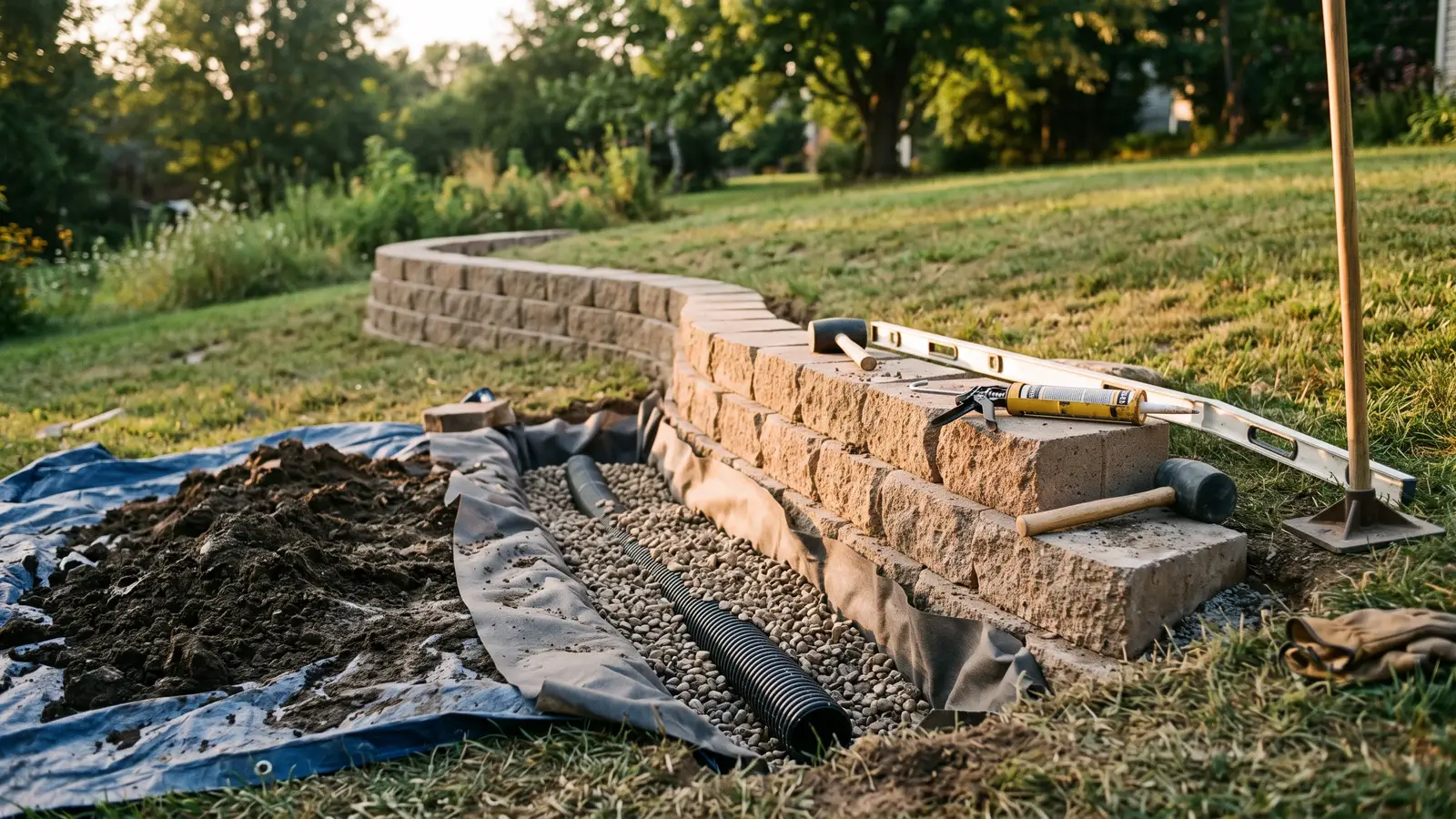
Also about Drainage
Ask This Old House · S23 E19
Ask This Old House Season 23 Episode 19: Mini Split Maintenance and a Retaining Wall That Is Mostly Drainage
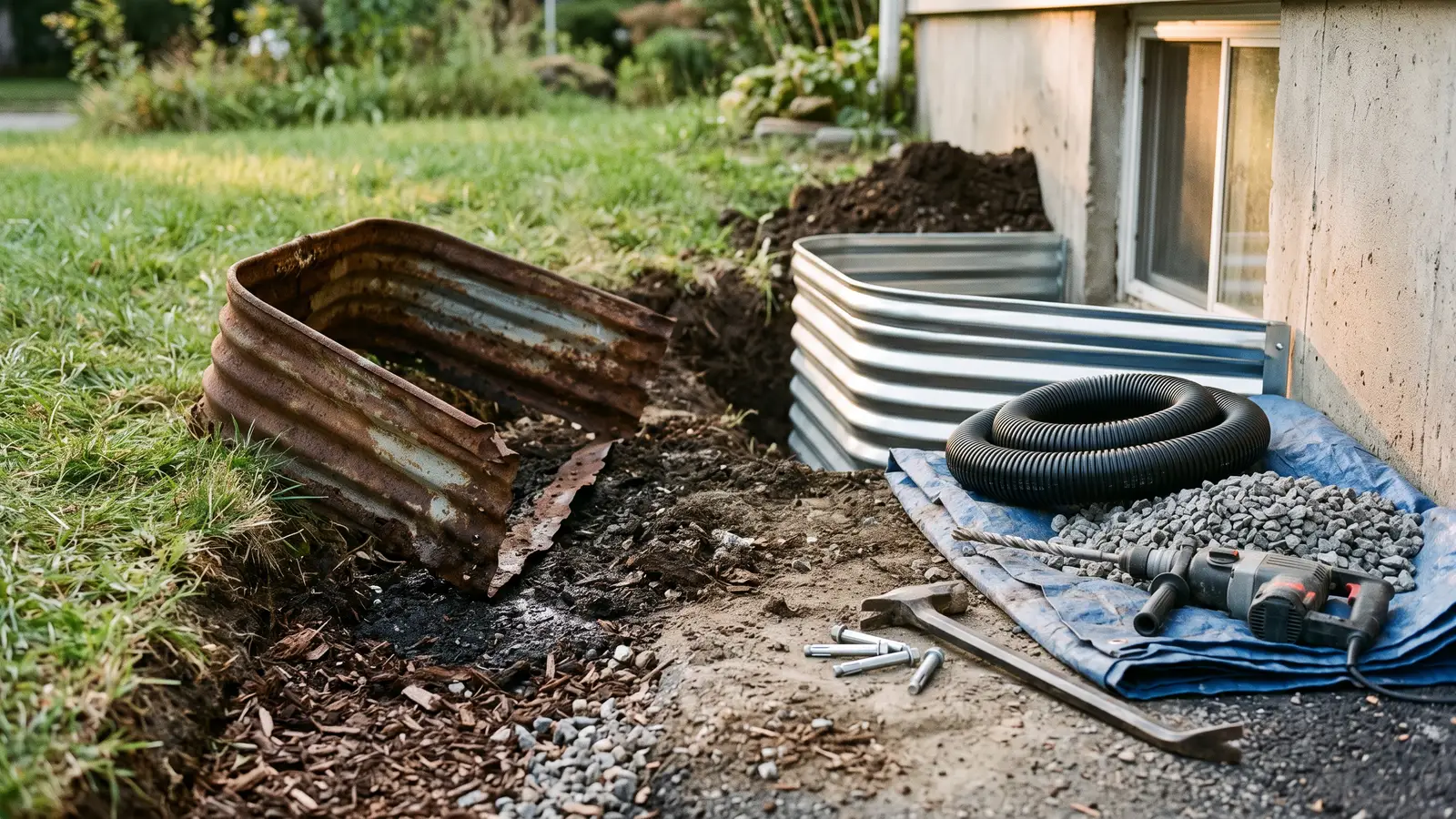
Also about Drainage
Ask This Old House · S24 E10
Ask This Old House Season 24 Episode 10: An Idaho Backyard Makeover for Community Dinners, Plus Two Window Wells That Finally Fit
Also about Drainage
Ask This Old House · S23 E6
Ask This Old House Season 23 Episode 6: When Drainage Meets Determination
Also about Drainage
Ask This Old House · S23 E17