This Old House S47 E14: Asbestos Surprise, Aluminum Siding Recycling, and an 89-Pound Beam Through a Window
The inevitable asbestos discovery, a field trip to a recycling facility, and a 24-foot steel beam craned through a rear window — because sometimes the front door isn't an option.
The Asbestos Conversation
Every old-house renovation reaches the asbestos moment. In an 1896 Victorian, the question isn't whether you'll find it — it's where. Charlie meets with abatement specialist Ron Peik from Alpine Environmental, who confirms asbestos on ductwork behind a recently demolished wall.
Asbestos was used extensively in construction from the late 1800s through the 1970s — in insulation, floor tiles, pipe wrap, duct wrap, roofing, siding, plaster, and joint compound. In an 1896 house, duct insulation is a prime suspect. The material isn't dangerous when it's intact and undisturbed (this is called "non-friable"), but the moment you start demolition — cutting, breaking, sanding — fibers can become airborne.
Ron's crew handles the removal with proper containment: negative air pressure, HEPA filtration, protective equipment, and disposal in sealed, labeled containers. This is absolutely not DIY territory. Asbestos abatement is licensed, regulated, and inspected for good reason. The fines for improper handling are steep, and the health consequences are worse.
If you're renovating a pre-1980 home: get an asbestos survey before you start demo. Period. The test costs $200-500. Lung cancer costs more.
Aluminum Siding: Off the House, Into the Recycler
With Liz and Patrick's decision to replace the windows and remove the aluminum siding, Kevin and Charlie strip the aluminum from top to bottom. Underneath: the original Victorian wood shingles that Tom peeked at in Episode 12. They're still there, weathered but intact — a testament to the quality of old-growth wood and the fact that the aluminum siding actually protected them from the elements for decades.
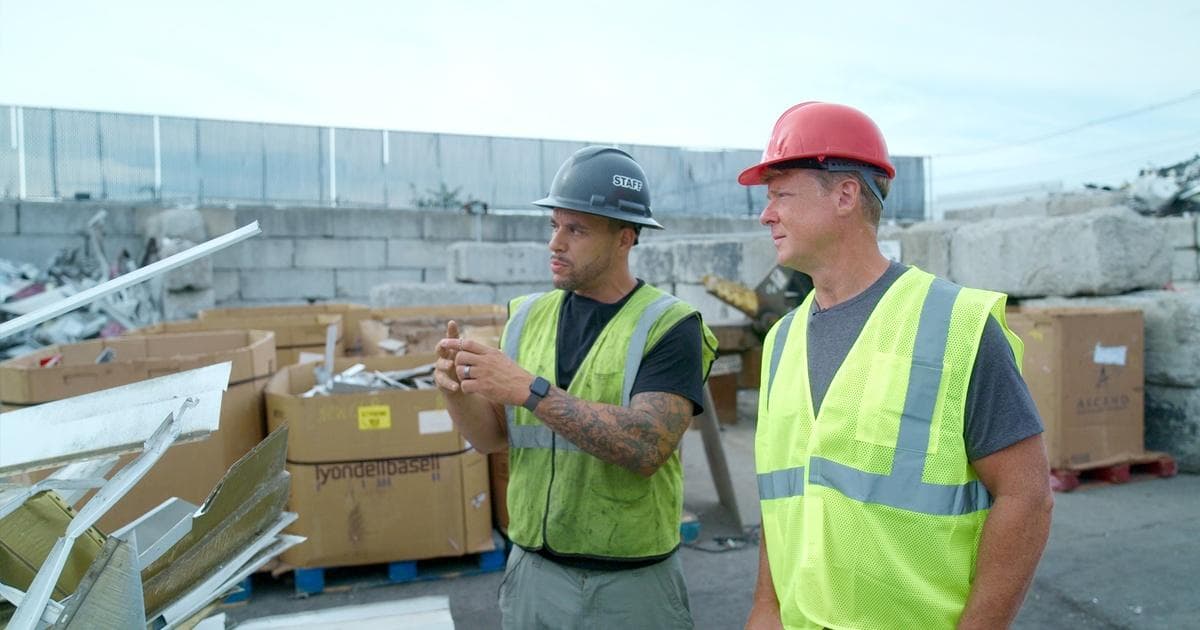
The aluminum goes into a specialized dumpster bound for a recycling facility, where Kevin meets metal buyer Anthony Mastrangelo. The recycling process is genuinely interesting: aluminum is infinitely recyclable without losing quality, and recycling it uses only 5% of the energy required to produce new aluminum from ore. The siding from one house becomes the raw material for anything from beverage cans to automotive parts.
This segment quietly makes a case for thinking about renovation waste differently. Instead of the typical "fill a dumpster and send it to the landfill" approach, separating materials for recycling recovers value and reduces environmental impact. The aluminum from this house has monetary value at the scrapyard — it's not waste, it's a resource.
The Steel Beam: 89 Pounds Through a Window
Here's the segment that makes you appreciate structural engineering and logistics equally. To open the first floor between the kitchen and living room, a load-bearing wall has to come out. Its replacement: a 24-foot-long steel beam weighing 89 pounds that will run from the back of the house to the center, supported by steel posts.
The problem: how do you get a 24-foot beam into the middle of an occupied, partially demolished Victorian house? Answer: through the rear window, via crane. The beam from Quinn Brothers is lifted, threaded through the opening, and carefully set in place by the metalworks crew.
This is the kind of operation that looks dramatic on TV and is equally dramatic in person. A steel beam doesn't bend, doesn't forgive, and doesn't fit through standard door openings. The crane rental, the rigging, the precise positioning — it all has to be planned to the inch. One miscalculation and you're putting a beam through a wall you didn't plan to remove.
For context: this beam is doing the job that the load-bearing wall (and before that, parts of the center chimney) used to do. It's transferring the weight of the second and third floors and the roof to concentrated points (the steel posts) instead of distributing it along a wall. The engineering is straightforward; the execution is anything but.
DIY Confidence Scale: Episode 14
- Asbestos abatement: Absolutely Not DIY. Licensed professionals only. No exceptions.
- Aluminum siding removal: Intermediate. The actual stripping is straightforward — start at the top, work down, pry carefully. Arranging recycling takes some research but is worth the effort.
- Steel beam installation: Professional Only. Structural engineering, crane operation, and steel fabrication are all specialized trades. This is a team effort requiring multiple professionals.
Additional Resources
- This Old House — S47 E14 Official Page
- Watch Episode 14 on PBS
- Alpine Environmental (asbestos abatement)
- Scrap It (aluminum recycling)
- Quinn Brothers (structural steel)
Next time: the HVAC system gets smart upgrades instead of a full replacement (Richard's favorite kind of job), closed-cell spray foam enters the chat, and Tom installs a window with a flashing lesson that should be required viewing for every contractor. The Needham project is finding its groove.
Keep reading
Related episodes & guides